



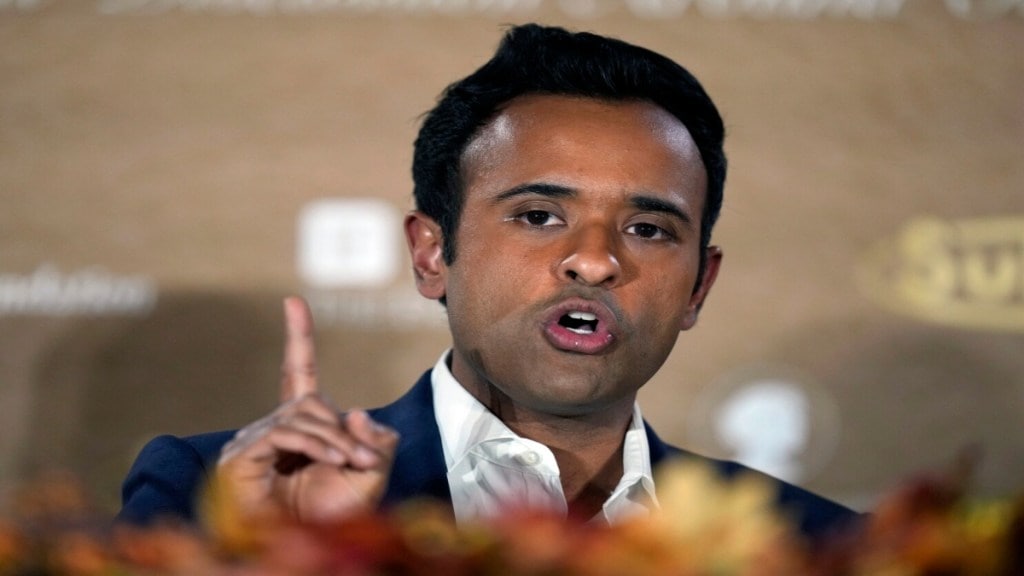
Ex-DOGE lead and Republican politician Vivek Ramaswamy is facing significant backlash online after a controversial remark in his recent New York Times opinion piece titled ‘What Is an American?’, where he wrote: “either you’re an American, or you’re not.”
The line, intended to define American identity in clear terms, has triggered heated debate on social media, especially among immigrant communities and critics who view the comment as overly simplistic and exclusionary.
What is the controversy about?
In his op‑ed, Ramaswamy, who is of Indian origin and the youngest Republican to have run for presidency, aimed to draw a line between two competing visions of American identity. He argued that one view, rooted in “lineage, blood and soil” and increasingly associated with white nationalist sentiments, places undue emphasis on ancestry.
“As Ronald Reagan quipped, you can go to live in France, but you can’t become a Frenchman; but anyone from any corner of the world can come to live in the United States and become an American. No matter your ancestry, if you wait your turn and
obtain citizenship, you are every bit as American as a Mayflower descendant, as long as you subscribe to the creed of the American founding and the culture that was born of it. This is what makes American exceptionalism possible,” he wrote in the op-ed.
Ramaswamy advocated for a credal definition of “Americanness” based on shared beliefs, such as commitment to the rule of law, freedom of conscience and expression, colourblind meritocracy, the US Constitution, and a sworn allegiance to the nation. He rejected the idea that ancestry or ethnic background should determine who qualifies as truly American.
Ramaswamy further argued that anyone from “any corner of the world” can come to the US and become an American through the proper legal process, echoing the country’s founding ideals of opportunity and civic identity.
What’s the backlash about?
Social media reactions have been intense and largely critical. Some users dismissed his binary framing, arguing that identity is more nuanced than citizenship status.
Comments ranged from questioning how he would treat those “who do not believe in these things,” to racially charged insults asserting that Indians or other minorities could “never” be Americans despite Ramaswamy himself being born and raised in the US.
“Reminder that Vivek Ramaswamy is an actual anchor baby, so everything he says can be completely disregarded. Foreigners who have no right to be here don’t get to lecture me about what it is to be American,” a user wrote on X.
“First, I disagree with the way you equate the left and right’s “identity politics,” as you put it. At its best, the left’s version of “identity politics” is a liberal corrective. It’s rooted in the civil rights, feminism, and gay rights movements. Each of these is about making good on the Enlightenment’s ideals and liberal principles you espoused in your piece,” another user wrote.
Ramaswamy responds
Ramaswamy has responded to some of the racist and xenophobic abuse directed at him online in his op-ed, noting that he has been subjected to slurs and even calls for him to be “sent back to India,” despite his lifelong American citizenship.