



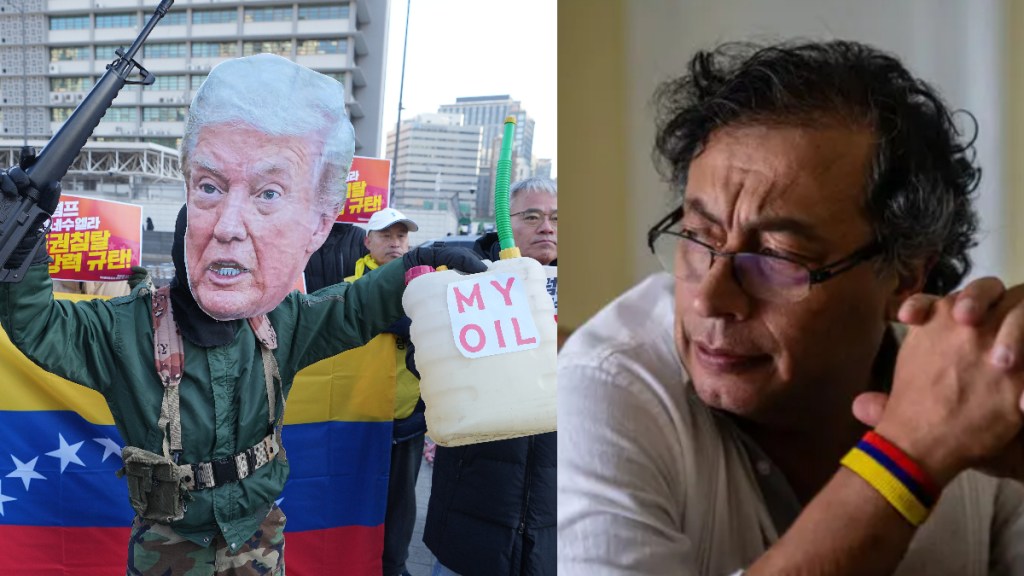
US President Donald Trump issued a chilling warning to Colombia and its President Gustavo Petro after America’s overnight military operation against Venezuela, which is also a South American country. The 79-year-old American leader has repeatedly mounted threats against his Colombia counterpart, but the already public discord between the two leaders stretched to new extremities on Sunday night (US time).
The American commander-in-chief’s decision has especially been grabbing quite the attention, considering his 2024 presidential campaign billed him as a self-proclaimed “peace” candidate. Consequently, Trump doubled down on the same identity marker in 2025, insisting that he solved several global wars.
Echoing the same message he used to hit out against Venezuela, Trump declared Colombia a “sick” country in his interaction with media representatives on board the presidential aircraft on January 4. According to an official ‘Audio Only’ clip titled “President Trump Gaggles with Press on Air Force One, Jan 4, 2026,” the MAGA leader suggested that Petro’s administration was going to be short-lived.
Trump’s attention-grabbing, inflammatory remarks against the Colombian president made headlines not just after Saturday’s large-scale strike on Venezuela, but also following the nation’s leader Nicolas Maduro and his wife’s capture by US forces. They have since been removed from their country and have been indicted on drug charges in New York.
Next US target after Venezuela? What Trump said about Colombian President Gustavo Petro
As per the official audio released by the White House SNS account, Trump said: “We’re in the business of having countries around us that are viable and successful, and where the oil is allowed to freely come out because that’s good. It gets the prices down. That’s good for our country”
“We have a very sick neighbour. It’s not a neighbour, but it’s close to a neighbour, and that’s Venezuela. It’s very sick.” After calling out the South American nation, he moved on to target another one, saying, “Colombia is very sick, too. Run by a sick man who likes making cocaine and selling it to the United States. And he’s not going to be doing it very long.”
When pushed further to explain what he meant by that declaration, Trump added, “He’s not going to be doing it very long… He has cocaine mills and cocaine factories. He’s not going to be doing it very long.”
Thereafter, a press representative questioned if that meant that the US would be launching an operation against Colombia as well. “It sounds good to me,” Trump replied.
Why Colombia could be Trump’s next target?
As has already been established so far, the Trump administration’s second term has especially amplified its drug cartel war. In 2025, the United States of America launched numerous strikes on alleged drug traffickers, targeting boats and ships in the Caribbean.
Just months back, President Trump silently signed a directive to the Pentagon, allowing it to deploy military force against certain Latin American drug cartels. His administration has notably viewed such organisations and those associated with them as terrorists.
As part of the same ‘war on drugs’ effort, the Republican leader declared that the US was going to “run” Venezuela “until such time as we can do a safe, proper and judicious transition.” Trump also pushed that US companies will amend Venezuela’s “badly broken” oil infrastructure and “start making money for the country.” It has prompted discussions around how the US government’s potential true interest was in the Latin American nation’s vast oil reserves.
His major announcement came after Venezuelan leader Nicolas Maduro and his wife were captured and brought to the US, as Trump accused the Latin American politician’s government of flooding America with drugs and gang members.
Akin to his remarks taking aim at the Venezuelan leader, Trump has repeatedly called out Colombian President Gustavo Petro. Just this week, the MAGA leader accused Petro of “making cocaine” and “sending it into the United States” during a press conference after the attack on Venezuela, while also threatening him to “watch his a**.”
Petro, in turn, vehemently spoke out against the Trump administration’s action, calling the operation against the South American neighbour as “an assault on the sovereignty” of Latin America, which could stir a humanitarian crisis.
Trump vs Gustavo Petro
As mentioned above, this isn’t the first time Trump and Petro have sparred against each other. Back in October, the US president called his Colombian counterpart a “fresh mouthed” politician with little influence and someone who appeared more than an “illegal drug leader.”
In a Truth Social post published at the time, Trump announced that the US will no longer provide subsidies to Colombia after Petro accused America of “murder” in connection with a military strike on a boat.
In September, the US State Department revealed that cocaine production had hit an all-time high under the Petro administration. That same month, the Trump government said that it would revoke the Colombian leader’s visa after he joined New Yorkers to join a pro-Palestinian protest. During one such rally, he told US soldiers to “disobey Trump’s order” while he was in the US for the UN General Assembly.
Even during the UNGA, Petro urged that “criminal proceedings” be launched against the Trump administration over its airstrikes on alleged drug-trafficking boats. Colombia media reports suggested at the time the US authorities’ announcement of Petro’s visa revocation was sounded off when the politician was on his way back to Bogota.
“Criminal proceedings must be opened against those officials, who are from the US, even if it includes the highest-ranking official who gave the order: President Trump,” Petro said while addressing the UNGA in late September, insisting that those on board the said boats were neither gang members nor drug traffickers.
Around the same time, the Colombian president also stepped out wearing a red keffiyeh, the checkered scarf associated with the Palestinian cause amid Israel’s war in Gaza, at The Hague Group’s event in New York City.
Describing the Gaza crisis as a “genocide” and “crime against humanity,” Petro told thousands outside the UNGA during Israeli Prime Minister Benjamin Netanyahu’s speech: “We respond by talking, taking to the streets… and we respond with weapons. And therefore, it is necessary to configure a more powerful army than that of the United States and Israel combined.”
In a more direct swipe at Trump, Petro even accused the US president of being “complicit in genocide” in Gaza.
Colombian President Gustavo Petro condemned the US missile strikes and migrant abuse in his speech at the UN General Assembly. He said US President Donald Trump was "complicit in genocide" in Gaza and called for "criminal proceedings" against him. pic.twitter.com/nUptyRlXrB
— DW News (@dwnews) September 24, 2025