



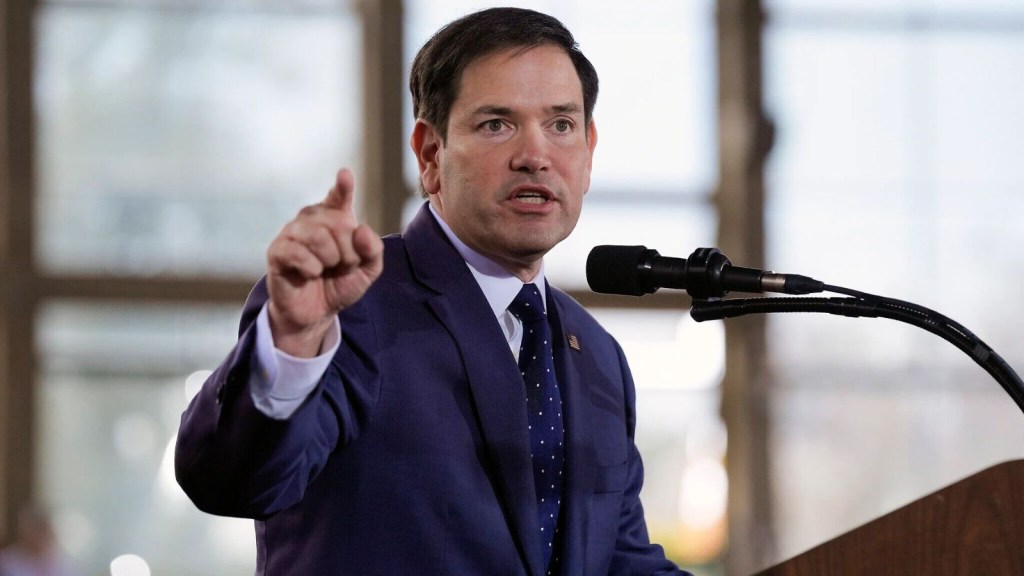
A day after President Donald Trump said the United States would “run” Venezuela following the removal of Nicolás Maduro, Secretary of State Marco Rubio moved to calm fears of a long American takeover. Speaking on Sunday, Rubio said the US does not plan to get involved in Venezuela’s day-to-day governance. Instead, Washington will continue enforcing an existing oil quarantine and use that pressure to push for policy changes in the country, according to AP.
Rubio: US is not at war with Venezuela
Trump had said the US would temporarily run Venezuela to ensure a “safe, proper and judicious transition,” even suggesting that American oil companies would step in to repair the country’s damaged infrastructure and revive its economy. Rubio, however, said the oil blockade was already in place before Maduro was removed from power and would continue as a tool to influence Venezuela’s leadership, not as a step toward direct rule. “They will continue enforcing the oil blockade, which was already in place, and use it to press for policy changes in Venezuela,” Rubio said, according to AP.
Clarifying the United States’ stance after the removal of Venezuelan President Nicolás Maduro. Rubio stressed that the recent operation is not a war against Venezuela. “This is not a war against Venezuela,” Rubio told NBC. “We are at war against drug trafficking organisations. That is our focus, not the country itself.” He said the US will continue to seize boats carrying drugs toward America.
Rubio said the US will watch Venezuela closely to see what the country does next. “We will judge everything by what they do,” he told CBS. He added that the United States has “multiple levers of leverage” to protect its interests, including the ongoing oil quarantine on Venezuelan tankers.
In an interview with NBC, Rubio added that Maduro could have left Venezuela in the past week and a half, avoiding the operation altogether. He said the US had offered “very generous” arrangements to Maduro, but the president refused. “The US is going to give Venezuela an opportunity to address the problems raised by our administration,” Rubio said. Until then, he added, Venezuela will continue to face pressure from the US, the oil quarantine, and targeted operations against drug shipments.
Immediate changes to serve US interests
When asked if the United States is now running Venezuela, Rubio said the most immediate changes the US expects will be in its national interest. He highlighted that people in charge of the military and police in Venezuela have openly cooperated with drug trafficking organisations, creating threats to the US that Washington intends to address.
Rubio explained why Congress was not notified before the operation. Speaking to the US media, he said it was not needed because the mission “wasn’t an invasion.” Instead, he described it as a “law enforcement operation” in which Maduro was arrested on the ground by FBI agents.
When asked why other members of Maduro’s government were not arrested, Rubio said the US focused on the top priority. The government has offered rewards for information leading to the capture of other key officials, which include, $25 million for Interior Minister Diosdado Cabello and $15 million for Defence Minister Vladimir Padrino. “You’re not going to go in and wrap up everyone,” Rubio said. “People can only imagine the howls we would have faced if we had stayed longer.”
Maduro now held in Brooklyn jail
Maduro is currently being held at the Metropolitan Detention Center in Brooklyn, a facility known for its harsh conditions. Some judges have previously refused to send inmates there, even though it has housed high-profile prisoners such as R. Kelly and Sean “Diddy” Combs. He is expected to make his first appearance in Manhattan federal court on Monday.
US prosecutors in the Southern District of New York have charged Maduro and Flores with multiple crimes, including conspiracy to commit narco-terrorism, cocaine trafficking, possession of machine guns and destructive devices, and conspiracy involving such weapons.
Maduro has long denied these accusations, insisting the US uses its “war on drugs” as a cover to seize Venezuela’s vast oil reserves, estimated at around 303 billion barrels — nearly one-fifth of the world’s total.
Back in Venezuela, the Supreme Court ordered Vice President Delcy Rodríguez to step in as interim president. Under the country’s constitution, elections must be held within 30 days if a president is permanently unavailable.