



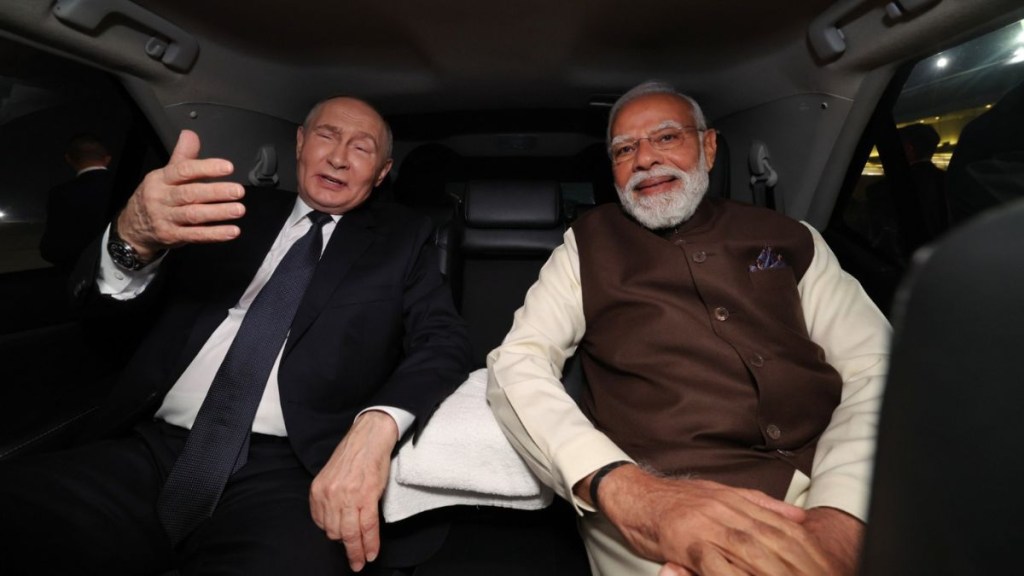
Russian President Vladimir Putin visited India earlier this month — holding extensive talks with his Indian counterpart and attending a key Summit in New Delhi. The interaction has now sparked furious backlash in the US with lawmakers lashing out at President Donald Trump.
‘Cutting out nose to spite our face’
“Trump’s policies towards India can only be described as cutting our nose to spite our face… Being a coercive partner has a cost. And this poster is worth a thousand words. You do not get a Nobel Peace Prize by driving US strategic partners into the arms of our adversaries,” said US representative Sydney Kamlager-Dove.
She also urged the US Congress to “move with incredible urgency to mitigate the damage that this administration has done to the US-India partnership”. Kamlager-Dove told the House Foreign Affairs South and Central Asia Subcommittee that it was essential for the two countries to rebuild their cooperation — calling “essential to American “prosperity, security, and global leadership”.
‘US-India is a defining relationship of 21st century’
US Representative Bill Huizenga also stressed the importance of the US-India relationship during the hearing on Wednesday — adding that the recent Putin visit had “raised some understandable concerns”. He also noted that ‘authoritarian powers’ such as China and Russia were now “redrawing borders by force, undermining democratic norms and coercing their neighbours”
“The US-India relationship is no longer just important. It is a defining relationship of the 21st century. If America wants a free Indo-Pacific, resilient supply chains and a world where democracy, not authoritarianism, sets the rules, then our partnership with India is critical…American companies are eager to enter the Indian market on a level playing field. A new trade deal with India under President Trump and Prime Minister Modi would further realise this goal and enhance the relationship,” said Huizenga.
He also noted that all previous US governments (irrespective of political affiliation) had “strengthened ties, or certainly at least attempted to, making clear that the United States does not see India as a temporary or transactional partner”.