



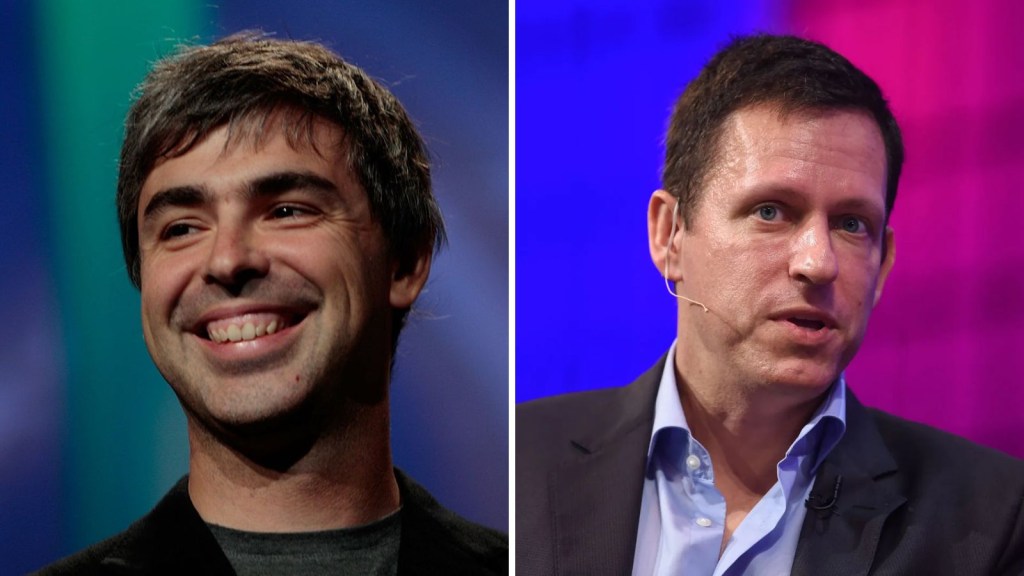
Some of America’s richest people are quietly thinking about spending less time in California, or even leaving the state altogether, because of a proposed tax that would target billionaires. According to a report from the New York Times, among the popular names are Larry Page, the Google co-founder, and Peter Thiel, the tech investor. The reason is a possible ballot measure that could heavily tax the wealthiest residents if voters approve it next year.
What the California Billionaire tax would do?
The proposal is officially called the “2026 Billionaire Tax Act.” It would apply to California residents whose net worth is more than $1 billion. Under the plan, they would be taxed up to 5% of their total assets.
This also means, anyone worth at least $20 billion as of January 1, 2026, would also face a one-time tax of $1 billion. If the measure becomes law, Larry Page would face a tax bill of about $12.8 billion, on top of the $1 billion one-time payment. Peter Thiel would owe roughly $2.35 billion, while Chamath Palihapitiya’s bill would be around $60 million.
The proposal was introduced by the healthcare union Service Employees International Union–United Healthcare Workers West. The group says the tax could raise as much as $100 billion from about 200 billionaires living in California.
According to the union, about 90% of the money would go toward healthcare, while the remaining 10% would be used for food and education-related purposes. According to the proposed plan, the funds would cover major losses in federal and state healthcare funding.
If the measure gathers enough support (signatures) and makes it onto the November ballot, and if voters approve it, the tax would apply retroactively, according to NYT. Anyone living in California on January 1, 2026, would be covered.
Low chances of approval
It is far from certain that the proposal will even reach the ballot. But according to the NYT, billionaires are not willing to take the chance. David Lesperance, a tax and immigration adviser to wealthy clients, told the NYT, many of his clients are already taking actions. He said nearly all of them are trying to cut their California connection and move assets out of the state as quickly as possible.
The process is lengthy and can consume a lot of time, given that leaving California is not an overnight deal. The state’s tax agency examines where someone truly lives. It looks at things like primary homes, voter registration, driver’s licenses, bank accounts, investments, and where family members are based.
Support and opposition for the Billionaire tax grow
Supporters of the measure say the tax is necessary because income inequality in the United States has grown at a sharp rate. Recent data from the Congressional Budget Office shows that the top 10 percent of families now hold about 69 percent of the nation’s wealth. The bottom half of families hold just 3 percent.
The proposal has drawn strong opposition from Silicon Valley investors and state leaders, including Governor Gavin Newsom. Speaking at a DealBook conference this month, Newsom said a wealth tax is not practical. He is now raising money for a committee aimed at defeating the measure. That committee has already received donations, including $100,000 from venture capitalist Ron Conway, according to the NYT.
State analysts, cited by the NYT, estimate California could collect tens of billions of dollars in one-time payments if the tax passes. But they also warn that income tax revenues could drop by hundreds of millions each year if wealthy residents leave the state.
What happens next
To qualify for the November 2026 election, supporters must collect 874,641 valid signatures. If voters approve the measure, California lawmakers would still have the power to amend or repeal it under state ballot rules.
So far, it is not clear how many signatures have been gathered. Campaigns are required to disclose progress once they reach 25% of the target, and as of Saturday, the billionaire tax proposal had not yet crossed that mark.
Peter Thiel looks beyond Los Angeles
Peter Thiel, who is 58, owns a home in the Hollywood Hills and runs his investment firm, Thiel Capital, from Los Angeles. But people close to him say he has been exploring the idea of opening an office in another state, which also includes spending less time in California. Thiel, reportedly, has also gained citizenship in New Zealand and has looked into citizenship in Malta.
Larry Page considers an exit
Larry Page, 52, has lived in Palo Alto for many years. But people briefed on internal discussions say he has talked about leaving California by the end of the year. In mid-December, three limited liability companies linked to Page filed paperwork to incorporate in Florida, according to state records, NYT reported. Those companies are managed by a parent firm connected to Page’s investments and family office.
Page has stayed mostly out of the public eye since stepping down from daily management at Alphabet in 2019. He has spent time overseas and has been working on personal projects related to artificial intelligence.