



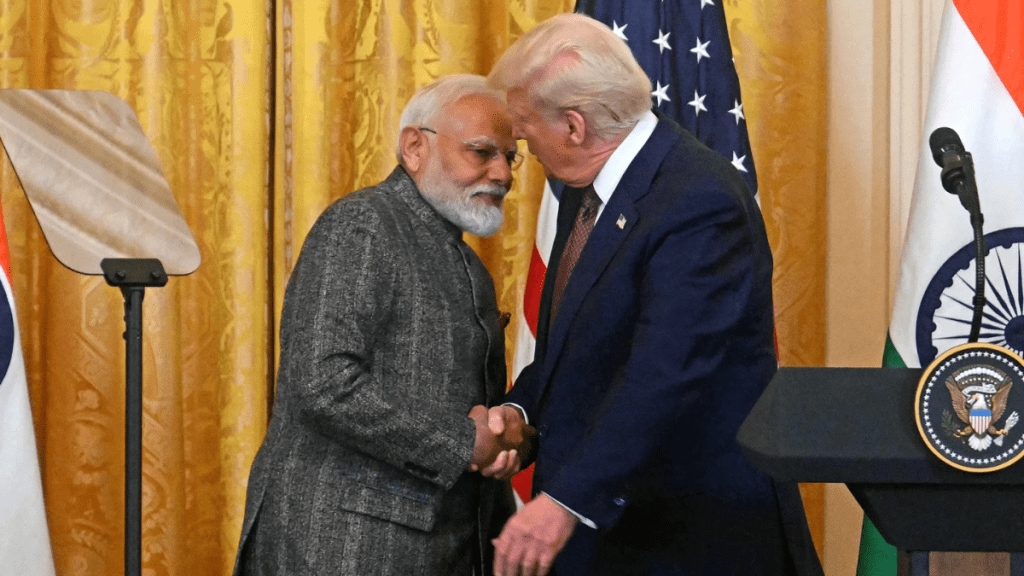
US lawmakers and foreign policy experts believe that America’s partnership with India is now “a defining relationship of the 21st century,” IANS reported. They warned that China’s growing aggression makes it even more important for Washington and New Delhi to work together, not only on defence, but also on trade, technology, the economy and other sectors.
China’s aggression puts spotlight on India–US ties
The remarks came during a House hearing on the US–India strategic partnership. Bill Huizenga, who chaired the session, said the partnership is “no longer just important. It is a defining relationship of this century.” He added that if the US wants a free and stable Indo-Pacific region, it must work closely with India.
According to the IANS report, Huizenga also mentioned the way China’s behaviour is becoming more dangerous, citing concerns over Beijing’s larger naval presence, pressure along the India–China border, and its attempt “to encircle and control the Indian Ocean.”
Lawmakers acknowledged how India has shown some of the strongest resistance to Chinese pressure. Jeff Smith from the Heritage Foundation said India has acted firmly at its border to stop Chinese coercion. He added that India banned TikTok almost overnight, something the US has not done yet and has even placed tough limits on Chinese investments. He believes India has become one of America’s most important strategic partners.
Experts also spoke about the cooperation between the two countries in many areas. They said India and the US are tracking Chinese submarines together, carrying out joint patrols in the South China Sea, and even training together for mountain warfare in the Himalayas.
Dhruva Jaishankar of ORF America, according to IANS, said both countries have grown closer due to economic opportunities and similar concerns about China. He reminded lawmakers of China’s military mobilisation in 2020, which led to clashes in which 20 Indian soldiers died. He also warned that China’s network of ports and military access points across the Indo-Pacific could allow Beijing to choke key sea routes.
Sameer Lalwani from the German Marshall Fund said India can take on more day-to-day security responsibilities in the Indian Ocean, making China’s military planning more difficult. But he warned that slow progress in implementing defence projects, the “say-do gap” could slow momentum.
Experts said that despite some recent friction, the need for a stronger partnership is clear. Smith said it would be “strategic malpractice” to throw away 25 years of trust.
Concerns over US tariffs and trust issues
However, despite years of cooperation and trade deals, lawmakers admitted that the recent actions taken under the Trump administration are hurting that relationship. Ranking Member Sydney Kamlager-Dove criticised the Trump administration’s approach, saying Trump “will be the American President that lost India.” She said high tariffs are damaging trust and pushing partners away.
Lawmakers discussed that India is currently facing higher US tariffs than China, and warned that Washington must be careful not to “drive strategic partners into the arms of our adversaries.” Meanwhile, India also has reservations about America’s renewed outreach to Pakistan’s military. External Affairs Minister S. Jaishankar said India’s view comes from a long history of Pakistan using terrorist groups. Because of this, he said, third-party involvement often encourages “Pakistan’s adventurism.”