



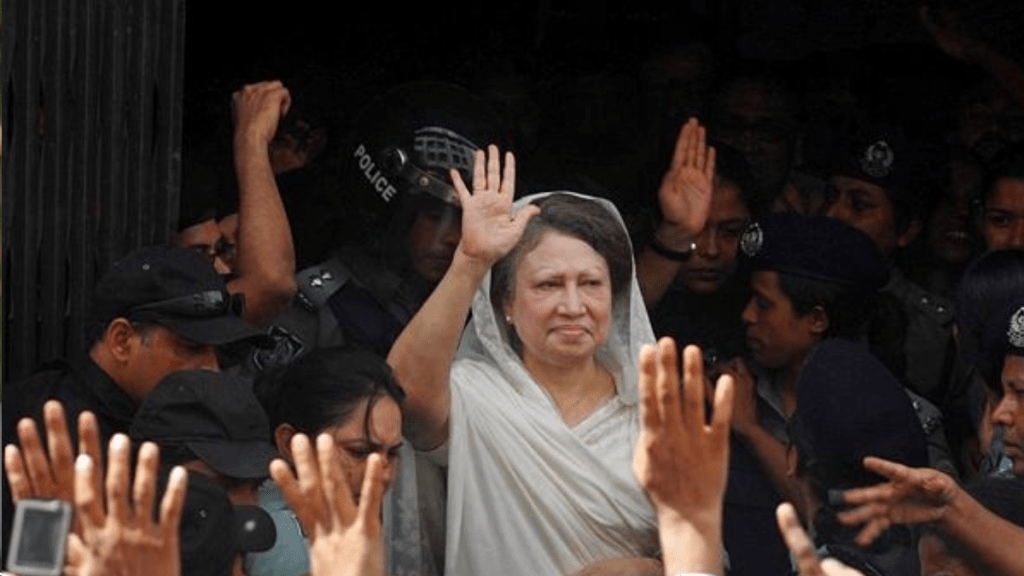
Khaleda Zia, the first female prime minister of Bangladesh, has breathed her last at the age of 80 after battling prolonged illness. She was suffering from advanced cirrhosis of the liver, arthritis, diabetes, chest and heart problems, her doctors said, as per a report by Reuters. She was undergoing treatment at Evercare Hospital in Dhaka, where she passed away.
“The BNP Chairperson and former prime minister, Begum Khaleda Zia, passed away today at 6 am, shortly after the Fajr prayer,” BNP said in a statement.
The party added, “Inna lillahi wa inna ilayhi raji‘un [Indeed, we belong to Allah, and indeed, to Him we shall return]. We pray for the forgiveness of her soul and request everyone to offer prayers for her departed soul.”
The BNP Chairperson and former Prime Minister, Begum Khaleda Zia, passed away today at 6:00 a.m., shortly after the Fajr prayer. Inna lillahi wa inna ilayhi raji‘un. We pray for the forgiveness of her soul and request everyone to offer prayers for her departed soul. pic.twitter.com/KY2948UPD5
— Bangladesh Nationalist Party-BNP (@bdbnp78) December 30, 2025
Her son, Tarique Rahman, returned to Bangladesh on December 25 after spending 17 years in exile. Following Khaleda Zia’s death, Rahman is expected to take over as the full-time chairman of the Bangladesh Nationalist Party (BNP); he currently serves as the party’s acting chief. Zia’s passing comes just weeks before the national elections scheduled for February 12 next year.
‘Pray for my mother,’ Zia’s son
Khaleda Zia’s son, Tarique Rahman, has shared a long, emotional message on the demise of his mother. He said that to him, she was a “tender and loving mother”. “Throughout her life, she stood firm against autocracy, fascism, and domination, leading the struggle for freedom, sovereignty, and the restoration of democracy,” he expressed.
My mother, BNP Chairperson Begum Khaleda Zia, has responded to the call of Almighty Allah and left us today. Inna lillahi wa inna ilayhi raji'un (Indeed, we belong to Allah, and to Him we shall return).
— Tarique Rahman (@trahmanbnp) December 30, 2025
To many, she was the leader of the nation, an uncompromising leader, the… pic.twitter.com/bLsEtzYWgi
PM Modi mourns Khaleda Zia’s death
Prime Minister Narendra Modi condoled the demise of the former prime minister of Bangladesh, stating that her role in shaping Bangladesh’s progress and strengthening ties with India would not be forgotten.
“Deeply saddened to learn about the passing away of former Prime Minister and BNP Chairperson Begum Khaleda Zia in Dhaka. Our sincerest condolences to her family and all the people of Bangladesh. May the Almighty grant her family the fortitude to bear this tragic loss,” PM Modi said on X.
In the next few lines, he recalled meeting with her in Dhaka in the year 2015. “As the first woman Prime Minister of Bangladesh, her important contributions towards the development of Bangladesh, as well as India-Bangladesh relations, will always be remembered. We hope that her vision and legacy will continue to guide our partnership.”
Deeply saddened to learn about the passing away of former Prime Minister and BNP Chairperson Begum Khaleda Zia in Dhaka.
— Narendra Modi (@narendramodi) December 30, 2025
Our sincerest condolences to her family and all the people of Bangladesh. May the Almighty grant her family the fortitude to bear this tragic loss.
As the… pic.twitter.com/BLg6K52vak
Khaleda Zia death: Leaders pay tribute
Tributes began pouring in following Zia’s passing. BNP’s Rajiv Zafar Chowdhury, in a post on X (formerly Twitter), said, “…With heavy hearts, we mourn an irreplaceable loss—not only for the Bangladesh Nationalist Party, but for the nation as a whole and for all who believed in her leadership, courage, and lifelong sacrifice for democracy and sovereignty.”
BNP Chairperson and former Prime Minister, our beloved and revered leader Begum Khaleda Zia, passed away this morning at 6:00 a.m. (Bangladesh time), answering the call of Almighty Allah. With heavy hearts, we mourn an irreplaceable loss—not only for the Bangladesh Nationalist… pic.twitter.com/oApqIoBheZ
— Rajiv Zafar Chowdhury (@Rajiv_Z_Chy) December 30, 2025
Who was Khaleda Zia?
Khaleda Zia served as the prime minister of Bangladesh from 1991 to 1996 and then from 2001 to 2006. She was the widow of the former president of Bangladesh and army commander, Ziaur Rahman, who was assassinated on May 30, 1981. She also served as the chairperson and leader of the Bangladesh Nationalist Party (BNP) since 1984, which her husband founded in 1978.
After her government’s term ended in 2006, national elections planned for January 2007 were postponed because of political unrest and violence. This led to a military-supported caretaker administration taking control of the country. During this period, Zia and her two sons were accused of corruption by the caretaker government.
Zia was sentenced to a jail term
In 2018, courts sentenced Zia to 17 years in prison in connection with corruption cases involving the Zia Orphanage Trust and the Zia Charitable Trust.
In April 2019, she was moved from prison to a hospital for medical care. In March 2020, she was placed under house arrest for six months on humanitarian grounds and was barred from participating in politics. Her release was later extended for medical treatment until 5 August 2024.
Following a large student-led uprising in 2024, Prime Minister Sheikh Hasina resigned from her post and fled to India, and the President of Bangladesh ordered Zia’s release. On 27 November 2024, she was cleared of all corruption charges.