



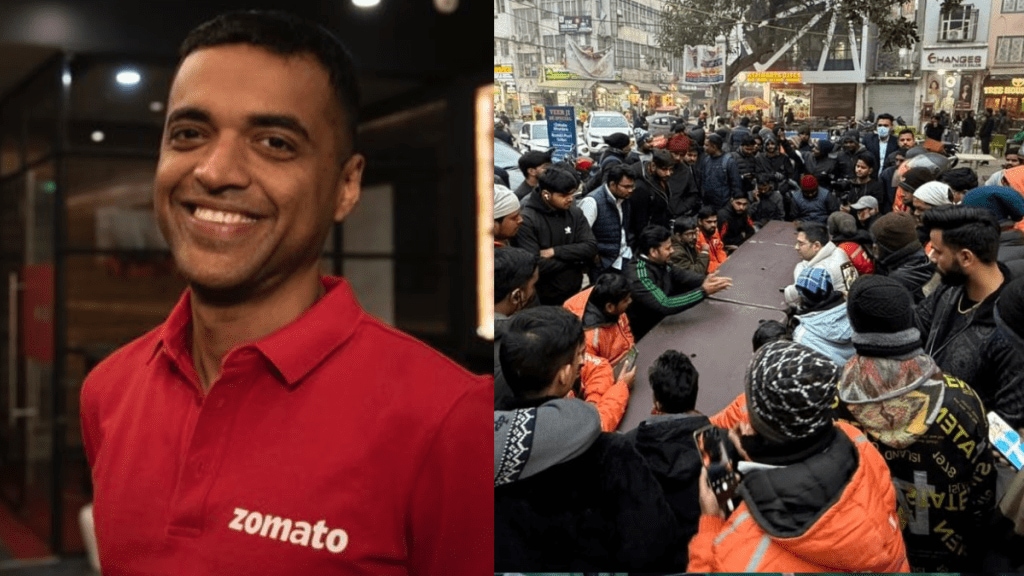
Zomato founder and CEO Deepinder Goyal has been facing heat online following his comments on the December 31 strike by gig workers. In what he described as his final post on the issue, Goyal addressed the broader question of class divide and the discomfort surrounding the gig economy. However, the post has also drawn sharp criticism, with several users questioning his portrayal of labour visibility and asking “which India he grew up in”, pointing out that rich households have long relied on “battalions of domestic workers”.
‘Labour of the poor no longer invisible’
In the now viral post, which has clocked over two million views, Goyal defended the gig economy, arguing that it has made labour visible in a way no one has predicted. He said gig workers are no longer hidden from consumers, but are seen delivering food, groceries, and essentials while enduring harsh weather, traffic, and long working hours.
“For centuries, class divides kept the labour of the poor invisible to the rich,” Goyal wrote before adding, “Factory workers toiled behind walls, farmers in distant fields, domestic help in backrooms. The wealthy consumed the fruits of that labour without ever seeing the faces or the fatigue behind it. No direct encounter, no personal guilt.”
Goyal argued that the gig economy has fundamentally altered this dynamic. “This is the first time in history at this scale that the working class and consuming class interact face-to-face, transaction after transaction”. This, he described, as unsettling for consumers.
He said that we now tip “awkwardly” because inequality is “personal” rather than “abstract” these days. “We are confronting guilt. That Rs 800 order might equal their entire day’s earnings after fuel, bike rent, and app cuts.”
‘Lies wrapped in corporate feel-good morality,’ says Internet
Entrepreneur and IIT Delhi graduate Sandeep Manudhane said that there are “6 lies, wrapped in corporate feel-good morality,” and went on to “unpack” each one by one.
“India has no real capitalism, no real free markets, no choice of work (for most). All our capitalists have done is privatization of profits, socialisation of losses, and guilt-burdening for anyone who calls this out,” he said before adding that Goyal should maybe reach out to delivery partners, listen to them, and give them honourable wages & terms of work.
Check out his complete post below:
6 lies, wrapped in corporate feel-good morality
— Sandeep Manudhane (@sandeep_PT) January 2, 2026
Let me unpack each one by one –
Lie # 1. For centuries, class divides kept the labor of the poor invisible to the rich. Factory workers toiled behind walls, farmers in distant fields, domestic help in backrooms. The wealthy… https://t.co/a7jQlTVtBx
“Extraordinary level of gaslighting!” said journalist Kadambini Sharma, before adding, “For centuries, people were not living in cities marked by high rises and deliver to home systems. Factory workers and farmers have been very visible in India. And even in big cities you just have to step out and have and have-not divide is for everyone to see. Interacting with have-nots is a daily life feature here…instead of doing something about the better working situation of gig workers, this person is trying to guilt the consumers into silence!”
Author Anurag Minus Verma said that Goyal’s post “reads like script of his ronnie videos”.
In response to this part of his post, one social media user quoted Goyal – “The inequality is no longer abstract. It is personal,” before adding – “And yet, we label a segment of these people as ‘miscreants’ – for rightfully lamenting against a system that is skewed against them, and will continue to thwart them for generations.”
Another joined, “First time? Gajab [Amazing]. People interact with street vendors/labourers all the time, multiple times a day at scale in every corner of the country.”
“I am doing a public service to society by exposing the poor to the rich – Billionaire CEO,” mocked a third.
A fourth asked, “Which India did he grow up in? Every street, every corner, your housemaid, cook, and cleaner—inequality was always visible in India. The hard reality is that we Indians want inequality, we thrive on it, we can’t exist in a world where all are equal, because it would question our existence—who will satisfy our ego unless we are bigger than someone?”
In pre-gig era, luxury was without discomfort: Goyal
Goyal went on to explain that in the pre-gig economy era, the wealthy enjoyed “luxury without moral discomfort” because labour remained unseen. Today, every delivery highlights “systemic inequality”. “That’s why debates explode. It’s not just policy. It’s emotional reckoning. Some defend the system (‘they choose it’), others demand change (‘this isn’t progress, it’s exploitation’).”
Goyal argued that many proposed solutions are less about improving worker dignity and more about restoring invisibility. “The unsaid ask of clumsy ‘solutions’ isn’t dignity. It is about returning to invisibility,” Goyal wrote.
This part again, didn’t sit well with the Internet, with one saying, “The rich didn’t see the poor before gig workers? In a country, the rich have a batallion of staff-domestic workers, dhobis? Damn this is breathtaking ignorance,” before adding, “Quick delivery apps made the poor invisible.”
The rich didn’t see the poor before gig workers? In a country the rich have a batallion of staff-domestic workers, dhobis? Damn this is breathtaking ignorance.
— Dushyant Arora (@atti_cus) January 2, 2026
No. Quick delivery apps made the poor invisible. Everyone used to know who their doodhwaala sabji waala was. Community…
‘Banning gig work won’t solve the problem,’ says Goyal
The 42-year-old also supported the gig economy, saying that “banning gig work” would not reduce inequality but would eliminate livelihoods.
“You remove livelihoods. These jobs don’t magically reappear as formal, protected employment the next day. They disappear, or they get pushed back into the informal economy, where there are even fewer protections and even less accountability. Over-regulate it until the model breaks, and you achieve the same outcome through paperwork instead of slogans: the work evaporates, prices rise, demand collapses, and the people we claim to protect are the first to lose income.”
Goyal said that once this happens, the wealthy will get their “old comfort back” and “guilt dissolves”. More so, he said, “convenience” will return without “faces”.
“We go back to clean abstractions and moral posturing from a distance. The poor don’t become safer, they become invisible again: back in cash economies, back in backrooms, back in shadows where regulation rarely reaches and dignity isn’t even debated,” he further said.
He also said that the gig economy exposed the “reality of inequality to the people” who previously couldn’t see it. “The doorbell is not the problem. The question is what we do after opening the door. Visibility is the price of progress. We can either use this discomfort to build something better (which we keep doing continuously, as delivery partners are our backbone), or we can ban and over-regulate our way back into ignorance. One of those choices improves lives. The other simply helps the consuming class feel virtuous in the dark.”
Last one on this topic, and I have been holding this in myself for a while.
— Deepinder Goyal (@deepigoyal) January 2, 2026
For centuries, class divides kept the labor of the poor invisible to the rich. Factory workers toiled behind walls, farmers in distant fields, domestic help in backrooms. The wealthy consumed the fruits…
One social media user, in response to this, said that he disagrees with Goyal, adding that the “doorbell didn’t expose inequality, the balance sheet did”.
I have so much respect for Deepinder. One of the most inspiring people of this generation in India…
— Vineeth K (@DealsDhamaka) January 2, 2026
But I do not agree with this view, here is my view:
CEOs of quick-commerce and e-commerce companies are millionaires (and billionaires) today, while the very gig workers who…
“Should have quit while you were ahead, Mate. Now you’ve stepped into a quagmire you’re clearly not informed about. None of anything you’ve just said is relevant to India, and certainly guilt isn’t. Inequality, poverty and caste divides are validated even by scripture here!” added another.
A third said, “Modi says nothing good in India happened before 2014, and you say the rich couldn’t see the poor- doodh wala sabji waala, domestic workers, cooks, mochi, tailor until your apps came around. I mean 100/10 for being aatm-mugh and thinking the world didn’t exist before you. My god.”
“Don’t think it is such a simple issue. I am against gig work because it is destroying Indian cities even further. The infrastructure can’t support gig workers in millions riding their vehicles on already broken footpaths just for some 10-minute convenience that is not even needed,” a fourth said.
What has happened?
On December 31, delivery workers employed by quick commerce platforms organised a protest and raised several demands, including fair wages, safe working conditions, social security and workers’ rights protection, among others.
In response to this strike, Goyal said that Zomato and Blinkit operations ran “unaffected” on New Year’s Eve, adding that the platforms delivered at a record pace without offering any additional incentives beyond routine New Year surge payouts. According to him, over 4.5 lakh delivery partners across both platforms completed more than 75 lakh orders, an all-time high, to over 63 lakh customers during the day. He said that this was only made possible with the help of local law enforcement that kept “a small number of miscreants in check”.
Goyal also said that the delivery partners are not asked to drive fast for 10-minute delivery, instead it is “enabled by the density of stores around your homes, not by asking delivery partners to drive fast”.
He said delivery partners neither see time on their apps, nor are they penalised for delays. Orders are picked and packed within 2.5 minutes, and riders typically cover under 2 km in about eight minutes at an average speed of 15 kmph.
Gig workers’ earnings and union’s response
In a separate post, he also shared the earnings of the gig workers after much backlash on social media about his comments on how the operations at the platforms he owns remain unaffected, even as there were protests in several areas.
“In 2025, average earnings per hour (EPH), excluding tips, for a delivery partner on Zomato were Rs 102. In 2024, this number was Rs 92. That’s a ~10.9% year-on-year increase. Over a longer horizon, EPH has shown steady growth,” Goyal said on X, before adding, “Most delivery partners work for a few hours and only a few days in a month. But if someone were to work for 10 hours/day, 26 days/month, this translates to ~₹26,500/month in gross earnings. After accounting for fuel and maintenance (~20%), the net earnings for the partner are ~₹21,000/month.”
In response to this, the gig workers’ union said, “Deepinder Goyal claimed Rs 102/hour EPH (2025). But at 10 hrs/day × 26 days, gross ≈ Rs 26,500. After fuel and maintenance (~20%), net is ~Rs 21,000/month—for 260 hours of work. That’s ~Rs 81/hour net, with no social security, no paid leave, no accident cover,” before adding, “Tips? Just ₹2.6/hour, and only ~5% orders get tipped. This is not decent work.”