



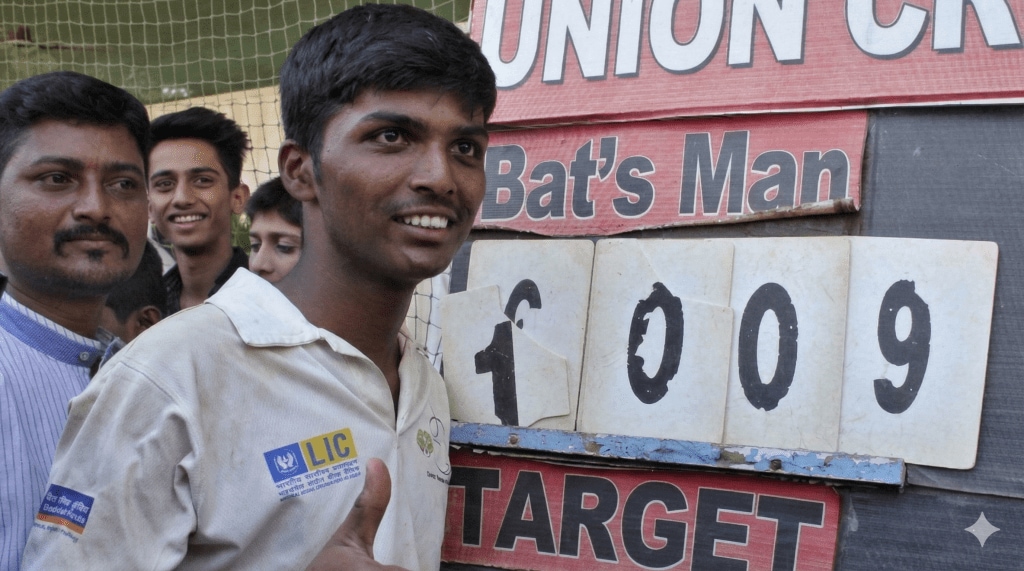
Union Cricket Academy ground in Wayale Nagar is not Wankhede Stadium. It sits between two housing societies in Kalyan, a Mumbai suburb that dreams don’t usually visit. On a normal day, you might see a few kids playing with a tennis ball while clothes dry on nearby balconies.
On 5th January 2016, this small rectangle of dirt became the most talked-about cricket ground in the world.
Pranav Dhanawade was fifteen. He was wicketkeeper for his school team, Smt KC Gandhi School, and his coach had moved him up to open the batting for a two-day school tournament match. The idea was simple. Make him stay at the wicket, teach him patience.
The opposition, Arya Gurukul School, had sent their junior team. Their main players were busy with Class 10 board exams. These kids were twelve-year-olds who had never faced a leather ball before.
Nobody expected what happened next.
Boy who wouldn’t get out
Pranav started Monday on zero. By stumps, he was 652 not out. He had already broken a record that had stood for 117 years, Arthur Collins’ 628 from 1899, and beaten Prithvi Shaw’s Indian record of 546.
Tuesday morning, he came back. He had slept, taken a bath, and set himself a target. One thousand runs.
He got there in the afternoon. His final score was 1009 not out off 327 balls, with 129 fours and 59 sixes. His school declared at 1465 for 3 and won by an innings and 1382 runs. The other team made 31 and 52.
Seven hours and twenty-seven minutes at the crease. That’s how long Pranav stood there.
Father who drove an auto
Prashant Dhanawade plies his autorickshaw around Kalyan. That Monday, a friend called while he was driving. “Your son has 300 and won’t stop.” He rushed to the ground.
He watched Pranav score another 300 runs, went home, and returned Tuesday morning with Mohini to see his son cross four figures. By Tuesday evening, Wayale Nagar looked different, with TV vans blocking the narrow lanes.
Prashant and Mohini gave interview after interview, barely breathing between questions.
Prashant plays tennis-ball cricket when he can. He never had money to chase his own cricket dreams. When Pranav was five and playing in the gullies with a tennis ball, his father saw something and sent him to MIG Club in Bandra. That’s where the boy learned to play with a real cricket ball.
Kids who gave up 1000 runs
Mayank Gupta was small. He bowled two overs, and Pranav hit him for 33 runs and two sixes. Mayank tells this story with pride.
Ayush Dubey gave up 350 runs in 23 overs. He got two wickets and dropped Pranav once. Dubey noticed Pranav struggled with balls outside off stump, so they kept bowling there, but Pranav figured out the short square boundaries and flicked everything to leg.
Sarth Salunke conceded 284. Harshal Jadhav went for 281. These numbers would end a professional bowler’s career, but these were children.
Coach Yogesh Jagtap admitted most of his team had only played with tennis balls. They were scared of the leather ball. There were 21 dropped catches and three missed stumpings. Some boundaries were just 30 yards from the wicket.
Coach who had a plan
Harish Sharma doesn’t apologize. He promoted Pranav to open after the boy kept throwing his wicket away at number seven.
This was Pranav’s first century in an MCA-recognized tournament. He had scored plenty in school matches, but never here. His game was always about quick scoring, and down the order he never faced enough balls to make big runs. Opening gave him time.
Harish also gave him advice before the match. “If you want to play at Wankhede, fifties won’t make an impact. You need to score big.” That stuck with Pranav.
World that noticed
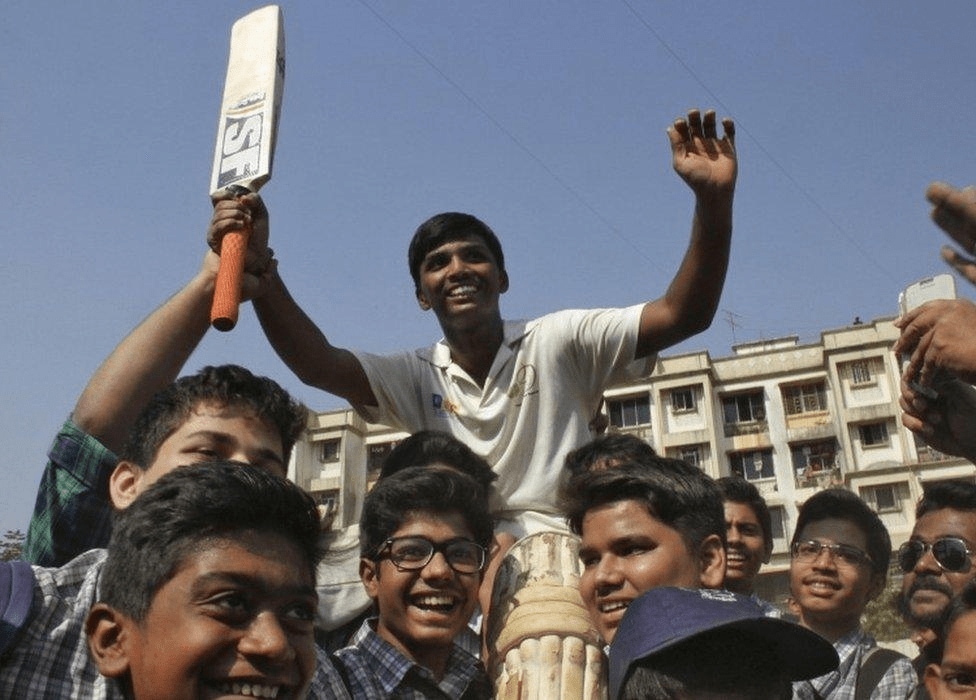
By Tuesday night, everyone knew. Sachin Tendulkar tweeted. Ajinkya Rahane sent a message.
MS Dhoni, at a press conference, said what mattered. “To score like that anywhere, at that age, is very difficult. We need to nurture and guide him. The limelight will be on him, and it is important for his coach and parents to guide him right.”
Michael Atherton mentioned it during the Cape Town Test. The BBC called. Maharashtra’s sports minister Vinod Tawde announced the state would pay for Pranav’s education and coaching.
The innings got thousands of tweets. International media wrote about it. Suddenly people were comparing him to Tendulkar.
Record that raised questions
Rahul Dravid gave a speech shortly after this game, saying schoolkids should retire after a certain score because it wasn’t fair to teammates who wanted to bat. Many critics called Harish Sharma’s decision unsportsmanlike. Why bat on when you’re 500 runs ahead?
Mumbai has seen this before. Tendulkar and Kambli’s 664-run partnership in 1988. Sarfaraz Khan’s 439 at age twelve. Prithvi Shaw’s 546 at fourteen. Arman Jaffer’s three straight double centuries. The city produces batting monsters regularly.
Dravid’s point makes sense. But so does Harish’s. The system rewards spectacle, not solidity. Before Pranav’s big day, his coach told him the truth. Fifties don’t get you noticed. World records do.
The boy who grew up
Five years later, Pranav gave an interview. He was 21. His contemporaries had IPL contracts. He was still trying to make Mumbai U-19.
“Inconsistency hurt me,” he admitted. “Missing the U-19 team was a setback. The pandemic took away two years of U-23 trials. Now I want to prepare for Ranji.”
“The expectation was huge after the record,” he would say later. “Every time I walked out to bat, I felt the pressure. It got the better of me.”
“I lost focus and played loose shots,” he said. But his father’s encouragement kept him going. The man who couldn’t afford his own dreams had given his son a chance. Pranav knew what that meant.
What we celebrate
Pranav Dhanawade did his job. He kept his promise to his coach. He spent seven hours at the wicket. The record is his. The questions are ours.
What are we really celebrating? A boy’s dedication or a system that demands miracles? A father’s pride or a culture that only notices the impossible?
The answer is both. But the second part needs more attention.
The ground in Wayale Nagar is still there. The boundaries are still short. Kids still play with tennis balls while clothes dry nearby. Pranav’s name is in the books. Whether it leads to Wankhede is another story.