



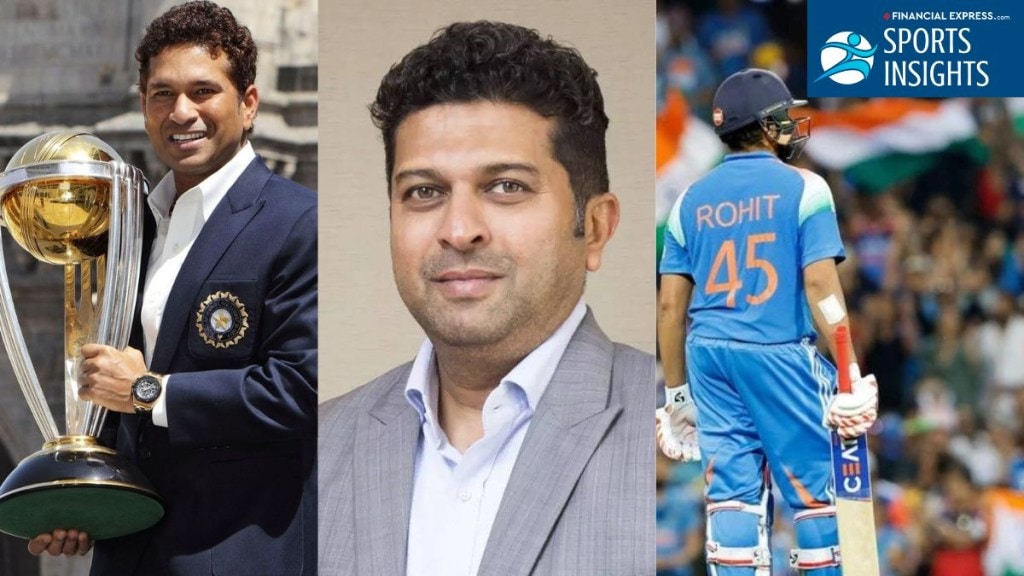
Every Mumbai cricketer has a Matunga story. For Jatin Paranjape, the story began at Ganesh Bhuvan. This was a house where the walls probably knew more about a straight drive than most national coaches.
He grew up in the shadow of his father, Vasoo Paranjape. Vasoo was the man who shaped the hands of Sunil Gavaskar and the mind of Rohit Sharma. In that house, cricket was not just a game. It was a classical language spoken over tea.
Jatin learned it well enough to beat a young Sachin Tendulkar to the Junior Cricketer of the Year award in 1986. But while Sachin went on to become a god, Jatin’s journey took a sharp turn into the world of spreadsheets and startups.
The boy who beat Sachin to the trophy
Picture Bombay in 1986-87. The Bombay Cricket Association is about to announce its Junior Cricketer of the Year. In the room is a fourteen-year-old Sachin Tendulkar.
The whole city already knows his name. The kid is special. But the name they call out is Jatin Paranjape. That year, Jatin was better. That is how good you had to be to beat Sachin.
Jatin comes from a house where cricket is not a game but a language. His father Vasoo Paranjpe played Ranji Trophy in the 1960s and was a legendary Mumbai and India-level mentor. In their Matunga home, they spoke cricket over breakfast.
They argued about technique over dinner. The walls of that house heard more about the straight drive than most coaching manuals.
Vasoo taught Sunil Gavaskar. He shaped Rohit Sharma’s mind. And he taught his son that Mumbai cricket is not about talent. It is about showing up every day when nobody is watching.
By the time he made his first-class debut in 1991, he was already a stylish left-hander with a high ceiling. He played in a Mumbai dressing room that was essentially an elite academy. It featured captains like Ravi Shastri and Sachin Tendulkar.
Jatin recalls one specific net session with the legendary Frank Tyson. Tyson came up to him after a session and told him that if he improved his leg-side play by 30 percent, he would be as good as Mark Taylor.
This one comment moved Jatin from an under-confident mindset to a dominant, attacking one. It was about the psychology of the game as much as the footwork.
Toronto Innings and the ankle that snapped
Jatin made his Ranji debut in 1991-92. Seven years of domestic grind followed. Seven years of scoring runs on tired Mumbai maidans. Seven years of knowing that one bad season could end everything. In 1997-98, he made over 600 runs in just four Ranji outings. The selectors finally looked up. They picked him for India A tour of Pakistan. Then an ODI against Kenya and Bangladesh. Then the big one. The Sahara Cup in Toronto.
India was playing Pakistan in a high-pressure match. Jatin walked in and played a pivotal, run-a-ball unbeaten 23. He stayed calm under the intense pressure of an India-Pakistan clash and steered the team to victory in the opening game.
The cricketing fraternity saw a man who belonged on the big stage. It looked like the start of a long international career. Then, the lights went out.
Just two games later, he suffered a severe ankle injury while fielding. In the late 1990s, sports medicine was not the advanced science it is today. That injury did not just hurt his foot: it effectively ended his international run after just four matches.
He was forced to fly home. Even though he scored 652 runs at an average of over 50 in the next domestic season, the national selectors had moved on. Most players would have become bitter about such a stroke of bad luck. Jatin just looked for a new pitch to play on.
Pranks and dressing room brotherhood
Before his career was cut short, Jatin lived through the golden era of Indian cricket camaraderie. There is a famous story from a national camp in Indore where the brotherhood of the team was on full display.
Sachin Tendulkar and Jatin decided to play a prank on a sleeping Sourav Ganguly. They found his door slightly unlocked and crept in with buckets of water. They flooded the room until the water hit ankle level. Jatin calls it a proper surgical strike.
He also learned about leadership early. In 1987, he was vice-captain of the Mumbai Under-17 team under Sachin Tendulkar. The team manager initially refused to play a left-arm spinner named Hasan Momin.
A young Sachin and Jatin went to the manager’s room and threatened to resign their leadership positions if their teammate was excluded. The manager soon agreed.
This early exposure to sticking one’s neck out for a peer became a foundational principle for Jatin’s later corporate life. It taught him that leadership is about loyalty to the group.
From Nike Netherlands to the Kohli connection
Jatin always had a thing for numbers. He once wanted to be a Chartered Accountant because he loved the logic of finance. When his playing days ended, he moved into sports management. He spent two years at Australian Sporting Frontiers before Nike headhunted him.
Nike eventually sent him to the Netherlands. He spent three years in Hilversum managing European Football marketing. He was dealing with the branding for giants like Manchester United, Arsenal, and Barcelona.
He was learning the Nike ethos of lightweight, zero-distraction gear. He learned how a global corporate machine translates athletic needs into actual products. It was a masterclass in global business.
When he returned to India as the head of Nike Cricket in 2014, he revolutionised the national team’s apparel. He used his dressing room relationships to conduct wear testing. He would take prototypes to the players and ask for honest feedback on weight and fit.
He wanted to make sure the athletes felt zero distraction from their gear while playing in the intense Indian heat. His most significant corporate achievement was signing a young Virat Kohli. Before the 2008 Under-19 World Cup, Nike only had Sreesanth on their list. Jatin knew they needed a more stable star.
He saw the hunger and confidence in Kohli’s eyes during a camp. He signed him up before Kohli ever played for RCB or the Indian senior team. It was a masterstroke that showed Jatin’s eye for talent was just as sharp as his cover drive.
He saw the fire in Kohli that would eventually change the face of Indian cricket.
Selector with a slipped disc
In 2016, Jatin was appointed to the All India Senior Selection Committee. He brought a sense of humour to a thankless job.
He compared being a selector to being a wicket-keeper. If you catch a ball, nobody says thank you. But if you drop one, everyone asks how you could be so bad. It is a job where you are expected to be perfect and ignored when you are.
His commitment was almost legendary. He once suffered a slipped disc on a rowing machine in the gym and was in intense physical pain.
Despite this, he travelled all the way to Mysore for a Ranji Trophy game. He went specifically to watch a young Devdutt Padikkal play. He believed that if a talent is worth watching, you show up no matter how much your back hurts.
He was also a bridge for senior players. He recalls a conversation with Rohit Sharma when the latter was out of the Test side. Rohit was offended by rumours that he did not care for red-ball cricket. He told Jatin that he grew up playing with the red ball and lived for it.
This conversation, along with Ravi Shastri’s foresight, led to the decision to promote Rohit as a Test opener.
It was a move that saved Rohit’s red-ball career and turned him into a modern great. Jatin’s ability to listen to the player’s heart was just as important as looking at the scorecard.
Birth of a 100 crore empire
The idea for KheloMore did not come from a business textbook. It came from the frustration of a father in Mumbai. Jatin was trying to find tennis coaching for his children and found the process messy and difficult.
He realized that while India is a sports-obsessed nation, the infrastructure to find coaches and book grounds was broken. You had to call people, negotiate, and hope for the best.
He launched KheloMore in 2017 to solve this. It started as an aggregator for sports venues and coaches across disciplines like cricket, football, and badminton. Today, it has grown into a sports tech giant. The business model is simple but effective.
They earn commissions on every booking and sell venue management software to ground owners. This software helps owners increase their revenue by up to 300 percent by helping them manage their slots better.
The company is valued at approximately 82 crore. It has attracted big investors like Dream11 and Eruditus founder Ashwin Damera. The company reported a revenue of nearly 10 crore for the financial year ending March 2024. Jatin jumped on the Pickleball bandwagon lately, running social games for just 99 rupees to get regular folks moving. His whole belief is that sports shouldn’t be some elite privilege; it should be for anyone who wants to be active.
Strategic expansion and global ties
Jatin also noticed that coaching in India was pretty hit-or-miss; uncertified and inconsistent. To fix this, KheloMore partnered with Cricket Victoria to launch the Melbourne Cricket Academy in India in 2024. This brings an Australian curriculum into Indian schools.
It certifies local coaches and gives them a digital platform with the latest drills. It professionalizes the grassroots level of the game.
He is now expanding the platform to over 20 cities. He aims to have over 10,000 venues listed soon. A recent partnership with Rose Merc Limited involves exploring equity funding of up to 20 crore to fuel this growth.
The goal is to make India a truly multi-sport nation where anyone can pick up a racket or a ball and find a place to play.
Family and Cricket Drona
Jatin’s business is rooted in his family. He is married to Gandhali Paranjape, the sister of actress Sonali Bendre. Gandhali is a director at KheloMore and has been a key force in building the network of coaches and academies. They live in Mumbai with their twins, Aditi and Dhruv.
In 2020, Jatin co-authored the book Cricket Drona as a tribute to his father’s legacy. The book features essays from legends like Tendulkar and Dravid who were shaped by Vasoo’s wisdom.
It serves as a bridge between the old-school values of the Matunga circuit and the modern tech world Jatin now leads. It is a reminder that while the tools of the game change, the spirit and the mentorship stay the same.
The long innings
Jatin Paranjape’s story is about the art of the pivot. He was the boy who beat Sachin to an award, an international player stopped by a freak injury, a corporate leader who modernised Indian sports apparel, and a selector who helped shape the current national team.
Now, he is an entrepreneur building the digital home for Indian sports.
He often quotes Albert Einstein, saying he isn’t the most intelligent man, but he just spends more time on problems. This patience is what turned a career-ending injury into a 100 crore business empire.
He has moved from the fear of failure to the joy of the journey. Whether he is selecting a national captain or helping a parent find a badminton coach, Jatin Paranjape is still at the crease.
He is proving that even if your international career is short, your impact on the game can be eternal. He is not just playing the game anymore: he is building the stadium for the next generation.