



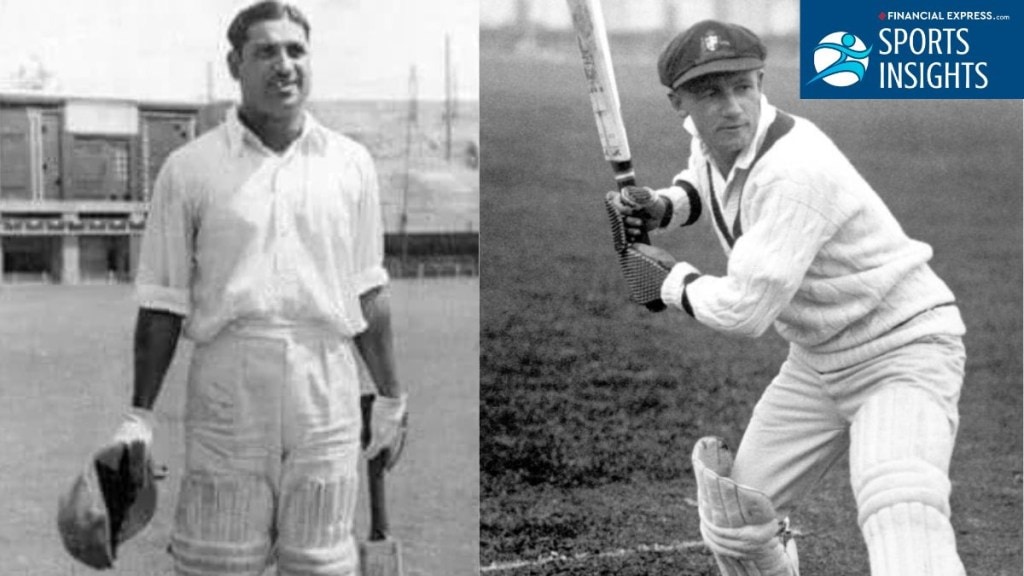
December 1948 at Poona Club Ground. In the middle of a four-day Ranji Trophy match against Kathiawar, a typical cricket game became an experience no one will forget. A local player named Bhausaheb Babasaheb Nimbalkar scored 443 runs while only being nine runs shy of Don Bradman‘s world record, then, the opposing team simply packed up and headed to the railway station.
The rule that made everyone run hungry
Back then Ranji Trophy had a simple rule. If the match ended in a draw, the side that had more runs at the end of the first innings won. Therefore, the teams felt compelled to score as many runs as possible because they didn’t want to give the opposing side a chance. Four day matches often became batting practice. Holkar had made 912 runs just four years before this game. Big scores were normal. But nobody expected what happened in Poona.
Day One: The start of something big
Kathiawar batted first and made 238. By end of the day 1, Maharashtra had lost only one wicket and had reached 132 runs. When Nimbalkar came to the crease to join KV Bhandarkar, score was81 for 1. What happened next shocked everyone.
Building a mountain run by run
The two batsmen stayed together till the end of day two. They added 455 runs in about five hours. Bhandarkar got out for 205 after batting six hours. Nimbalkar found another partner in SD Deodhar. By stumps he had reached 300. Maharashtra ended day two at 587 for 2.
Day three began and the runs kept flowing. Nimbalkar and Deodhar added 242 for the third wicket. Deodhar fell for 93. Mohan Lal also got out soon. The score became 801 for 4. But Nimbalkar kept batting. He crossed 400. He was now closing in on Bradman’s record of 452.
Nine runs short and a captain’s anger
At tea on day three, Maharashtra had 826 runs for 4 wickets. Nimbalkar was on 443. Two sessions and a full day remained. Everyone knew Maharashtra would win. The only question was records. Nimbalkar needed just ten runs to go past Bradman. Maharashtra was also close to Holkar’s record of 912.
The captain of Kathiawar was His Highness the Thakur Sahib of Rajkot He had scored 77 in his own innings, the highest he ever made in his career. He had bowled two overs and given away 16 runs. During the tea break, while players stood on the field as was the custom, he lost his temper. He told Maharashtra captain Raja Gokhale to declare the innings or his team would leave.
Gokhale and the umpires requested two more overs. Just two overs so Nimbalkar could break the record. The Thakur Sahib said no. His team walked off, packed their things in the hotel, and went to catch their train.
The man left standing alone
Nimbalkar stood in the middle of the ground with his bat. “They kept saying you have scored so many runs, why do you want more,” he said years later. “Their captain felt his team would be remembered for the wrong reasons. I did not like their approach. How could they be so unsporting? When I learned I was just ten runs short, I wanted to achieve it badly. It would have put Sir Don’s name behind me.”
He only learned about the record at tea. “If I knew it was going to be this way, I would have done better. My captain asked me to stay at the wicket and I did what the team wanted; I was playing for my side and not for myself,” said Nimbalkar who batted for eight hours and 14 minutes. Nimbalkar hit 46 fours and one six during his epic innings.
A message from the Don himself
The story could have ended there. But the real Don Bradman heard about it. He sent a personal message to Nimbalkar. He told him to go for the record. He congratulated him. Years later Nimbalkar still remembered what Bradman said.
“Sir Don ranked my innings above his own. That shows how great he was. Even though he held the world record and I only had the Indian record, he still said my innings was better.” Bradman even spoke on radio and asked Kathiawar to let Nimbalkar continue. But the train had already left the station.
A Lifetime in White without the Blue cap
Nimbalkar played 80 first-class games and produced 4841 runs at an average of 47.93 runs per game. In the Ranji Trophy alone he produced 3687 runs at an average of 56.72 runs per game. Nimbalkar also had the ability to bowl medium pace and could also keep wickets.
“I think I was good enough to play Tests,” he said. “I don’t know why selectors ignored me always. What hurt most was that less talented players got chances.” He played one unofficial Test against Commonwealth XI in 1949-50. That was it.
He lived to 92 years old. He spent 26 summers in cricket whites. His 443 not out remains the highest first class score by an Indian batsman. It is still the fourth highest innings in top level cricket history. Hanif Mohammad broke Bradman’s record ten years later with 499. Brian Lara made 501 in 1994. But Nimbalkar’s name stays in the books, not with a world record but with a story of what could have been.
That December day in Poona, cricket was not just about runs. It was about pride, politics, and a team that chose to walk away rather than watch a man make history.