



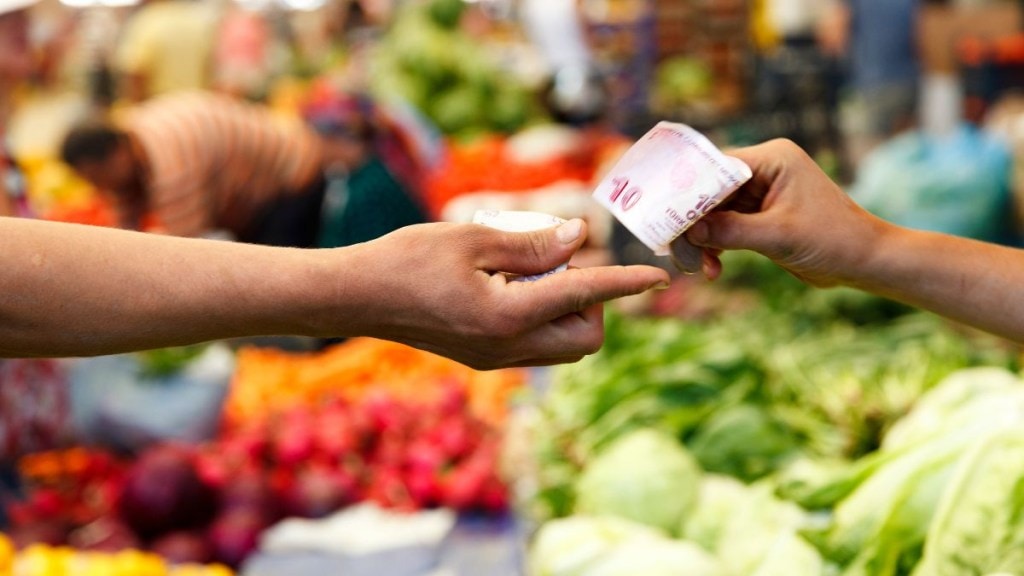
After food inflation hitting elevated double digits in October, 2024, agri-commodities prices have softened and retail food inflation has remained in the negative zons for the last six months because of robust harvest and adequate imports.
Taking into consideration robust rabi sowing and adequate stocks, the retail food inflation in 2026 is expected to rise moderately. A waning of a favourable base is still likely to ensure the inflation rate to be below the high levels reported in 2024, experts said.
“The monsoon will decide the future of food prices in India. Globally, La Nina is likely to end by early 2026 and in case Indian monsoon rains suffer, the prices might feel the pinch by end of 2026,” Shweta Saini, CEO, Arcus Policy Research, told FE. Saini stated that fundamentally, crops are in good shape currently, and crop balance sheets look strong.
Food inflation rose to 10.87% in October, 2024 on year and since then it has fallen and was reported at (-) 3.91% in November, 2025, largely driven by base effect and subdued prices of vegetables, cereals, pulses, meat, eggs and spices.
Read FE 2026 Money Playbook: Your Ultimate Investment Guide for the new year
“Most of the prices of agricultural commodities would rise by around 5% due to base effect in 2026, while rise in food inflation would be moderate,” a leading trader of agricultural commodities told FE.
Cereal Stability and Record Buffer Stocks
Prices of cereals including rice and wheat are expected to stable next year, the government has as over three times the buffer surplus grain stock with the agencies – Food Corporation of India and state agencies, at 86.62 million tonne (MT) at the beginning of month against a buffer of 21.4 MT for January, 2026.
The government has an effective (including receivable from millers) rice stock of over 57 MT against a buffer of 12.8 MT for January 1. While the performance of monsoon would impact rice output in the 2025-26 crop year (July-June). Cereals have the highest weightage in food commodities of 9.67% in the consumer price index.
Robust wheat sowing in the ongoing rabi season is likely to boost output and bolster the government stock and ensure open market sale in case of a spike in prices next year. The supply situation is so robust that response to the government’s open market sale of wheat has been lukewarm. In case of wheat, prices are likely to be stable with surplus stocks and robust crop outlook likely to ensure improved supplies.
Till the third week of December, wheat has been sown in 30.16 million hectare, marginally up from 30.03 mha reported during the same period in 2024. Last year there was record sowing of 32.8 Mha, resulting in a record output of 117.9 million tonne (MT) in 2024-25 crop year (July-June)
“Initial field reports indicate good sowing progress and favourable weather conditions, pointing towards another potentially bumper wheat crop. With the minimum support price (MSP) at a satisfactory level, the outlook appears positive,” Navneet Chitlangia, President, Roller Flour Millers’ Federation of India, said.
However, Chitlangia has cautioned that if private players are unable to adequately cover their carrying costs, it may discourage private stocking in the market during the 2026 harvest season.
Although pulse import is likely to fall sharply in by around 45% to around 4 million tonne (MT) in FY26, from a record 7.34 MT in 2024-25, adequate government as well as private stock compounded by possibility of encouraging harvest of current rabi crops – chana and lentils, which constitute about 60% of the country’s pulses output is likely to keep price stable next year.
“Mandi prices of major pulses varieties are ruling 10 to 20% below last year as well as the minimum support price. While there will be some uptake in prices next year, the prices would be range bound and would be far below the 2024 level,” Nitin Kalantri, managing director, Kalantry Food Products, a Latur, Maharashtra-based pulses processor, told FE.
India imports about 15% to 18% of its pulses consumption annually.
The cooking oils prices next year would largely depend on global prices which have been at elevated levels for the last many months. India imports 57% of its edible oils consumption of around 24 MT annually.
The acreage under mustard was up 4% on year at 8.46 million hectare (Mha) by mid-December. Rajasthan, Uttar Pradesh, Madhya Pradesh, Haryana and West Bengal have shown significant expansion in crop area in the current rabi season (2025-26), according to the third report of the mustard crop by the Solvent Extractors Association of India (SEA) released recently.
Price Recovery Trend
According to officials, if the weather holds good for the next two months, the mustard output, which has the biggest share in domestic oilseed output production, is likely to be higher than the previous year. This may give a boost to edible oil production thus reducing imports prospects.
India’s horticulture sector comprising of fruits, vegetables and plantation crop is set to reap relatively faster growth during the rabi marketing year starting January 2026 onwards for three reasons – rationalisation of acreage, better price realisation and a statistical low-base effect -, according to a Crisil analysis.
That would be conspicuous given softer profitability prospects for other field crops. In 2025, the prices of key vegetables such as onion, potato and tomato declined (-) 38%, (-) 34% and (-) 24% on-year, respectively.
For the rabi marketing year 2026 points to a gradual improvement in price realisation, supporting farmer income and profitability.
“Lower on-year supply is likely to lead to a recovery in prices, with the prices of onions, potatoes, garlics and cumin projected to rise 15–25%, 15–20%, 20–30% and 2–5%, respectively,” Pushan Sharma, Director-Crisil Intelligence, said.
For garlic, potato and pea, while acreage is set to increase, steady demand will keep prices firm, according to Crisil. It stated that fruit acreage is expected to be largely stable on-year, with an increase in acreage in select crops such as bananas owing to strong domestic demand as well as rising exports.
Due to two years of above normal monsoon have ensure that in the current sugar season 2025-26 (October-September), where crushing activities are on, Indian Sugar and Bio-energy Manufacturers Association (ISMA), has projected sugar production at 34.3 MT, an increase of 16% from 2024-25 sugar. “Looking ahead to 2026–27 season, sugarcane output is expected to register good growth. Improved planting trends, better water availability and sustained productivity gains across key cane-growing states provide confidence of a stronger crop, which will comfortably support sugar and ethanol requirements,” Deepak Ballani, Directora General, ISMA, said.
Analyst forces a mixed trend in prices for spices – turmeric, jeera and coriander in 2026, there is a possibility of moderate increase in prices of jeera and coriander, inflation in turmeric is likely to be higher. “While jeera coriander prices may not see a spike in 2024, turmeric prices will firm because of loser output,” Ankit Agarwal, Director at the Erode, Tamil Nadu-based Amar Agarwal Food India, said.