



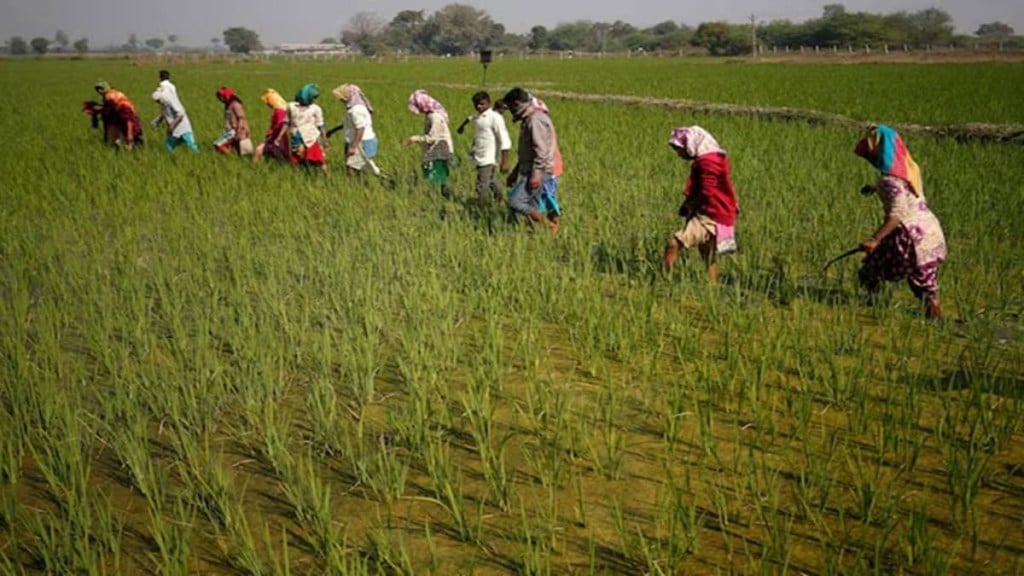
India’s foodgrain and horticultural output continued to rise at a satisfactory pace in 2025 on account of surplus monsoon, adequate supply of highly subsidised fertilisers. Several measures including direct cash transfer, crop insurance and assured purchase at remunerative prices from the farmers also helped.
However, because of liberalised imports of edible oils and pulses and their higher output, the farmers’ price realisation remains under stress. Mandi prices of many agricultural commodities continue to rule below the Minimum Support Price (MSP).
Production-Price Paradox
The prices of stable vegetables — tomato, onion and potato –during most of part of 2025 ruled way below the 2024 level because of the sharp rise in production induced by higher price realisation in 2024.
Pushan Sharma, Director-Crisil Intelligence said that in the current rabi season 2025, the prices of onion, potato and tomato declined by 38%, 34% and 24% on-year, respectively. Despite the government’s intervention through assured purchase from the farmers at MSP, mandi prices of several pulses and kharif oilseeds like soybean are ruling below the benchmark price.
“Sole focus on production leads to glut, lower farmgate prices and stagnating incomes is the most frustrating part. Short-sighted agricultural policy and declining allocations in real terms for agricultural research and development are not the right strategy for Viksat Bharat,” Ajay Vir Jakhar, Chairman, Bharat Krishak Samaj, told FE.
While persistently low food inflation has come in handy for the macroeconomic managers and monetary authorities, the terms of trade being tilted against farmers is causing rural income revival insufficient, and non-durable.
Production of foodgrains – rice, wheat, pulses and coarse cereals– rose 7.7% to a record 357.73 million tonne (MT) in 2024-25 crop year (July-June), up from 332.30 million tonnes in 2023-24. Correspondingly, in 2024-25, the horticulture production, which includes fruits and vegetables, increased by 4% to 369.05 MT, up from 354.74 MT in 2023-24.
“At several places prices of crops have tumbled and are ruling below the MSP. This does not augur well for farmers, as their incomes remain low,” Ashok Gulati, agricultural economists, told FE.
Gulati said in the next fiscal the government must reform fertiliser subsidies, which has potential to save Rs 40,000 crore annually. This can be invested in building more efficient value chains of perishable agricultural products.
The gross value added (GVA) for agriculture and allied activities is projected to grow at 3.7% and 3.5% in the first two quarters of 2025-26 in real terms, which may bring down overall farm growth in the current fiscal below 4%. In FY25, farm sector growth was 4.6%.
Ramesh Chand, member, Niti Aayog recently stated that agri-sector growth is likely to be close to 4% in FY26. Crops account for roughly 55% of farm-sector GVA, and the livestock sector’s share is 30%.
The crop segment, which includes horticulture, has been losing share in the gross value added in agriculture and allied sectors. The livestock sector has been growing at a larger compound annual growth rate as consumption of dairy, meat and egg continue to surge.
Financing the Next Phase of Growth
In 2025, under the agriculture ministry’s flagship scheme that seeks to provide unique IDs for the farmers which are linked to their land records, 16 states so far provided over 74 million such IDs also referred to as Kisan Pehchaan Patra.
The move to create farmers’ digital registry is part of the government’s digital agriculture mission, which would enable farmers to access benefits from a host of schemes.
Under AgriStack – databases of Geo-referenced village maps, crop sown registry and the farmers registry IDs are being created. In 2025, the government continued with the direct benefits transfer under PM Kisan Samman Nidhi of Rs 6000 in three equal instalment to close to 90 million farmers and since launch of the scheme in February, 2019, over Rs 4 lakh crore has been transferred to farmer’s bank accounts
The year also saw higher credit flow, loans disbursal to the agricultural sector by commercial banks and regional rural banks set to exceed a record Rs 32.5 crore in FY26, driven by greater formalisation of rural lending and rise in credit demand, according to Nabard.
Credit to the agriculture sector from commercial banks and regional rural banks is set to exceed a record Rs 32.5 lakh crore in FY26, driven by greater formalisation of rural lending and rising credit demand, according to Nabard
Under the agriculture ministry’s modified interest subvention scheme, KCC holders can access loans of up to Rs 3 lakh at 7% interest for working-capital needs, with an additional 3% subvention for prompt repayment, bringing the effective rate to 4%.
At present, 77.1 million KCCs are active, including 1.24 lakh for fisheries and 44.4 lakh for animal husbandry. Over 40 million farmers currently enrolled under highly subsidised the Pradhan Mantri Fasal Bima Yojana. Agriculture ministry has stated that Rs 1.82 lakh crore has been paid to farmers under PMFBY since its launch in 2016 as compensation which was five times of the total premiums of Rs 35,864 crore paid by them under the scheme.
“Because of higher imports and diversion of grains for ethanol manufacturing, prices of several commodities such as maize, soybean and other crops remained subdued thus hitting farmers income,” Siraj Hussain, former secretary, agriculture ministry, said.
To boost farm gate prices of pulses, the government imposed a 30% import duty on yellow peas used as a cheaper substitute of chana, largely used in the food processing industry from November 1, 2025 ending duty free imports allowed from December, 2023.
In December 2023, the government had allowed duty free import of yellow peas and the relaxation was extended from time-to-time.
To bridge the gap between domestic production and consumption, the government continues to extend duty free imports of tur and urad has been allowed till March 31, 2026, while bengal gram and masoor has imported duty of 10% valid till end of FY26.
Indian imports about 15% to 18% of its annual pulses consumption mostly tur, urad and lentil (masor) from Africa, Myanmar, Canada, Russia and Australia.
India imported a record 7.3 MT of pulses in FY25, however it is expected to decline sharply in 2025-26 to about 4 MT because of higher carry forward stocks and robust domestic production.
Under the Pradhan Mantri Annadata Aay Sanrakshan Abhiyan (PM-AASHA) and other schemes, to encourage domestic pulse production and reduce reliance on imports, the government has decided to procure 100% of the marketable surplus of tur or Arhar, Urad, and Masur under minimum support price (MSP) for the 2025-26.
To boost oilseeds output. Government agencies – Nafed and NCCF – have been procuring soybean and mustard at MSP so that farmers get remunerative prices while market prices fall below benchmark.
In June, 2025, the government had cut the import tariff, including basic custom duty and cess on palm, soybean and sunflower oils, to 16.5% from 27.5%. Sources said the reduction in duty was because of a sharp rise in prices of edible oils in recent months.
However, the basic custom duty on refined oils remains unchanged at 32.5%. India continued to import 57% of its annual cooking oils consumption as production of oilseeds have not kept pace with rising demand.
India imported edible oils were valued at 1.61 lakh crore (16.01 MT in terms of volume) during the 2024-25 oil year (November-October). Agriculture minister Shivraj Singh Chouhan recently told FE that the government’s import policy for agricultural products should balance the interest of farmers as well as consumers so that prevailing depressed prices of commodities do not hit farm income.