



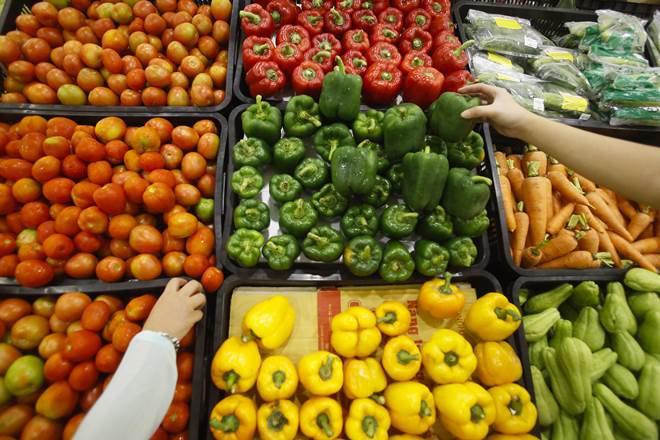
Vegetable shopping during winters is the time when you go to the market thinking of the fresh and plentiful supplies of tomatoes, cabbage, spinach, cauliflower and other green leafy vegetables that you don’t really manage to get during the summers. And most importantly, the abundance of the availability of these vegetables gives you the comfort of paying less in winter than in summer. However, the rule seems to be the other way round of late where prices in summer have appeared to be less or equal to the prices in winter months.
As per The Indian Express, the average retail prices in Delhi during June were lower than or equal to their November 2016 levels for 12 out of 20 vegetables. This is also consistent with the official Consumer Price Index (CPI) numbers: the all-India CPI (base: 2012 = 100) for vegetables in May and June 2017 — at 125.6 and 133.3 respectively — ruled below the 141.9 of November, and not much above the 125.3 level for the peak winter month of December. Not only this, the IE report from an online marketplace data until November 21 reveal these to be higher than the average for June in 15 out of 20 tracked vegetables. This again is seemingly in line with the latest CPI for vegetables, which, at 162.5 in October, was higher than the corresponding 133.3 figure in June.
A major reason for this unexpected and unseasonal price rise of vegetables is believed to be the heavy rain in September and October across Maharashtra, Karnataka and the Rayalaseema region of Andhra Pradesh. The late rains caused some damage and also delayed the harvesting of the standing tomato, kharif onion, capsicum and spinach crops, thereby impacting market arrivals. Apart from this, demonetisation whose effects on prices led to farmers terminating their summer tomato crop after the initial few pickings during May-June is also touted as the reason behind high prices of tomatoes according to IE.
But, the price hike this season is largely limited to perishables. Crops such as cereals, pulses, oilseeds, cotton or even potatoes, which need cold storage are seem to have low prices. As per IE, bajra (pearl millet) is currently selling at Jaipur’s Chomu Mandi at Rs 1,140-1,150 per quintal, as against Rs 1,400-1,410 during this time last year. The same case is noticed for Davangere in Karnataka (Rs 1,150 versus Rs 1,450), urad (black gram) at Ashoknagar in Madhya Pradesh (Rs 2,300-2,350 versus Rs 5,100-5,200) and potatoes in Agra (Rs 400-410 versus Rs 970-980). As per IE, the varying price trends for perishables and non-perishables depends on what demonetisation and GST may have done to produce trading, which, in India, has traditionally been cash-based and financed through a chain of mandi intermediaries, processors and retailers.