



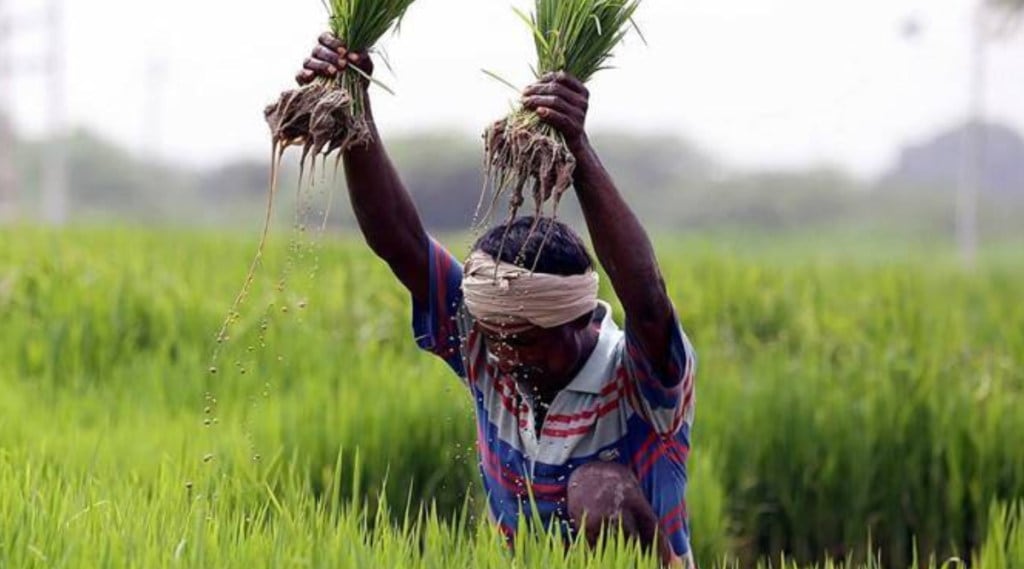
In the Union Budget 2022-23, the government has focussed on creating a digital ecosystem for farming. Finance Minister Nirmala Sitharaman announced that the government will promote the use of ‘Kisan Drones’ for activities like crop assessment, digitisation of land records, spraying of insecticides, and nutrients. This is likely to drive a wave of technology in farming, she said. In the agriculture sector, this is one of the major developments announced by the government in recent times. In her Budget speech, FM Sitharaman also said the government will launch a scheme for the delivery of digital and hi-tech services to farmers. It will rope in public sector research and extension institutions along with private agri-tech players and stakeholders of the agri-value chain. For this purpose, the government will also set up a fund to finance startups for agriculture and rural enterprise, relevant for farm produce value chain, through NABARD, she said.
Use of modern technologies like mobiles, remote sensing, drones, artificial intelligence, etc. in the assessment of crop yields, crop losses and output estimates will ensure better farming practices, hence more foodgrain production, according to experts. Along with an increase in productivity, the use of digital and hi-tech services will help farmers cut costs, find new markets and buoy their competitiveness in the global markets.
Some of the states have already been using technology in agriculture and farming. Odisha is one of the pioneers. It has automated the procurement process in the state to ensure MSP benefits. The Odisha government has created a database of 14.93 lakh farmers with a verified land acreage of 51.97 lakh acres. With the help of satellite imaging and cadastral mapping of the paddy fields and GPS, the state government has cleared all discrepancies on the ground. Also, it has integrated the farmers’ registry with the state’s land records database. This has helped all government policies reach farmers.
From a food deficit state to a surplus one, Odisha has come a long way. The state is now the fourth largest contributor to the national paddy pool. The government has implemented a tech solution called ‘Crop Analytics’ in 29 districts where it procures paddy directly from farmers. The programme first aggregates yield data through crop mapping, land monitoring and survey, and then using crop analytics, it visualises and analyses data captured during the agricultural season for yield patterns, registration anomalies, crop patterns and procurement predictions. It has brought transparency and accountability across the supply chain and helped in ensuring allocated food reached the targeted beneficiaries without leakage. “Our Crop Analytics solution builds on the digital ecosystem that we have created for Odisha’s agriculture landscape. Crop Analytics, an amalgamation of technologies like satellite imaging & processing, analytics and visualisation, is just the right bet for farmers to streamline crop planning, ramp up yield and avail benefits from government-led interventions. The solution is beneficial for governments too,” said Manoj Mishra, secretary (Electronics & IT) and Science & Technology, Odisha government.
“By using satellite imaging and analytics, they can do accurate field-level authentication. And, by using this ground truth intelligence, the concerned government agencies can ensure benefits like MSP payout and disbursal on targeted schemes reaches the genuine farmers”, Mishra added.
The Odisha government had implemented the National Food Security Act in November 2015. The Act provides legal entitlements to existing food security programmes such as the Public Distribution System, Midday Meal Scheme and Integrated Child Development Services scheme. Using automation in Fair Price shops, Odisha has brought massive improvements in the number of authenticated transactions. Now, almost all beneficiaries receive the benefits as it removes leakage and manipulation. To further strengthen the food security systems, the state government is also using emerging technologies such as blockchain, advanced analytics and enterprise resource planning. Through scientific management of warehouses/inventories, it has checked diversion and wastage.
Going forward, the Naveen Patnaik government in Odisha is committed to further advancing its food security systems. According to the UN definition, food security means all people, at all times, have physical, social, and economic access to sufficient, safe, and nutritious food that meets their food preferences and dietary needs for an active and healthy life. The state government said it will increase its focus on digital authentication of beneficiaries, optimisation of transportation costs and expansion in the network of registered farmers. “Odisha has been one of the pioneers in leveraging technology to improve governance and quality of service for the stakeholders. Crop Analytics is a futuristic tech-led solution that promises to accelerate Agriculture 4.0 and lead to outcome-driven policy interventions”, Mishra said.
Hope these measures will further help the state government in achieving the goals of food security and zero hunger.