



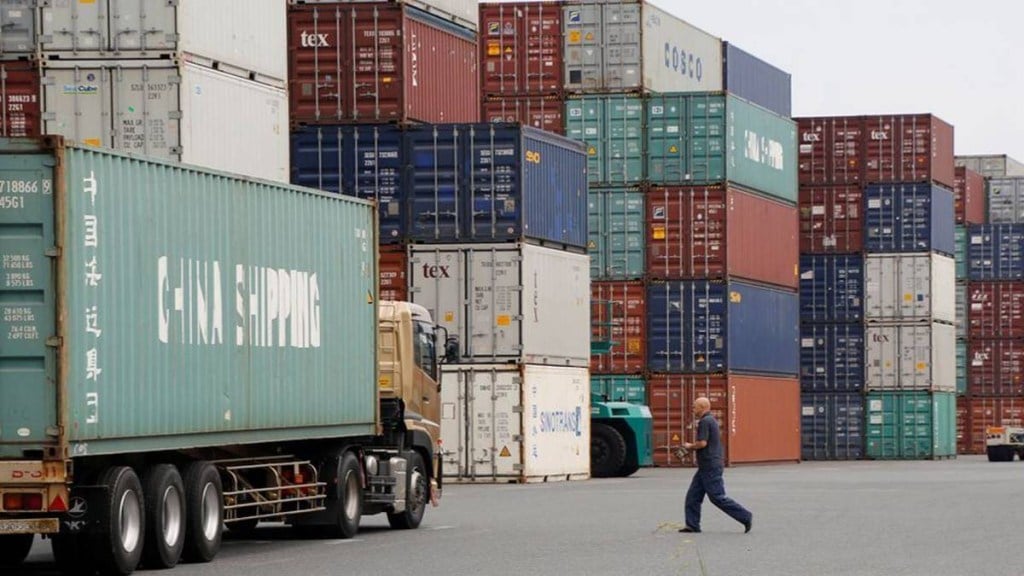
The last-quarter spurt would see India’s merchandise exports to be around $445 billion in the financial year 2023-24, about 1.3% lower than previous year’s level of $451 billion. The new year is challenging and growth from hereon will depend on inflation-interest rate dynamics in the key markets of the US and Europe, trade experts said,
“The merchandise exports in March are expected to be around $ 40 billion, as $ 5-6 billion will be added to the monthly shipments number. This should take the overall exports for this year to $440-445 billion,” director general and chief executive officer of Federation of Indian Export Organisations (FIEO) Ajay Sahai said.
Before exports started looking up from October 2023 onwards, there was a 9% year-on-year decline in April-September.
Services exports are up 6.7% on year till February to $314.8 billion. They are expected to end the year at around $345 billion. For 2023-24 overall exports are expected to touch $ 790 billion, up from $ 777.6 billion last year.
The decline of 1.3% in merchandise exports compares well with the 5% decline in world trade in goods in 2023 estimated by United Nations Conference on Trade and Development (UNCTAD).
The revival in performance of good exports since December and 12% growth in February coupled with steady growth in services exports would keep the overall exports of the country in the positive zone in the financial year ending March 31.
The next year appears challenging as there has been no let up in geopolitical frictions like the crisis in the Red Sea and Ukraine war that are directly impacting trade flows. The Red Sea crisis that has seen direct attacks on merchant shipping has indeed its sixth month while the Ukraine war has completed two years.
The Red Sea crisis has impacted freight rates and duration of voyages. So far buyers have adjusted to higher costs but still the impact could come on commodities trade, Sahai said.
The freight cost of commodities trade is much higher and margins are not enough to absorb any big fluctuations. The impact of the Red Sea may still come on commodities which may see trade shifting to geographies other than Asia, Northwest Africa and Europe that have been impacted most, he added.
The Indian government is monitoring the situation arising out of the Red Sea and other geopolitical disruptions through a high-level inter-ministerial group of officials. As of now there is nothing much that can be done by the government on the Red Sea situation.
“How inflation in the key market behaves and whether rate cuts would follow. If that (rate cuts) happen it would have a much more positive impact on exports in the coming year,: Sahai said.
In his remarks on Friday US Federal Reserve Chairman Jerome Powell indicated that interest rates would come down in 2024 but not before more confirmation comes on decline in inflation. This means the cuts will be in the later part of the year. Some expect the European Central Bank (ECB) to lead with the cuts, which can come as soon as June.
The US Fed started raising rates in March 2022 and the 11 increases since then have taken the benchmark rates 23-year high of 5.4%. ECB rates are at 4.5%. The increase in rates has led to compression of demand from economies that account for 33% of India’s merchandise exports.