



By N Chandra Mohan
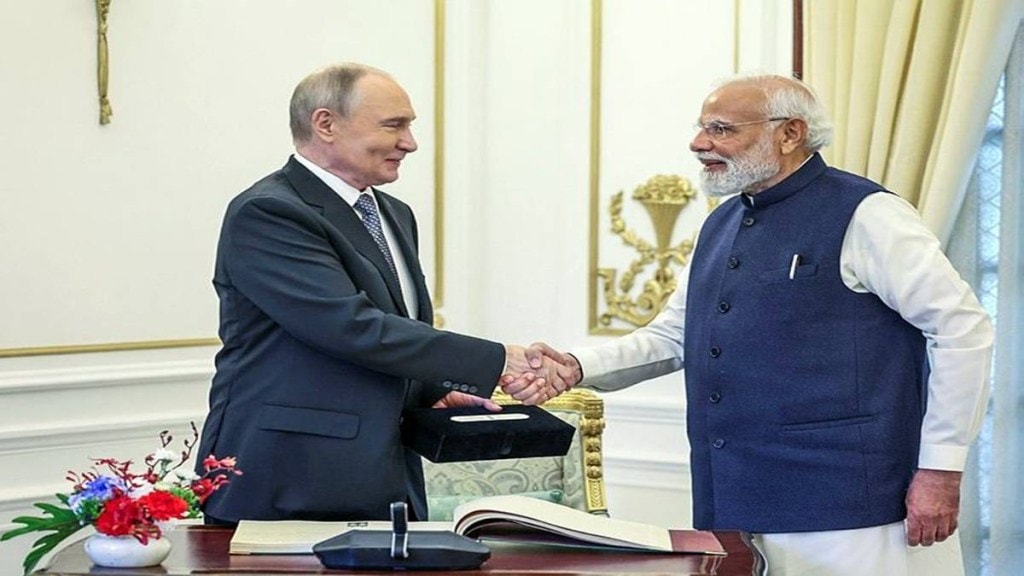
There is considerable international attention on Russian President Vladimir Putin’s first visit to India since the war in Ukraine began in 2022 for the 23rd bilateral summit. India’s time-tested ties with Russia have passed through a challenging period as it did not join western nations in condemning Russia’s invasion, while appealing for dialogue to end the conflict. India was slapped with punitive sanctions by US President Donald Trump for buying Russian oil to fund Putin’s war in Ukraine. But times are a-changing with the US intensifying efforts to broker peace between Moscow and Kyiv. New Delhi has much to gain if this initiative succeeds and US-Russian relations improve that will permit it to redefine its strategic ties with both powers.
India’s relations with Russia may not have the scope and depth of its alliance with the erstwhile Soviet Union, but they have stood the test of time. It has been 25 years since both nations signed a historic declaration on a strategic partnership and 15 years since it was elevated to a special and privileged strategic partnership. But this relationship has lacked ballast on the economic front—like the lop-sided trade, for instance—to realise the potential of this partnership. The vision 2030 economic cooperation agreement between India and Russia should enable a more contemporary engagement on the solid foundation of time-tested ties between the world’s fastest-growing $4-trillion economy and a $2.5-trillion economy that have much to offer each other.
To be sure, Putin also realises this imperative as he told a leading TV channel that “we have laid out an ambitious plan for our collaboration in key domains. The most critical areas are indeed forward-looking. I am referring specifically to high technology. Our partnership with India encompassed such fields as space exploration, energy (notably nuclear power, exemplified by the prominent Kudankulam Nuclear Power Plant project (KKNPP), shipbuilding, and aviation. There are many interesting areas for cooperation that are looking to the future. Take, for example, artificial intelligence. … These are the matters we will discuss”.
Trade imbalance with Russia remains India’s biggest challenge
However, urgent steps are most needed on trade as India’s exports are limited while it has imported a lot of Russian oil, taking bilateral trade to $68.7 billion and its deficit to $58.9 billion. With US sanctions on Russian oil, the targeted $100 billion in bilateral trade will not be possible without widening the trade basket through more Indian exports of pharmaceuticals, agriculture, and textiles, besides the smooth settlement of trade transactions in national currencies. A free trade agreement between India and the Eurasian Economic Union and connectivity initiatives like the International North-South Transport Corridor, and the Chennai-Vladivostok Eastern Maritime Corridor could boost trade. Indian skilled workers in IT, construction, and engineering can address the labour needs in Russia. A mobility agreement has been inked in this regard.
The showpiece of Russia’s partnership with India is nuclear power generation and defence. The flagship project is, of course, the 6,000 megawatt (Mw) KKNPP in Tamil Nadu, which will have six VVER-1000 (and possibly VVER-1200) nuclear reactors. KKNPP units 1 and 2 have been connected to the national grid in 2013 and 2016. Progress continues in other units. Both Russia and India confirmed their intention to broaden cooperation in nuclear energy, including fuel cycle and life cycle support for operating KKNPP.
Defence ties remain central to India-Russia cooperation
Defence is a big-ticket item for bilateral cooperation as India extensively uses Russian weaponry. While additional procurement of S-400 surface-to-air missiles is very much on the anvil, bilateral discussions continue for the Su 57 fifth-generation fighter jet. Even if there are no summit deliverables in this regard, the joint statement noted that the partnership is reorienting presently to joint research and development, and co-development and co-production of advanced defence technology and systems. These include the joint manufacturing of spare parts and components as both nations take forward a broad-based, time-tested engagement, including greater people-to-people contacts in the spirit of Druzhba-Dosti.
The writer is an economics and business commentator based in New Delhi