



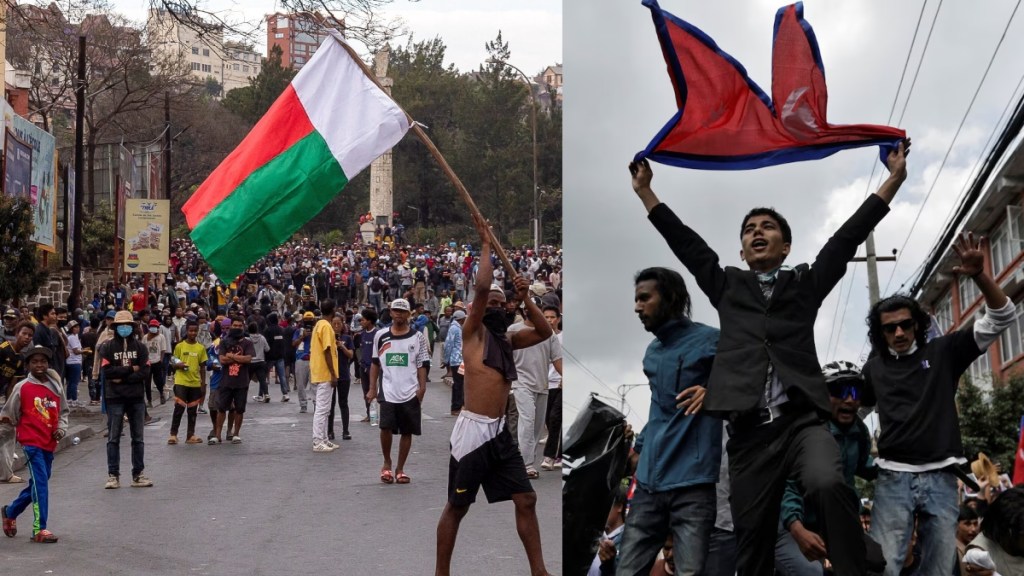
From brainrotting doomscrollers to disruptors reshaping political discourse worldwide, the Generation Z shed many a stereotype to acquire a powerful new identity in 2025. A passive, disengaged cohort emerged as a strong force capable of harnessing collective anger to demand accountability, and even topple governments.
From Bangladesh to Nepal to Madagascar, Timor Leste, Mexico, Indonesia, Sri Lanka, the political awakening, when it came, was a storm waiting to erupt. A generation of youngsters — woke, educated, aspirational – entered the adult world, not to opportunity and progress, but to face corruption, joblessness and despair. Witnessing privilege and divides of income and class, their fragmented frustrations crystallised into collective anger and spilled onto the streets. And, when a rage-baited Generation Z moved their attention beyond their personal devices, taking to the streets to storm the citadels of corruption, it surprised everyone. Maybe even themselves.
Armed with emblems inspired by pop culture such as Manga comics, their protests had import enough to rattle governments across Latin America, Asia and Africa – the latter two geographies having about 60% of the population as youth.
Asia was a hotbed, and the uprisings came to be labelled as the ‘Asian Spring’ — on the lines of the Arab Spring. The frame of youngsters hoisting flags atop demolished buildings in Nepal in September is one of 2025’s most compelling images. When the statistic of over 20% youth unemployment met a viral outrage over nepo babies’ privilege, it sparked off a rampage, leaving a toppled government amid the trail of destruction. Only in the hands of the Gen Z could Discord, a gaming and chat platform, become democracy, electing a prime minister through it.
Indonesia
Indonesia, with Asia’s third-largest unemployment rates, where the youth rose in anger against corruption and privilege and managed to bring the ruling powers to the dialogue table just weeks before Nepal erupted, was an inspiration. A Jolly Rogers flag was a direct adoption.
Sri Lanka
But then, Asia had led the charge much earlier – in Sri Lanka in 2022, where Prime Minister Mahinda Rajapaksa resigned and President Gotabaya Rajapaksa fled to safety as youth — angered over food scarcity and power cuts — took down entrenched elite and revelled in emptied palatial presidential quarters to prove their point. Bangladesh followed in 2024, where students united in anti-government protests over recruitment reforms, resulting in President Sheikh Hasina abandoning power and fleeing to India.
Madagascar
A similar story unfolded in Madagascar in September, where lack of basic amenities of water and power mobilised the youth to form the Gen Z Mada, short for Gen Z Madagascar, which, along with a customised Jolly Rogers flag, whipped up a frenzy that led to the ouster of President Andry Rajoelina.
Kenya, Peru, Mexico, Turkey, Morocco… all faced similar wrath over unrealised and out-of-reach dreams, where the traditional touch points of success — a job, house, stability – were unattainable.
Digital platforms served as force multipliers of a frustration that transcended boundaries, and at places like Nepal, their ban led to the anger just boiling over. Bred on smartphones, for a generation used to pouring its heart out on a keypad, denial of social media seemed a basic violation of rights, and proved to be a heavy price to pay for governments.
‘Rage farming’ — provocative, divisive, or offensive content that elicits anger and guarantees reaction – amplified the fury. Only, the anger was not manufactured or manipulated, but real, and a mobilising force.
Lessons learnt will include not to take the power of the digital lightly, nor the young fingers tapping it into a collective consciousness. Some like Zohran Mamdani, a millennial who rode on a wave of Gen Z support to secure the New York mayor’s election, apparently recognised the potential of a politically awakened cohort.
The year 2025 showed that no longer are the Gen Z disengaged or in withdrawal mode. The quiet quitters changed modus operandi to open revolt to effect change.
This calls for an embracing of an entire generation instead of alienation. It will bode well for political leaders to engage with the awakened youth, who have the power to shape global dynamics in the coming years.
For the Gen Z the world over, the resurgence of their mates in the Global South needs to be taken as a sign of untapped power, an opportunity that should not be lost to short attention spans, a momentum that should not be as transitory as a reel. Will the Zoomers lose steam to settle back into self-imposed cocoons, or marshall themselves into a force that says the Gen Z have arrived, and they are a story here to stay? 2026 will tell.