



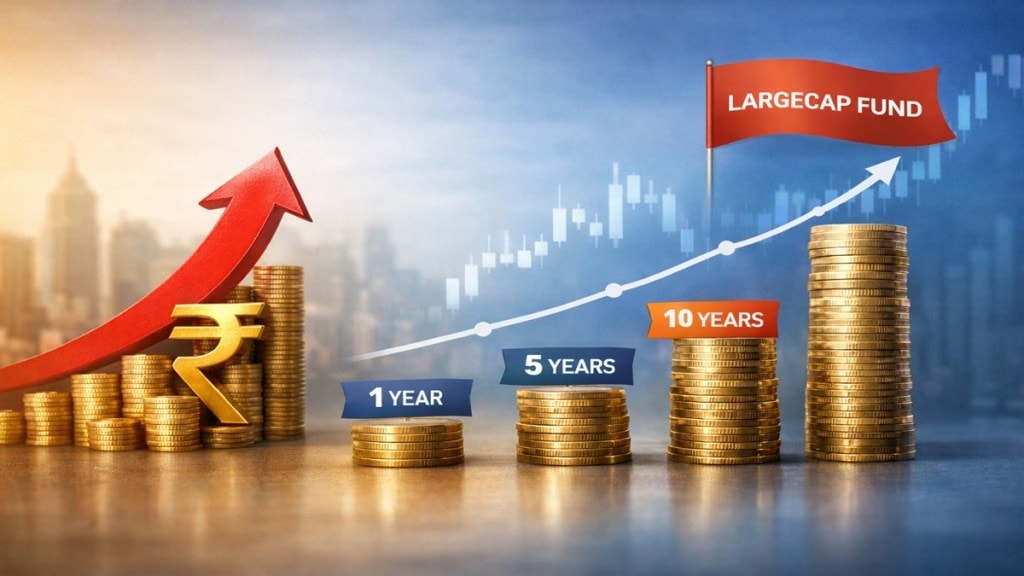
Best large-cap fund across short- and long timeframes: In a year when stock market volatility tested investors’ patience, one large-cap fund has quietly stood out. ICICI Prudential Large Cap Fund – Direct Plan – Growth has emerged as the only large-cap fund to consistently beat its benchmark, the Nifty 100 TRI, across 1-year, 5-year and 10-year timeframes, a rare achievement in the category.
A tough year for equities, but large caps held ground
The year 2025 has been far from smooth for equity investors. Sharp corrections in small-cap and mid-cap stocks led to heavy sell-offs, while large-cap stocks showed relatively better resilience.
Over the last one year, the Sensex and Nifty managed gains of around 8–10%, while broader indices told a mixed story. The Nifty 100 index delivered about 8%, even as the Nifty Smallcap 250 slipped nearly 7% and the Nifty Midcap 150 rose a modest 4–5%.
This divergence highlighted a familiar trend—during volatile phases, large-cap stocks tend to offer stability compared to smaller companies.
Large-cap funds underperformed the index, except one
Despite the resilience in large-cap stocks, the large-cap mutual fund category as a whole did not have a great year. The category delivered about 7% returns in one year, lagging behind the Nifty 100 TRI’s roughly 9% gain. More importantly, the category has underperformed its benchmark not just in one year, but also across 3-year, 5-year and 10-year periods.
Out of 31 large-cap funds analysed (Value Research data), only one fund broke this pattern.
ICICI Prudential Large Cap Fund delivered 10.35% in one year, outperforming both the benchmark and the category average. It also managed to stay ahead of the index over longer horizons, making it the sole fund in its category to do so consistently.
Consistent outperformance across timeframes
A closer look at performance numbers explains why the fund stands apart:
1 year:
Fund (Direct): 10.35%
Nifty 100 TRI: 9.02%
Large-cap category: 7.42%
3 years:
Fund: 18.50%
Nifty 100 TRI: 15.09%
Category: 15.69%
5 years:
Fund: 18.63%
Nifty 100 TRI: 15.56%
Category: 15.54%
10 years:
Fund: 15.72%
Nifty 100 TRI: 14.37%
Category: 15.54%
Note: Both direct and regular plans of the fund have managed to beat the benchmark across these periods, underlining the consistency of its strategy.
Size, costs and long track record
Launched on January 1, 2013, the fund has delivered 15.84% returns since inception. It tracks the Nifty 100 TRI as its benchmark and comes with an expense ratio of 0.84% for the direct plan. With an AUM of over Rs 78,000 crore (as of November 30, 2025), it is also the largest fund in the large-cap category, reflecting strong investor confidence.
Risk-adjusted performance adds comfort
While the fund falls under the Very High Risk category—as is the case with all equity funds—its risk metrics offer some reassurance:
Higher average returns than the benchmark indicate better long-term performance.
Lower volatility suggests smoother returns compared to the index.
Sharpe and Sortino ratios show that the fund has rewarded investors better for the risk taken, especially on the downside.
A beta of 0.89 means the fund tends to fall less than the market during corrections.
A positive alpha of 4.04 highlights effective fund management and stock selection.
Simply put, the fund has not only delivered returns but has done so with better risk control.
Portfolio built around market leaders
The fund’s portfolio reflects a clear large-cap bias. Financials form the biggest chunk, followed by energy, technology, consumer discretionary and industrials.
At the stock level, holdings such as HDFC Bank, ICICI Bank, Reliance Industries, L&T and Bharti Airtel anchor the portfolio—companies known for scale, balance-sheet strength and market leadership.
What investors should keep in mind
The fund’s performance across market cycles makes it a strong case study in large-cap investing, especially during volatile phases. However, investors must remember that past returns are only indicative. Market conditions change, and future performance may not mirror historical numbers. Before investing, it is important to consider investment horizon, risk appetite, asset allocation, expense ratio and overall financial goals, rather than relying only on returns.
Disclaimer: The above content is for informational purposes only. Mutual Fund investments are subject to market risks. Please consult your financial advisor before investing.