



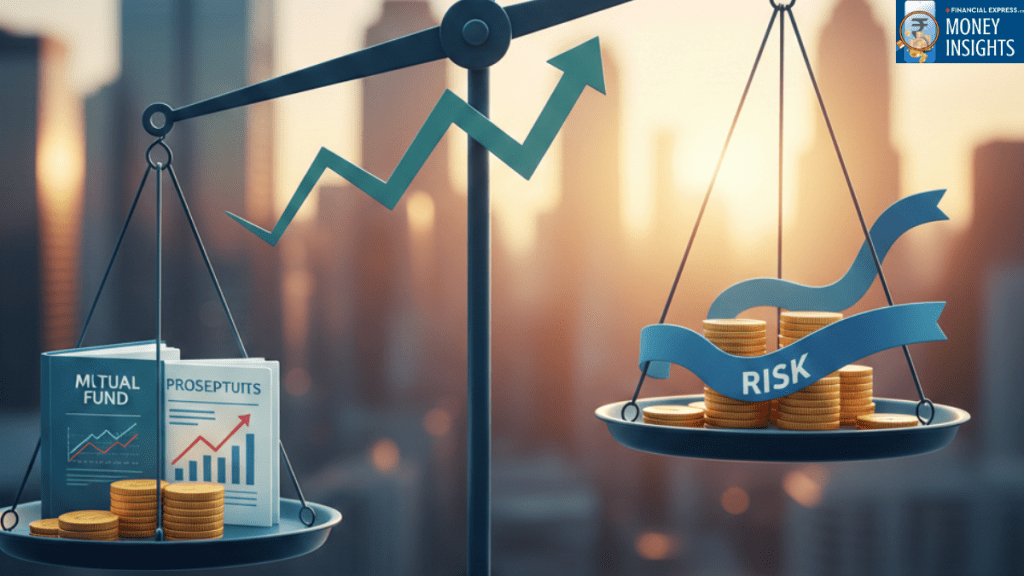
When you begin exploring mutual funds, returns usually take center stage. They are the first numbers you notice, and the ones most advertisements draw your attention toward.
Yet, as you look closer, you realise that the returns alone rarely explain how a fund truly behaves.
Every fund generates its performance by taking on some level of risk, and the way that risk is managed can differ widely across categories and even within the same category. You might find a fund that delivers impressive gains during good markets but struggles whenever volatility rises.
Another may grow at a steadier pace, giving you a clearer sense of what to expect. As you compare, it becomes evident that understanding the relationship between risk and return is just as important as the return itself. This is where risk-adjusted performance becomes relevant.
It helps to look beyond the headline number and see whether a fund is compensating you fairly for the risk it carries. Instead of relying on assumptions like “higher risk means higher return,” you begin to evaluate whether the risk a fund takes is actually adding value.
To clarify your decision-making, the Sharpe Ratio is useful. It offers a simple way to judge how well a fund has balanced risk and reward, helping you choose schemes that better align with how you want to grow your money over time.
Meaning of Sharpe Ratio
Developed by Economist William F. Sharpe (1966), the Sharpe Ratio tells you how much return a mutual fund has generated for the amount of risk it has taken.
In simple terms, it helps you understand whether a fund’s performance is driven by the fund manager’s skill and smart investing, or by higher risk-taking.
Think of it this way: two funds may show the same return, but one may have taken incremental risk (volatility) to get there. The Sharpe Ratio helps you see that difference.
A higher ratio suggests the fund has managed risk more effectively and delivered returns more steadily.
On the other hand, a lower ratio indicates that the fund has taken more risk and is more volatile, and the rewards (return) for taking that risk may not have been very strong.
Why does this matter? As an investor, you are not only looking for returns. You want returns that come with reasonable volatility.
The Sharpe Ratio brings that balance into focus. It gives you a more complete picture of how a fund has performed, especially when you are comparing similar schemes.
How to Calculate Share Ratio
To understand how the Sharpe Ratio works, it helps to look at its basic calculation. The ratio compares a fund’s excess return to its volatility.
In simple terms, it measures how much additional return the fund has earned over the risk-free rate for every unit of risk taken.
Sharpe Ratio = (Fund Return – Risk-Free Return) ÷ Standard Deviation of the Fund
In the formula, the 10-year G-sec yield is typically used as a proxy for risk-free returns.
On the other hand, the standard deviation is a measure of volatility, i.e., how much the fund’s returns move around over time. If the ups and downs are large, the standard deviation will be higher; if the returns stay more stable, it will be lower.
When you subtract the risk-free rate from the fund’s return, you get the fund’s excess return.
Dividing this by the standard deviation (its volatility) tells you how much return the fund delivers for every unit of risk it takes.
| What is Considered a Good Sharpe Ratio | ||
| Sharpe Ratio | Risk-Adjusted Return Quality | Verdict |
| Less than 1.00 | Very Low | Poor |
| 1.00-1.99 | High | Good |
| 2.00-2.99 | High | Good |
| 3.00 or Above | High | Excellent |
Source: Equitymaster
A higher number suggests better risk-adjusted performance, while a lower number indicates that the fund may not be compensating you adequately for the uncertainty involved.
Why is the Sharpe ratio Important?
The Sharpe ratio plays a central role in evaluating how effectively a mutual fund balances risk and return.
- Helps Compare Similar Mutual Funds: The Sharpe ratio lets you evaluate which fund has delivered better returns for the risk it has taken on. This makes comparisons meaningful than looking at returns alone.
- Highlights Performance Consistency: A higher ratio indicates steadier returns over time, helping you identify funds that manage volatility more effectively.
- Shows Whether the Fund is Taking Justified Risk: It helps you understand if the extra return a fund delivers is worth the level of uncertainty involved.
- Supports Better Portfolio Construction: By focusing on risk-adjusted returns, the ratio helps you choose funds that align with your risk tolerance and long-term goals.
- Useful for Monitoring Performance over Time: Changes in the Sharpe ratio indicate whether a fund’s risk-taking behaviour or performance quality is improving or deteriorating.
Limitations of the Sharpe Ratio
While the Sharpe Ratio is a helpful guide for comparing mutual funds, it also comes with limitations that you should keep in mind while making decisions.
- Assumes Normal Distribution of Returns: It assumes returns follow a normal distribution, even though markets are volatile. Periods of sharp rallies or sudden corrections fall outside this assumption. This can distort the true nature of risk in real-world investing.
- Historical Bias: A high Sharpe ratio reflects past behaviour. It may not hold if market conditions or the fund’s strategy change.
- Treats all Volatility as Negative: It treats positive and negative movements the same, which can make a strong-performing fund appear more volatile than it actually is.
- Sensitive to the Risk-Free Rate: Different analysts may use different risk-free benchmarks, leading to inconsistent comparisons.
- Misleading for Low-Volatility Funds: A small change in return can cause the ratio to swing sharply, giving a distorted picture of performance.
- Not Ideal Across Categories: Using it to compare, say, a large-cap fund with a small-cap or sectoral fund can lead to unfair conclusions because their inherent risk levels differ.
- Ignores Concentration and Liquidity Risk: The ratio focuses only on price-based volatility and misses risks such as liquidity and concentration risk.
- Does not reflect management or strategy: A fund with a high Sharpe ratio may have achieved that under a previous manager or a different approach.
These limitations make the Sharpe ratio a useful supporting metric rather than a standalone decision-making tool.
Conclusion
The Sharpe ratio ultimately gives you a clearer lens through which to evaluate mutual funds.
It helps you look past headline returns and understand whether a fund is truly rewarding you for the level of risk it takes.
While it is a valuable measure of risk-adjusted performance, it works best when used alongside other indicators, like portfolio quality, consistency, fund strategy, and long-term behaviour across market cycles.
When you view the ratio in this broader context, it becomes a practical guide that supports more informed and confident investment decisions.
Happy investing.
Disclaimer: This article is for information purposes only. It is not a stock recommendation and should not be treated as such. Learn more about our recommendation services here…
The website managers, its employee(s), and contributors/writers/authors of articles have or may have an outstanding buy or sell position or holding in the securities, options on securities or other related investments of issuers and/or companies discussed therein. The content of the articles and the interpretation of data are solely the personal views of the contributors/ writers/authors. Investors must make their own investment decisions based on their specific objectives, resources and only after consulting such independent advisors as may be necessary