



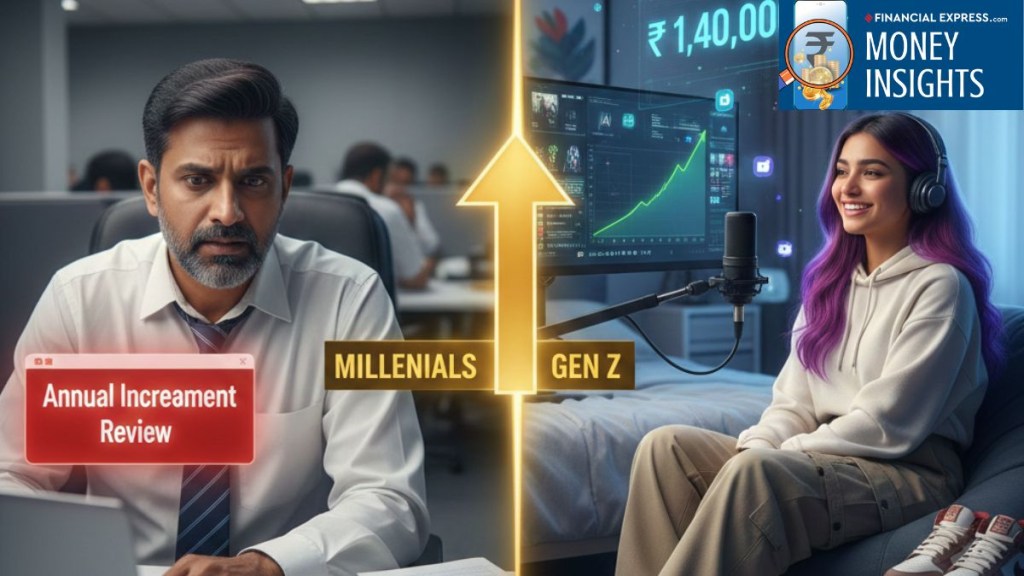
As someone in his early 40s, the first time I read on a reddit thread that 27-year-old Samay Raina, a comedian hailing from Kashmir, has a networth of over Rs 140 cr, I almost choked on my coffee. Now I know Samay personally and have seen him slog it at open mics and other shows for years, before he finally became fodder for media. His recent show in Delhi alone amassed around Rs 40 cr in ticket sales. As a millennial, the figure is too huge not to shock an average Millennial.
This while most millennials in their late 30s or early 40s are still waiting for their “annual increment” that barely beats inflation.
How GenZ is showing how it is done
Welcome to 2025, where Gen-Z has quietly built parallel economies that are making Millennials question every life choice they made in their early years. Because the numbers are brutal. According to Intuit’s and Glassdoor’s 2024 surveys, over 50% of Gen-Z in India (born 1997-2012) already have atleast 1 side gig.
And they are probably earning more than what many Indian millennials currently take home as salary after years of “experience.” A recently released comprehensive guide by Shine states that the median salary for someone with 3-5 years of experience in India is between 6 lacs and 15 lacs. While somewhere a 21-year-old with a decent following is out-earning this number without ever wearing formal shoes, mostly from his air-conditioned bedroom.
So, what exactly are these side gigs that are minting teenage and twenty-something millionaires while the rest of us refresh LinkedIn for the nth time today? Here are four hustles that have completely broken the old rules of money in India.
The Creator 2.0: Earning crores from tier 2 cities
The most visible one is the creator economy 2.0. This is no longer just about dance reels on Instagram. The top Indian creators on YouTube, Instagram and Twitch are pulling in numbers that would embarrass a mid-size start-up. As per a KPMG study, the creator economy India is worth an estimated $2.5 billion in 2025 and is projected to exceed $5 billion by 2027.
Names like CarryMinati (Rs 20 cr – 52 cr in 2024), Technical Guruji (Rs 18 cr – 48 cr) and Bhuvan Bam (Rs 2 cr – 10 cr crore) are public knowledge, but the real explosion is happening one tier below.
Creators from Tier 2 and Tier 3 cities are leading from the front. The Tribune quoted a Boston Consulting Group (BCG) report, that stated up to 2.5 million content creators are already influencing $300-$400 bn in consumer spending. A number that is expected to cross $1 tn by 2030.
Platforms like ShareChat and Moj state that about 80% of their creators hail from non-metro cities. A combination of cheap smartphones, accessible internet, and a spike of interest in localized language content, Tier 2 and Tier 3 cities are fast turning out to be the epicenter of India’s digital content creation.
The Flip: How sneakers became an asset class
Second on the list is something that is quietly printing money for GenZ. The sneaker and luxury resale space. Platforms like StockX, Mainstreet, Hyploot and even Instagram DMs have turned Gen-Z into professional flippers. The Sneakers market size could reach $128 billion by 2030 according to Grandviewresearch.
In India, limited-edition drops from Nike, Adidas Yeezy archives and Travis Scott collabs routinely sell out in seconds, only to reappear on resale at 300-600% markups. 25-year-old Vedant Lamba from Delhi, started a YouTube channel in 2017 when he wasn’t even 18. He then turned it into a full-fledged business and clocked Rs 24 cr in revenue in FY23 and Rs 30 cr in FY24.
Some reports quote that sneaker reselling is a $6bn large industry globally, growing at a CAGR of 11%.
And it’s not only about sneakers. Premium Footwear, watches, gym apparel etc are also seeing big growth. Adidas and Myntra have seen a 30-40% increase in premium options on their website, reflecting this trend. India’s large population aspiring for better products and a natural consumer behaviour of constantly seeking improvement are driving this trend.
The AI Hustle: Coding without knowing code
This one is the darkest horse, AI prompting and micro-SaaS. While Millennials were busy learning Python the hard way, Gen-Z skipped the coding bootcamps entirely and jumped straight to building thousands of dollars a month micro-tools using no-code + GPT wrappers.
Some Indian creators under 25 publicly crossed $100K ARR (Rs 90 lakh annual recurring revenue) in 2024 with tools that do ridiculously specific things. Like auto-generating Hinglish rap lyrics, turning LinkedIn posts into 30-second reels, or creating entire Notion templates for UPSC aspirants. Take Bhanu Teja. While others were fighting for internships, he built ‘SiteGPT’, an AI customer support tool as a solo developer. He hit Rs 1 cr in annual recurring revenue (ARR) working alone from his room, with profit margins that would make a traditional IT services company run for cover.
The Personal Brand: Monetising trust at 22
This is perhaps the most soul-crushing for Millennials… Building personal brands that become holding companies before they turn 23. The blueprint is brutally simple and public. Start a Twitter/X account giving advice on money, fitness, relationships or even ‘How to become a creator.” Grow to 100K followers in 12-18 months by being correct, controversially or otherwise. Launch a cohort course and Sell 3,000 seats at about Rs 5,000. Make crores over the weekend. Repeat every 90 days with a new topic.
Many Indians under 25 crossed Rs 10 crore in total revenue in 2024 using a similar playbook. Look at Sharan Hegde. Starting as a creator making finance reels, he converted his audience into ‘The 1% Club’, an ed-tech community that hit an annualized revenue of Rs 60 Crore in 2024. He didn’t just sell a course; he built a fintech startup on the back of Instagram views. He turned 30 last July just to put things in context.
It’s GenZ v/s Millennials – And Millennials are losing
Here’s what hurts the most when you’re on the wrong side of 30. None of these paths required a degree, GATE score, campus placement, or even showing up to an office. They required speed, audience capture, and a stomach for public failure. Gen-Z grew up watching Mr Beast turn ridiculousness into a science. They treat social media the way we treated campus placements: as the single most important thing that will decide the next decade of their life. And they’re winning.
No wonder many Indian Millennials feel anxious or depressed when they see younger people becoming financially independent faster than them. I know many fellow millennials who now believe that traditional career paths are dead. For the first time in modern Indian history, the younger cohort isn’t just earning more in absolute terms, but they are also earning more in their spare time than the older cohort earns from their full-time jobs.
So, the next time you hear a 22-year-old say he’s “busy”, understand that he might genuinely be closing a Rs 40 lakh brand deal while sitting on the pot. And the next time you feel that familiar pang of “I should have started earlier,” remember that the game isn’t over. It’s just that the rules were rewritten while we were busy waiting for that promotion e-mail.
GenZ isn’t just alright. They’re rich. And they did it before most of us managed to clear our home loans.
Disclaimer:
The purpose of this article is only to share interesting charts, data points, and thought-provoking opinions. It is NOT a recommendation. If you wish to consider an investment, you are strongly advised to consult your advisor. This article is strictly for educative purposes only.
Suhel Khan has been a passionate follower of the markets for over a decade. During this period, he was an integral part of a leading Equity Research organisation based in Mumbai as the Head of Sales & Marketing. Presently, he is spending most of his time dissecting the investments and strategies of the Super Investors of India.
Disclosure: The writer and his dependents do not hold the stocks/securities/funds discussed in this article.
The website managers, its employee(s), and contributors/writers/authors of articles have or may have an outstanding buy or sell position or holding in the securities, options on securities or other related investments of issuers and/or companies discussed therein. The content of the articles and the interpretation of data are solely the personal views of the contributors/ writers/authors. Investors must make their own investment decisions based on their specific objectives, resources and only after consulting such independent advisors as may be necessary.