



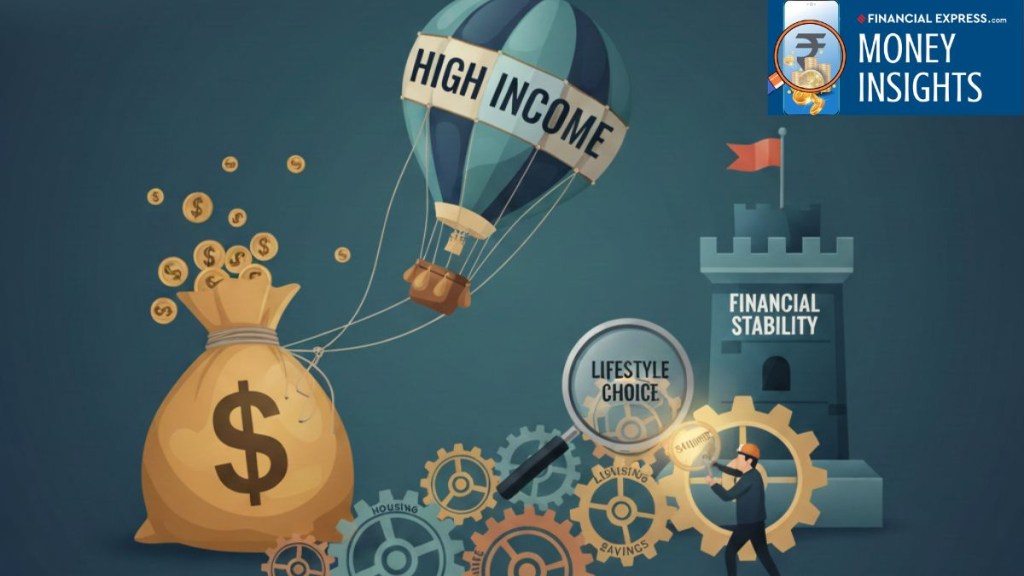
You earn ₹2 lakh a month. On paper that income suggests comfort and progress. But in reality, money still feels tight. You continue to put off investing and suffer from persistent anxiety. Salary day provides relief but not confidence. Within days of the salary being credited, the sense of control fades. Because all your money is going to EMIs that once felt really small.
This contradiction is not accidental. It is the result of a financial life built around convenience and appearance rather than resilience. High income hides a weak structure. As long as income keeps flowing, the system holds. But as soon as you think about what will happen if you lose your job, you start to freak out.
This pattern is common among professionals whose income grew faster than their financial decision-making.
How the lifestyle trap takes shape
The lifestyle trap does not arrive as a crisis; it forms subtly. Each upgrade feels justified. Each EMI feels small compared to income. Credit can temporarily remove friction and urgency from decisions that deserve both.
Over time, income stops representing freedom and starts representing obligation. Housing costs, vehicle payments, credit cards, subscriptions, and convenience spending consume large portions of monthly cash flow before choices are made.
None of this feels irresponsible in isolation. Together, it creates rigidity. You stop designing your financial life and start maintaining it. The goal quietly shifts from building stability to keeping everything running without disruption.
From the outside, the lifestyle looks successful. Internally, you know it depends on everything continuing exactly as it is.
The self-assessment most people avoid
Here’s what you need to ask yourself if you want to get out of this lifestyle trap:
- How much of your monthly income is already committed before the month begins?
- If your income stopped for three months, which payments would immediately cause strain?
- How many of your expenses exist only because credit makes them possible?
- Are you consistently building reserves, or are you mainly servicing obligations and hoping nothing goes wrong?
If these questions make you uncomfortable, that reaction matters. It indicates that your financial life depends on continuity rather than resilience. At this point, all your income levels say is that you can maintain your lifestyle as long as it is recurring. Often, people blame inflation, taxes, city living, and family duties for their issues. They often overlook their own relationship with money.
The emotional cost of earning well but feeling stuck
Financial fragility at a high income creates a specific kind of stress. It is not panic. It is vigilance. You track expenses mentally. You avoid surprises. You hesitate to take professional risks because income stability feels non-negotiable.
This stress is compounded by silence. High earners are not expected to struggle, and admitting discomfort feels embarrassing. So the pressure remains internal and unresolved.
Over time, this erodes confidence. You feel behind despite earning well. You delay long-term decisions. You continue selective upgrades because stepping down feels like admitting failure.
The correction requires a fundamental shift in thinking
Correction does not begin with apps, budgets, or investment products. It begins by changing how you define affordability.
Currently, affordability is judged by whether an expense fits into the monthly cash flow. EMIs encourage this thinking by breaking long-term commitments into small amounts. The long-term cost disappears from view.
An expense is affordable only if it does not weaken your safety, flexibility, or future choices. Income does not change this rule; only the surplus you build does. This shift is uncomfortable because it forces you to stop treating future income as if it were guaranteed. Even solid careers are precarious; true stability comes from the margins, not hope.
Why shrinking habits feels like a threat
Reducing lifestyle habits feels emotionally difficult because many of them are tied to your identity. They signal progress and validate effort. Letting go feels like admitting that some choices were driven by comfort rather than foresight.
The correction requires separating enjoyment from entitlement. Enjoyment improves life and can exist within limits. Entitlement assumes future income will always cover present decisions. When entitlement drives spending, every raise becomes a permanent obligation.
The goal is not to remove pleasure. It is to remove the excess that drains long-term commitment without delivering long-term value.
Restoring flexibility by reducing rigidity
Shrinking excess is not about discipline for its own sake. It is about restoring flexibility. Every fixed expense you reduce can increase your ability to absorb shocks without panic.
Recurring expenses deserve special scrutiny because they create rigidity. Individually, they feel harmless. Collectively, they lock your lifestyle into a narrow range that depends on uninterrupted income.
High earners often underestimate this risk because income hides fragility. Correction forces you to build margins that exist even when conditions are imperfect.
Why fixing leaks must come before building wealth
Many people attempt correction by jumping straight into investing. This often fails because cash flow remains constrained. Investments are paused, redeemed, or abandoned when pressure builds.
Effective correction follows a different order. First, reduce fixed commitments so that the monthly income produces a genuine surplus. Second, build liquidity so disruptions can be handled calmly. Only then does long-term investing become sustainable.
This sequence works because it aligns behaviour with reality. When surplus is real, consistency becomes easier, and discipline requires less effort.
Redefining success as an adult
The most difficult correction is psychological. Early success is visible and consumable. Financial adulthood demands a quieter definition.
Success becomes the ability to handle disruption without fear. It becomes the freedom to change direction without financial panic. It becomes confidence that your lifestyle does not collapse under stress.
This version of success attracts less validation. It feels slow at first. Over time, it delivers something far more valuable than appearances. Control.
The reality you need to sit with
Earning ₹2 lakh a month and being broke is not a failure of income. It is a failure of intent. Your money has the job of maintaining a version of life, not building one.
The moment you decide that growth matters more than upkeep, the equation changes. Not overnight, and not without discomfort, but decisively. This story feels familiar because it is not a personal failure, but rather a very modern one. And it is fixable, but only when you stop pretending that income alone will rescue you.
Chinmayee P Kumar is a finance-focused content professional with a sharp eye for investor communication and storytelling. She specializes in simplifying complex investment topics across equity research, personal finance, and wealth management for a diverse audience from first-time investors to seasoned market participants.
Disclaimer: The purpose of this article is only to share interesting charts, data points, and thought-provoking opinions. It is not a recommendation. If you wish to consider an investment, you are strongly advised to consult your advisor. This article is strictly for educational purposes only.