



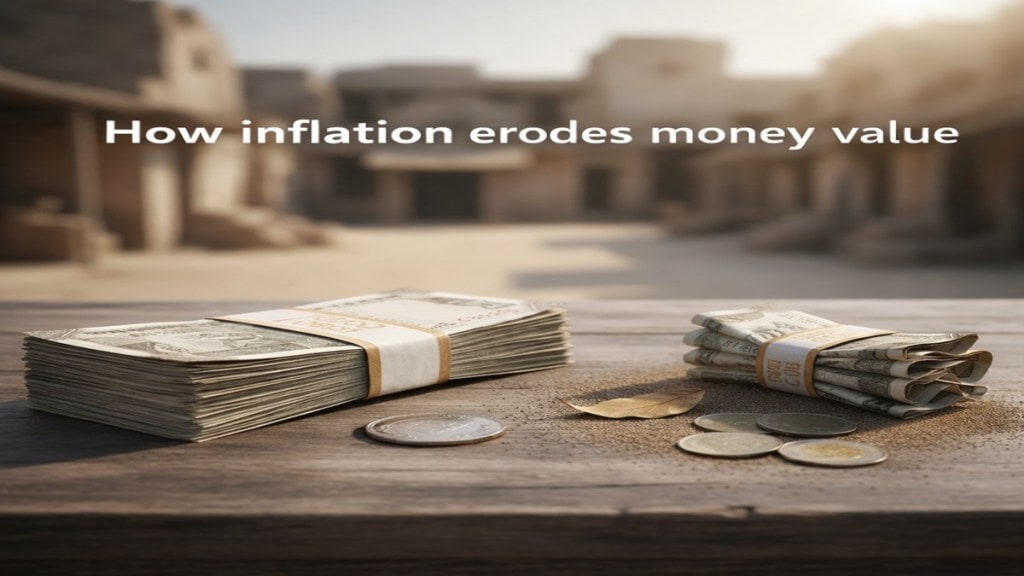
For most Indians, Rs 1 crore still feels like a life-changing amount of money. The word ‘crore’ itself carries weight, shaped by years of hearing it in normal conversations and success stories. That’s why many people assume that accumulating Rs 1 crore by retirement will automatically ensure financial comfort.
But this assumption often ignores one uncomfortable reality — the value of money does not remain constant. Over time, inflation steadily erodes purchasing power, meaning the same Rs 1 crore will buy far less in the future than it does today.
A familiar example that explains inflation best
A decade ago, Rs 1 crore was enough to buy a spacious 4-BHK flat in a good society in Noida. Today, that very same apartment would cost well over Rs 2 crore. The flat size hasn’t changed, the location hasn’t changed. What has changed is the value of money.
This gap neatly captures how inflation works in real life.
What inflation actually means for your money
Inflation refers to the gradual rise in prices of goods and services over time. As prices increase, every rupee you hold loses some of its buying power. In India, inflation is measured using the Consumer Price Index (CPI), which tracks the cost of everyday items such as food, housing, healthcare, education and transport.
Over the last decade, India’s inflation has largely stayed within the Reserve Bank of India’s comfort zone of 4–6 percent, with sharp but temporary spikes during the pandemic and global supply disruptions. While these numbers may look modest on paper, their long-term impact is anything but small.
So what happens to Rs 1 crore over 10 years?
Assume inflation averages 5 percent annually — a realistic assumption for India.
At that rate, Rs 1 crore today will have the purchasing power of just about Rs 61.37 lakh after 10 years. Looked at another way, anything that costs Rs 1 crore today will cost roughly Rs 1.62 crore a decade later.
This is why money that looks adequate today may feel insufficient tomorrow.
Why this matters for retirement planning
Consider a common situation. You are 50 years old and plan to retire at 60. You believe that a retirement corpus of Rs 1 crore will be sufficient because, at present, that amount seems capable of funding a house purchase, your child’s education or marriage, medical needs and a comfortable lifestyle.
However, by the time you retire, the same Rs 1 crore will no longer stretch as far. Everyday expenses would have risen, healthcare would be significantly costlier, and large life goals would demand much more money than they do today. Without adjusting for inflation, retirement planning becomes dangerously misleading.
Inflation’s quiet impact on daily life
Inflation doesn’t only affect large purchases like homes. It quietly reshapes routine expenses too. Healthcare bills that look manageable today can double over a decade. Higher education costs, especially overseas, rise even faster than general inflation. Household expenses, domestic help, insurance premiums and travel costs all creep up year after year.
The danger lies in the fact that inflation works silently. You don’t feel it in one year, but over 10 or 20 years, it can fundamentally change your standard of living.
Why saving alone is no longer enough
Many people still rely heavily on savings accounts or traditional fixed deposits. While these options offer safety, their returns often struggle to keep pace with inflation. When returns fail to beat inflation, money may appear to grow in absolute terms but actually shrinks in real value.
This is where investing becomes essential.
Investments that help beat inflation over time
For Indian investors, several long-term investment options have historically delivered returns higher than inflation.
Equity mutual funds, including index funds and flexi-cap funds, benefit from India’s economic growth and have the potential to generate inflation-beating returns over long periods.
The National Pension System (NPS) combines equity exposure with tax efficiency, making it a strong retirement-focused option.
Hybrid funds offer a balance between growth and stability, while gold continues to play a supporting role as a hedge during periods of high inflation or uncertainty. The key is not to avoid risk entirely, but to take measured, long-term risk that allows wealth to grow faster than prices.
The real takeaway
The biggest mistake investors make is planning for a round number instead of planning for purchasing power. Rs 1 crore may sound impressive today, but what truly matters is what that money can buy when you actually need it.
Inflation is unavoidable, but its impact can be managed. The sooner investors factor inflation into their goals and align their investments accordingly, the better their chances of preserving both wealth and lifestyle in the years ahead.