



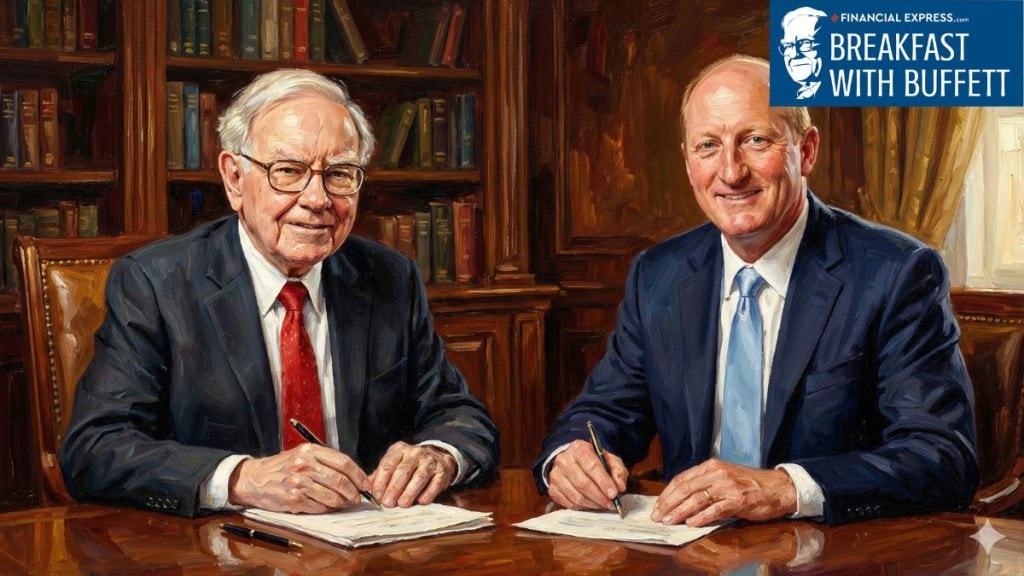
As the sun sets on the legendary 60-year tenure of Warren Buffett at Berkshire Hathaway, the global financial community is focused on one man: Greg Abel. At the annual “Woodstock for Capitalists” in Omaha on May 3, 2025, Buffett formally requested that the board appoint Abel as CEO by year-end. That was the start of what investors across the globe called the “Post-Buffett Era.”
The $1.1 Trillion Handover
Replacing the “Oracle of Omaha”, a man who delivered a staggering 4,384,748% return since 1965, is often described as the ultimate poisoned chalice. However, Greg Abel is no stranger to the Berkshire machinery. Having been the heir apparent since a 2021 slip of the tongue by the late Charlie Munger, Abel has been meticulously prepared for this $1.1 trillion transition.
Here are the five critical dimensions of Greg Abel that will define the future of Berkshire Hathaway, as he dons his new hat on the 1st of January 2026.
#1 The Accountant’s Ledger: Precision over Poetry
Warren Buffett’s career was backed by strong investment partnerships and stock picking. However, his chosen successor, Greg Abel is a trained accountant. Born in Edmonton, Alberta, in 1962, Abel earned his commerce degree from the University of Alberta in 1984 before joining PricewaterhouseCoopers (PwC).
This background in auditing and accounting is foundational to his leadership style. While Buffett is known for his silver-tongued advice and catchy analogies, Abel’s pragmatism is evidenced by his 20-year oversight of Berkshire Hathaway energy (BHE), where he grew pre-tax earnings to account much higher percentages of Berkshire’s total. This forensic approach to balance sheets has made him one of the most efficient capital allocators in the energy sector over the last two decades.
#2 The Power Play: Scaling Berkshire Hathaway Energy
Abel’s rise within the conglomerate is inextricably linked to the success of Berkshire Hathaway Energy. He joined the fold in 2000 when Berkshire acquired MidAmerican Energy, a company he had been running. Under his leadership, BHE transformed from a regional utility into a global energy powerhouse, now accounting for approximately 8% of Berkshire’s total revenue and pretax earnings.
Abel spearheaded massive, multi-billion dollar acquisitions that define BHE today:
- PacifiCorp in 2005.
- NV Energy for $5.6 billion in 2013.
- Dominion Energy’s pipeline business for $4 billion in 2020.
- AltaLink for $2.7 billion.
His ability to deploy offensive capital while maintaining a defensive buffer of resilient cash flows is what initially won Buffett’s absolute trust.
#3 Operational Rigor: Moving Toward Active Management
While the Berkshire Culture is famously decentralized allowing managers of subsidiaries like GEICO or See’s Candies to operate with near-total autonomy, Abel is expected to bring a tighter grip to the conglomerate.
Buffett has historically been a passive owner, only intervening in the event of a crisis or a massive capital allocation decision. In contrast, Abel has signalled he will be more active and hands-on. As the Vice Chair of Non-Insurance Operations since 2018, he already oversees more than 90 companies with 250,000 employees and $150 billion in sales. Investors expect Abel to modernize Berkshire’s legacy businesses, potentially using his trusted lieutenants to balance continuity with fresh operational rigor.
#4 The $334 Billion Dilemma: Hunting for “Elephants”
The most daunting task facing Abel is the sheer size of Berkshire’s war chest. As per latest reports, Berkshire held a record $380 billion in cash and short-term investments.
In his later years, Buffett famously struggled to find “elephants” – massive acquisitions that could move the needle for a trillion-dollar company. Abel will now have the final say on all major investment decisions, including the public stock portfolio.
While he is committed to Buffett’s value investing paradigm, recent moves into tech giants like Alphabet and Amazon, positions previously unthinkable for Berkshire, suggest Abel and “his” fund managers perhaps may be more willing to embrace the technology and renewable energy sectors than Buffett.
#5 Culture Post-Buffett: Substance Over Showmanship
Perhaps the most significant difference between the two leaders is their public persona. Warren Buffett is an icon for investors across the globe, a friendly philosopher who made annual meetings the big media wonders that they were. Greg Abel on the other hand is currently a blank slate to the average investor.
Abel stays away from the spotlight as he prefers focusing on fundamentals over media appearances. And was exactly this lack of showmanship that Charlie Munger admired. Munger, in fact, once famously said, “Greg will keep the culture”. Abel’s commitment is not to the cult of personality but to the unusual ability to retain earnings and reinvest them into high-quality businesses. Which is the very engine that built Berkshire.
A Legacy of Continuity, Not Carbon Copies
As Berkshire Hathaway pivots from the era of “The Oracle” to the era of “The Operator,” investors must recalibrate their expectations. The fundamental question is no longer whether Greg Abel can be Warren Buffett. He cannot, nor does he intend to, but whether the machine Buffett built can function without its chief philosopher.
Abel’s primary challenge will be the weight of success. Managing a $1.1 trillion giant requires a rare blend of extreme patience and the ability to strike with surgical precision when a $50 billion opportunity finally emerges.
While Abel lacks Buffett’s public charisma, his track record at BHE suggests a man who is comfortable navigating the complex intersection of heavy industry, regulation, and massive capital deployment.
For the retail investor, the era without Buffett at the helm represents a shift toward transparency and operational efficiency. The culture at Berkshire Hathaway will be still that of decentralized autonomy, but with Abel’s auditor’s eye now leading, the margin for error in subsidiary performance might just shrink.
Disclaimer:
The purpose of this article is only to share interesting charts, data points, and thought-provoking opinions. It is NOT a recommendation. If you wish to consider an investment, you are strongly advised to consult your advisor. This article is strictly for educative purposes only.
Suhel Khan has been a passionate follower of the markets for over a decade. During this period, he was an integral part of a leading Equity Research organisation based in Mumbai as the Head of Sales & Marketing. Presently, he is spending most of his time dissecting the investments and strategies of the Super Investors of India.
Disclosure: The writer and his dependents do not hold the stocks/securities/funds discussed in this article.
The website managers, its employee(s), and contributors/writers/authors of articles have or may have an outstanding buy or sell position or holding in the securities, options on securities or other related investments of issuers and/or companies discussed therein. The content of the articles and the interpretation of data are solely the personal views of the contributors/ writers/authors. Investors must make their own investment decisions based on their specific objectives, resources and only after consulting such independent advisors as may be necessary.