



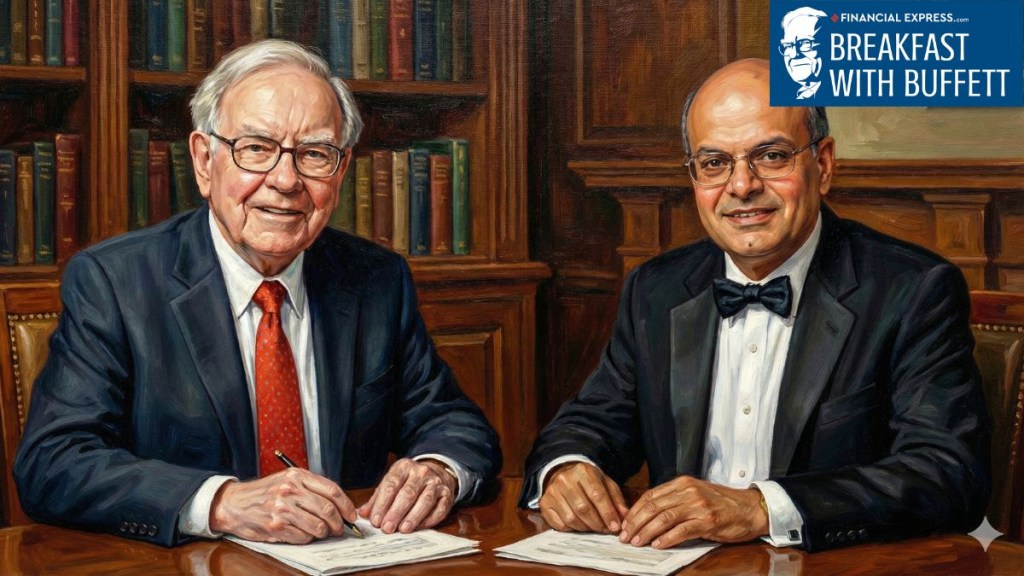
On a sleepy Saturday morning in 1986, a young man of Indian descent walked into the modest headquarters of Berkshire Hathaway in Omaha. He had no experience in the insurance industry. He didn’t even have a background in finance. Yet, by the end of that afternoon, Warren Buffett had handed him the keys to the company’s struggling reinsurance business.
That man was Ajit Jain. Today, as Berkshire Hathaway prepares for a future without its legendary founder, Jain stands as one of the twin pillars supporting the $1 trillion empire. While Greg Abel oversees the vast non-insurance operations, Jain remains the master of the “float”, the massive pool of capital that has fuelled Buffett’s greatest investments for nearly four decades.
From Odisha to Omaha: The Engineer Who Reimagined Risk
Born on July 23, 1951, in the coastal state of Odisha, India, Ajit Jain’s journey to the pinnacle of American capitalism was anything but conventional. He graduated from the Indian Institute of Technology (IIT) Kharagpur in 1972 with a degree in engineering, a background that honed the mathematical precision he would later apply to global risks.
His early career saw him as a salesman for IBM in India, where he was named “Rookie of the Year.” However, when IBM exited the Indian market in 1976 due to regulatory changes, Jain moved to the United States. He earned an MBA from Harvard Business School and spent several years at McKinsey & Co. It was through a former McKinsey colleague, Michael Goldberg, that Jain was introduced to Buffett.
The Saturday Meeting That Changed Berkshire Forever
When Jain joined Berkshire, the reinsurance division was a fledgling, often chaotic operation. Buffett, however, saw something in the engineer’s mind that others missed: an uncanny ability to price “super-cat” risks, massive once-in-a-century disasters that no other insurer would touch.
Buffett’s admiration for Jain is legendary. He famously told shareholders, “If Charlie, I, and Ajit are ever in a sinking boat and you can only save one of us, swim to Ajit.” This wasn’t something he just said. Buffett recognized that while he was a great capital allocator, Jain was the engine producing the capital. By 2024, Jain’s operations had generated over $100 billion in value for Berkshire shareholders, transforming the “float” from a few hundred million to nearly $174 billion.
While most investors focus on stock prices, Ajit Jain’s true masterpiece is this $174 billion “float”. Basically, premiums collected today that may not be paid out as claims for decades. In the low-interest-rate environment of the last decade, this capital was valuable. In today’s “higher-for-longer” interest rate landscape, it is transformative.
The Mathematical Edge
Unlike a bank that pays interest on its deposits, Berkshire’s cost of float has historically been negative. This means Jain effectively gets paid to hold $174 billion, which is then deployed into high-yield short-term Treasuries and Buffett’s equity picks.
At a 5% risk-free rate, that float generates nearly $8.7 billion in annual pre-tax income without Berkshire selling a single share of Apple or Coca-Cola. In a volatile market, Jain’s ability to maintain underwriting discipline ensures that this engine keeps humming, regardless of the economic weather.
Charlie Munger’s ‘Idea Factory’: The Discipline of Saying No
The late Charlie Munger was equally effusive. Munger, known for his pointed wit and high standards, described Jain’s mind as an “idea factory.” Jain didn’t just follow the rules of insurance; he rewrote them. He focused on underwriting discipline, the rare ability to walk away from a deal if the price wasn’t right, even if it meant doing zero business for months.
This psychological fortitude aligned perfectly with the Berkshire ethos. Jain and Munger shared a disdain for the herd mentality of Wall Street. Whether it was insuring the 2012 London Olympics or taking on massive retroactive reinsurance deals for Lloyd’s of London, Jain operated with a level of speed and decisiveness that remains unmatched in the industry.
Performance and the Partnering with Greg Abel
In 2018, Jain was named Vice Chairman of Insurance Operations, formalizing his role as one of Buffett’s two key successors. While Greg Abel, the 62-year-old head of Berkshire Hathaway Energy, is the designated CEO-in-waiting, Jain is his indispensable partner. Their partnership represents a duality of excellence.
Abel manages the operational complexities of railroads, utilities, and retail, while Jain continues to safeguard the insurance moat. Jain’s base salary was approximately $20 million in 2024, reflecting his status.
A Subjective Reward System
Now what sets him apart is that his compensation is determined subjectively by Buffett, based on his immense responsibility rather than short-term stock performance. This wasn’t the case with other executives.
Decoding the 2024 Share Sale: Estate Planning or Exit?
In September 2024, Jain was all over the news as he sold 200 Class A shares of Berkshire Hathaway for approximately $139 million. This sell-off lowered his personal stake by more than half. However, he still holds close to 166 Class A shares worth over $120 million through various trusts and his foundation.
Analysts viewed this not as a lack of confidence in Berkshire, but as prudent estate planning for a 73-year-old executive. Jain’s total net worth is estimated to be north of $200 million, a figure that would likely be billions if he had worked at a firm with a more aggressive equity-based compensation structure. However, Jain has always prioritized the Berkshire culture over personal accumulation.
Beyond the Boardroom: The Jain Foundation
Perhaps the most telling aspect of Jain’s character is his philanthropy. He established the Jain Foundation, a Seattle-based non-profit dedicated to finding a cure for dysferlinopathy (a rare form of muscular dystrophy) that affects his son. He applies the same solid data-driven approach to medical research as well, that he does to insurance underwriting. He funds global scientific collaborations to accelerate a cure. A testament to his dedication as a father. Now, as Berkshire enters its next chapter with Buffett’s exit and Abel taking over the steering wheel from him, Ajit Jain remains the Oracle of Underwriting at Berkshire. His journey from an IBM salesman in India to the right hand of the world’s most successful investor is a testament to the power of intellectual rigor.
Buffett’s “Gold Strike”: Legacy of a Lifetime
Warren Buffett often said that the discovery of Ajit Jain was a “gold strike” that changed Berkshire Hathaway forever. As the world watches Greg Abel’s operational management, it is Jain’s intellectual architecture, the ability to quantify the unquantifiable that will provide the company’s structural integrity. His partnership with Abel will be something to look forward to.
His journey from a rookie IBM salesman in India to Buffett’s circle of confidence is a masterclass in the power of specialized expertise. In today’s era of high-frequency trading and algorithmic volatility, Jain remains a staunch follower of the slow-thinking approach, proving that the most valuable asset in any portfolio is a mind capable of seeing risk where others only see a payday.
As Berkshire enters its next century, Ajit Jain’s fingerprints will remain on every major capital decision, a silent but formidable force in the world of global finance.
Disclaimer:
The purpose of this article is only to share interesting charts, data points, and thought-provoking opinions. It is NOT a recommendation. If you wish to consider an investment, you are strongly advised to consult your advisor. This article is strictly for educative purposes only.
Suhel Khan has been a passionate follower of the markets for over a decade. During this period, he was an integral part of a leading Equity Research organisation based in Mumbai as the Head of Sales & Marketing. Presently, he is spending most of his time dissecting the investments and strategies of the Super Investors of India.
Disclosure: The writer and his dependents do not hold the stocks/securities/funds discussed in this article.
The website managers, its employee(s), and contributors/writers/authors of articles have or may have an outstanding buy or sell position or holding in the securities, options on securities or other related investments of issuers and/or companies discussed therein. The content of the articles and the interpretation of data are solely the personal views of the contributors/ writers/authors. Investors must make their own investment decisions based on their specific objectives, resources and only after consulting such independent advisors as may be necessary.