



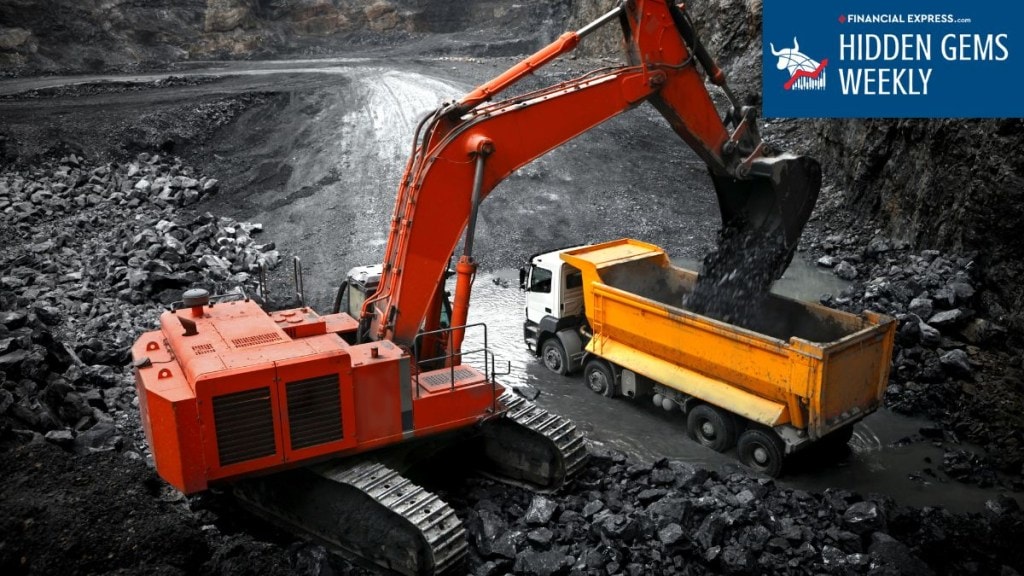
Welcome to the latest edition of Hidden Gems Weekly. In earlier weeks, we dug deep into a real estate stock, a packaging company and an engineering gem. This week, we turn to something that’s core to the economy – minerals and mining.
20 Microns Limited has spent decades operating in the background of Indian manufacturing, supplying materials that rarely attract attention but are difficult to replace. Today, a combination of deeper integration, a changing product mix, margin discipline and steady capital allocation is slowly reshaping what was once seen as a plain commodity-facing business.
Some companies grow by changing what they do.
Others grow by changing how they do it.
20 Microns belongs firmly to the second category.
For most of its listed life, the company has been viewed as a steady supplier of micronized minerals, tied closely to cycles in paints, plastics, ceramics and construction. Useful, dependable, but rarely seen as a business with structural upside.
That view no longer tells the full story.
This isn’t a pivot; it’s an evolution. There is no sector shift or headline-grabbing acquisition. Instead, the company is layering multiple small but meaningful changes that together are altering the quality of earnings.
The starting point still matters
In the financial year ending March 2025, 20 Microns reported consolidated revenue of about Rs 913 crore, a growth of roughly 18% year on year. Earnings before interest, tax, depreciation and amortisation (EBITDA) stood at around Rs 117 crore, while profit after tax was about Rs 62 crore.
Return on capital employed was close to 19.2%, and the debt equity ratio remained modest at roughly 0.4.
On the surface, these numbers look respectable but not transformative. They do not, by themselves, demand a re-rating.
The more interesting part lies in how these numbers are being built.
An industrial minerals business with uncommon integration
Most industrial mineral players in India operate as processors rather than owners of resources. They buy raw material, add processing value and compete largely on price and service.
20 Microns has chosen a different path.
The company has access to captive mineral resources across multiple locations, giving it greater control over quality, consistency and cost. Mining reserves run into millions of tonnes, spread across key mineral belts.
This matters because integration is not about growth during good times. It is about margin protection during bad ones.
When logistics costs rise or raw material quality fluctuates, companies without integration feel the pressure immediately. Integrated players absorb shocks more smoothly.
This advantage rarely shows up in a single quarter. It reveals itself across cycles.
The portfolio is quietly shifting upward
Industrial minerals are often viewed as low differentiation products. That assumption breaks once the portfolio evolves.
20 Microns has been pushing steadily toward functional additives and speciality applications. These are materials designed for specific performance outcomes rather than generic filler use.
Functional additives need application expertise, research and development support and long customer relationships. Once approved, switching suppliers is uncommon.
During the year, the company introduced more than 40 new products across paints, plastics, construction chemicals, rubber and speciality applications. A rising share of revenue now comes from products that sit higher on the value chain.
This shift improves margins and reduces volatility at the same time.
Margins that hold when volumes soften
The first half of the financial year 2026 offered a useful stress test.
Paint demand softened due to extended monsoons, delayed festive activity and pricing pressure across the industry. Revenue growth slowed and turned negative on a year on year basis in some quarters.
Yet EBITDA margins expanded.
In the September 2025 quarter, margins moved close to 14%, supported by cost discipline, sourcing efficiency and a better product mix.
That signal matters.
Commodity businesses usually see margins compress when volumes slow. Margin expansion in a weak demand environment suggests that structural changes are working.
Defending margins is often more important than chasing volume growth.
Geographic reach without chasing growth for headlines
20 Microns sells into more than 80 countries, but its international expansion has been measured rather than aggressive.
Instead of pushing exports for top-line visibility, the company has focused on markets where its products meet technical requirements. Overseas investments, such as limestone quarry operations in Malaysia strengthen raw material access rather than merely expanding distribution.
This approach keeps capital allocation grounded.
International presence supports the core business instead of stretching it.
A balance sheet built for downcycles
One of the least discussed strengths of the company is financial discipline.
Leverage remains modest. Interest coverage is healthy at 5.4x. Capital expenditure in financial year 2025 was about Rs 24 crore, largely directed toward debottlenecking, efficiency improvement and selective capacity enhancement.
There has been no attempt to force growth through debt.
In industrial businesses, clean balance sheets are not optional. They are insurance.
They allow companies to invest when others are forced to pull back.
Working capital remains an execution test
Working capital discipline remains an area to watch as the company moves further up the value chain and expands its global footprint.
Inventory management and receivables control will matter more as product complexity rises. Management has acknowledged this and is working on supply chain optimization and vendor rationalization.
The intent is clear. Execution will determine outcomes.
Boardroom mix
20 Microns remains a promoter led company under Chairman and Managing Director Rajesh C. Parikh, ensuring continuity of strategy and operating discipline.
At the same time, the board includes a meaningful presence of independent directors, an important safeguard for a capital intensive, resource linked business. This mix preserves execution agility while adding oversight on capital allocation, compliance and risk.
There are no visible governance red flags such as heavy pledging or aggressive related party transactions.
Valuation still anchored to the old narrative
Despite these changes, the market continues to value 20 Microns like a traditional industrial mineral supplier.
Valuation multiples reflect a business exposed to cycles rather than one gradually insulating itself from them.
That disconnect often persists until margins prove resilient across multiple demand phases. It also persists until return metrics begin to look less volatile.
In 20 Microns’ case, return on equity has settled into the mid-teens, driven by operating efficiency and improving working capital turns rather than leverage.
Reratings in industrial stocks rarely come from announcements. They come when investors realise earnings and returns are no longer as fragile as assumed.
The risks investors must still respect
This is not a risk free story.
Demand from paints, construction and plastics remains cyclical.
Mining operations face regulatory and environmental constraints.
Export markets carry currency and geopolitical risk.
None of these can be dismissed.
But risk must be weighed against preparedness. And 20 Microns appears better prepared than it was a decade ago.
Why this feels like a different kind of industrial story
What makes 20 Microns interesting today is not growth alone. It is the quality of growth.
Integration improves cost control.
Product mix supports margins.
Digital systems improve visibility.
Capital allocation remains disciplined.
The balance sheet reduces downside risk.
This is how industrial companies transition from price takers to solution providers.
Not suddenly.
But steadily.
20 Microns is not a momentum trade. It is a structural shift unfolding inside a company that has spent years doing unglamorous work.
Investors chasing headlines may overlook it.
Those watching margins, balance sheet strength and product evolution may not.
And in industrial investing, those are usually the stories that endure.
Disclaimer:
Note: We have relied on data from www.Screener.in throughout this article. Only in cases where the data was not available, have we used an alternate, but widely used and accepted source of information.
The purpose of this article is only to share interesting charts, data points and thought-provoking opinions. It is NOT a recommendation. If you wish to consider an investment, you are strongly advised to consult your advisor. This article is strictly for educative purposes only.
Manvi Aggarwal has been tracking the stock markets for nearly two decades. She spent about eight years as a financial analyst at a value-style fund, managing money for international investors. That’s where she honed her expertise in deep-dive research, looking beyond the obvious to spot value where others didn’t. Now, she brings that same sharp eye to uncovering overlooked and misunderstood investment opportunities in Indian equities. As a columnist for LiveMint and Equitymaster, she breaks down complex financial trends into actionable insights for investors.
Disclosure: The writer and her dependents do not hold the stocks discussed in this article. The website managers, its employee(s) and contributors/writers/authors of articles have or may have an outstanding buy or sell position or holding in the securities, options on securities or other related investments of issuers and/or companies discussed therein. The content of the articles and the interpretation of data are solely the personal views of the contributors/ writers/authors. Investors must make their own investment decisions based on their specific objectives, resources and only after consulting such independent advisors as may be necessary.