



Welcome to the latest edition of Hidden Gems Weekly. In recent weeks, we dug deep into a real estate stock, a packaging company and a niche engineering player riding a capacity-led inflection. Our most recent edition dug into a steel company. This week, we explore a smallcap that is pivoting from commodity processing to specialised manufacturing.
Often, businesses change quietly before the impact shows up in financial statements. The work happens inside factories, product lines and cost structures, long before it becomes visible in reported numbers.
Xpro India is in that phase.
The company operates in a specialised corner of polymer processing, supplying dielectric BOPP films and co-extruded plastic products to end markets such as electrical insulation, white goods and industrial packaging. Entry barriers are high, customer qualification cycles are long and domestic competition is limited.
These characteristics make Xpro a differentiated industrial business rather than a commodity manufacturer.
What defines the current phase is transition. Capacity is being added, the product mix is being upgraded and the geographic footprint is expanding. The costs of this shift are already visible in the numbers. The benefits are still catching up.
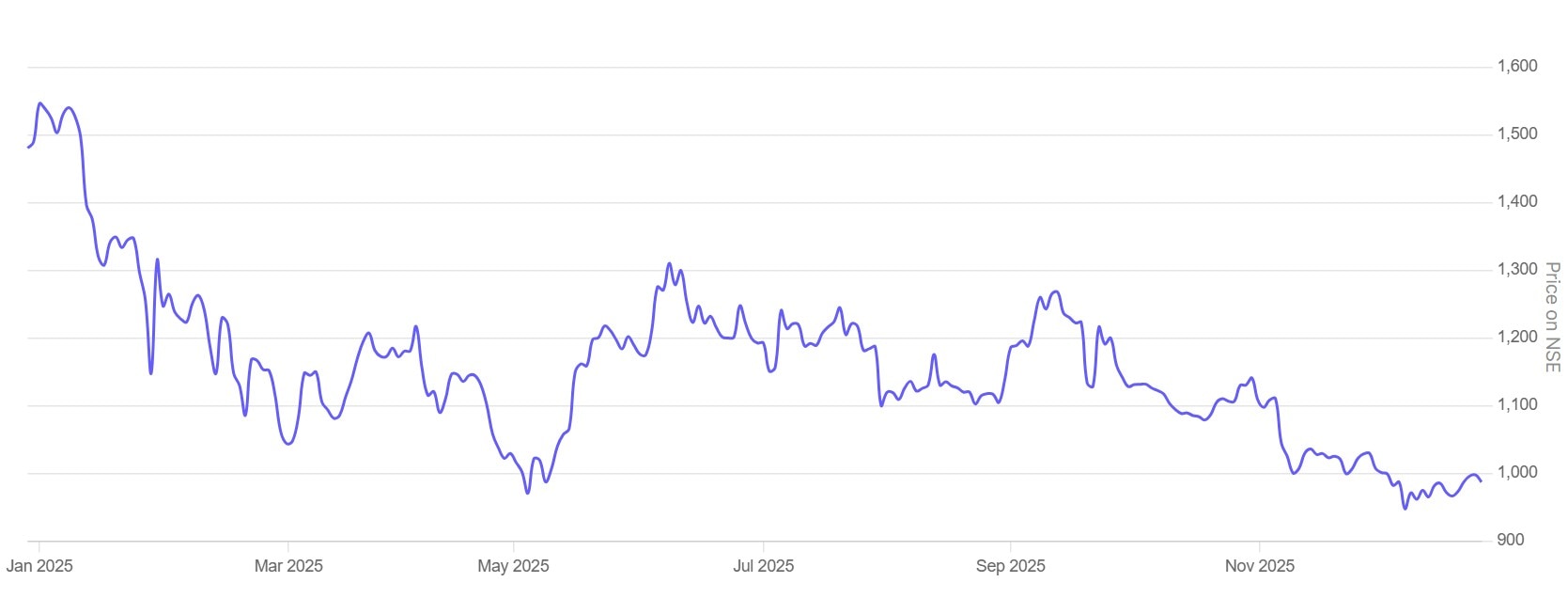
Xpro 1-Year Share Price Chart
Strategy: High-Tech Niches Over Commodity Volume
Xpro’s business is structured around niches where consistency and technical capability matter more than sheer volumes.
The dielectric films business, which accounted for about 26% of FY25 revenue, is the most strategic part of the portfolio. These films are used in applications linked to electrification, electronics and energy storage. Customer qualification is lengthy, but once approved, relationships tend to be sticky. This is also the most capital-intensive segment, with new lines taking time to stabilise.
The bulk of revenue comes from co-extruded sheets and thermoformed liners, which together made up about 62% of FY25 revenue. This business supplies plastic sheets and liners primarily to white-goods manufacturers. Volumes in this business grow steadily and are easier to scale. Margins, however, are thinner and more sensitive to operating leverage.
The remaining co-extruded cast films contribute a little over 11% of revenue. Its caters to packaging and industrial applications. While this segment is smaller in scale, it adds diversification and helps smooth revenue volatility.
Together, this business mix gives Xpro a balanced industrial footprint.
The Capex Bet: Doubling Down on Dielectric Films
Xpro is putting its money behind the part of the business it understands best — dielectric films.
New capacity is being added at Barjora, while a greenfield dielectric film facility is being developed in Ras Al Khaimah, UAE. Over time, these projects are expected to expand the addressable market, reduce concentration risk and improve margins through operating leverage.
The direction is logical. Dielectric films are where Xpro has pricing power and long-term relevance.
The challenge lies in sequencing.
Financials: The Visible Cost of Transition
The first half of FY26 has brought the stresses of this transition into sharp focus.
For the six months ended September 2025, revenue declined 2.8% year-on-year to Rs 264 crore. The more telling movement was in profitability.
Earnings Before Interest, Tax, Depreciation and Amortization (EBITDA) fell sharply to Rs 4.8 crore from Rs 29 crore a year earlier, with EBITDA margins compressing to 1.8% from 10.8%.
This deterioration was less a demand issue and more a timing and execution problem.
New capacities, particularly in dielectric films, were still in the commissioning and stabilization phase. Fixed costs kicked in before volumes, yields and operating efficiencies normalised, hurting operating leverage even though revenues were broadly stable.
At the same time, raw material and energy dynamics were unfavourable. Input volatility and a lag in pass-through compressed spreads, while the benefits of long-term power sourcing arrangements were not yet fully visible in the numbers.
There was also a financial overlay. Expenses related to the UAE subsidiary, which is still pre-revenue, flowed through the profit and loss account in the form of lease costs, financing charges and foreign exchange provisions, without any offsetting income.
In addition, euro-denominated supplier credit used for capital equipment led to an adverse currency impact during the period.
Finally, management chose not to defend margins aggressively. The focus remained on customer continuity, qualification timelines and long-cycle positioning rather than short-term price hikes or volume cuts. That preserved relationships and utilization, but came at the cost of near-term profitability.
The result was a phase where costs showed up faster than benefits, a familiar pattern in capacity-led transitions.
Solvency: Why the Balance Sheet Won’t Break
One reason Xpro has been able to stay the course through this phase is balance-sheet discipline.
The company does not carry heavy long-term debt linked to its legacy operations. Supplier credit has been used for expansion, but overall leverage remains manageable. Net worth is strong, providing room to absorb delays without forcing short-term decisions.
This matters in capital-intensive businesses, where execution rarely follows a straight line.
Governance: Professional Management, Birla Lineage
Xpro India’s board is chaired by Sidharth Birla and includes promoter representatives alongside non-executive and independent directors with experience across manufacturing, finance and corporate governance.
The executive side is led by C. Bhaskar, the Managing Director and Chief Executive Officer, who has spent over four decades with the company and continues to drive its operations, strategy and capital allocation.
Independent directors make up over 60% of the board, well above the regulatory minimum. Key committees, including audit and nomination and remuneration, are chaired by independent members, giving the board a strong oversight framework.
What needs to change from here
The business logic remains intact. Entry barriers are real, end-market relevance is strong and the strategy is coherent.
What needs to change is visibility.
Stabilization of new capacity, improvement in utilization and a return of operating leverage will determine whether the transition phase begins to reflect in earnings. Until then, reported numbers are likely to remain sensitive to cost movements and timing effects.
Valuation: Pricing in a Perfection Scenario
All of this would read differently if expectations were modest.
At present, Xpro trades around 171x trailing earnings and about 3.3x book value. The P/E is inflated on account of a one off loss in 1QFY26.
In addition, the stock is not being priced as a steady industrial business working through a difficult phase. It is being priced for a sharp and timely improvement in profitability.
That leaves little room for delays.
If execution improves and margins recover meaningfully, the valuation may eventually justify itself. If the recovery takes longer, the gap between business progress and reported earnings could persist.
The takeaway
Xpro India is a business worth following closely.
It has the right ingredients, a clear strategic direction and the financial strength to see its plans through. But the current phase is one where costs are visible before benefits.
Disclaimer:
Note: We have relied on data from www.Screener.in throughout this article. Only in cases where the data was not available, have we used an alternate, but widely used and accepted source of information.
The purpose of this article is only to share interesting charts, data points and thought-provoking opinions. It is NOT a recommendation. If you wish to consider an investment, you are strongly advised to consult your advisor. This article is strictly for educative purposes only.
Manvi Aggarwal has been tracking the stock markets for nearly two decades. She spent about eight years as a financial analyst at a value-style fund, managing money for international investors. That’s where she honed her expertise in deep-dive research, looking beyond the obvious to spot value where others didn’t. Now, she brings that same sharp eye to uncovering overlooked and misunderstood investment opportunities in Indian equities. As a columnist for LiveMint and Equitymaster, she breaks down complex financial trends into actionable insights for investors.
Disclosure: The writer and her dependents do not hold the stocks discussed in this article. The website managers, its employee(s) and contributors/writers/authors of articles have or may have an outstanding buy or sell position or holding in the securities, options on securities or other related investments of issuers and/or companies discussed therein. The content of the articles and the interpretation of data are solely the personal views of the contributors/ writers/authors. Investors must make their own investment decisions based on their specific objectives, resources and only after consulting such independent advisors as may be necessary.