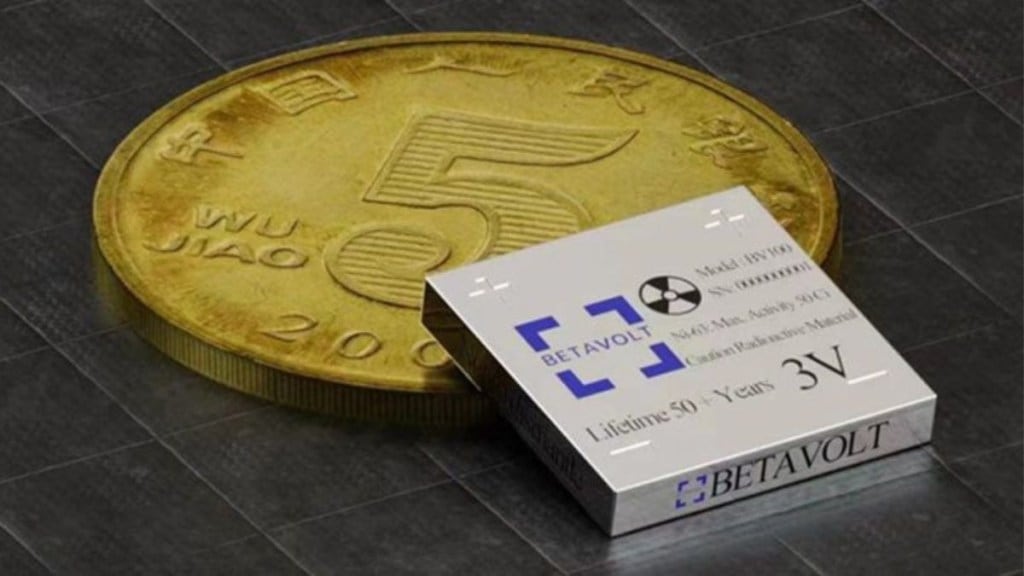
A Chinese start-up has introduced an innovative battery, asserting its ability to generate electricity continuously for 50 years without requiring charging or maintenance. As reported by The Independent, the innovation comes in the form of a nuclear battery developed by Betavolt, a Beijing-based company. Despite the use of the term “nuclear,” the battery’s size is surprisingly compact, with Betavolt managing to incorporate 63 isotopes into a module smaller than a coin, as indicated in the report. According to the company, this achievement marks the world’s first realization of the miniaturization of atomic energy.
The next-generation battery is currently undergoing testing and is slated for mass production to cater to various commercial applications, including phones and drones.
In a press release, Betavolt stated, “Betavolt atomic energy batteries can fulfill the demands for long-lasting power supply across multiple scenarios, such as aerospace, AI equipment, medical equipment, microprocessors, advanced sensors, small drones, and micro-robots.”
The company is in the process of testing the battery and has plans for imminent mass production.
Dimensions of the battery
The battery, measuring 15 x 15 x 5 millimeters, is composed of wafer-thin layers of nuclear isotopes and diamond semiconductors, as reported by Futurism.
Although the current power output of the nuclear battery is 100 microwatts at 3 volts, Betavolt aims to achieve a 1-watt power output by the year 2025.
Betavolt emphasizes that the radiation emitted poses no threat to the human body, making the battery suitable for use in medical devices such as pacemakers.
How does the battery work?
The battery’s operation involves tapping into the energy generated from decaying isotopes, a concept explored as early as the 20th century, and converting it into electricity.
Under its 14th Five-Year Plan from 2021-2025, China has been actively working on miniaturizing nuclear batteries.
With a layered design, the battery is claimed to be resistant to catching fire or exploding due to sudden force. Betavolt also asserts that the battery can function in temperatures ranging from -60 degrees Celsius to 120 degrees Celsius.
“Atomic energy batteries are environmentally friendly. After the decay period, the 63 isotopes turn into a stable isotope of copper, which is non-radioactive and does not pose any threat or pollution to the environment,” stated Betavolt.
The commencement of mass production is anticipated once the company concludes testing and secures all necessary clearances.