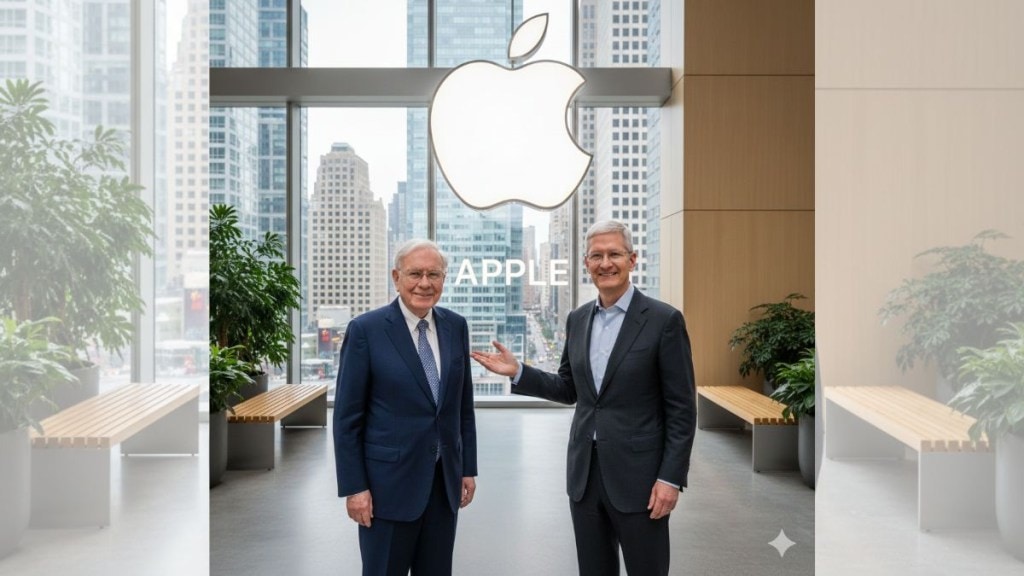
Warren Buffett once acknowledged that Apple CEO Tim Cook had generated more profits for Berkshire Hathaway than Buffett had through running his own company. Speaking at Berkshire Hathaway’s annual shareholders’ meeting in May, the veteran investor described his decision to back Apple as one of the smartest moves of his career.
Speaking to shareholders at Berkshire Hathaway’s annual meeting earlier this year. Mr Buffett said, “I knew Steve Jobs briefly, and Steve, of course, did things that nobody else could have done in developing Apple.”
“Steve picked Tim to succeed him, and he really made the right decision. Steve died young as you know, and nobody but Steve could have created Apple, but nobody but Tim could have developed it as he has. So on behalf of all of Berkshire, thank you, Tim.”
Buffett often viewed Apple through the lens of…
Over the years, Buffett often viewed Apple through the lens of a consumer brand rather than a traditional technology firm. He admired the company’s knack for designing and selling products that people kept coming back for. Because of this, he frequently compared Apple to Coca-Cola, another longtime holding in his portfolio.
Berkshire Hathaway made its initial move into Apple shares in 2016, marking a notable shift in the company’s long-standing investment approach.
Why time in the market beats trying to time it?
Buffett repeatedly points out that long-term gains come from remaining invested, tuning out short-term market fluctuations, and trusting the steady growth of strong businesses. Past market trends support this view.
He often cautions that attempting to predict market highs and lows rarely works, even for seasoned experts. Individual investors, in particular, tend to panic-sell during downturns and buy back after prices recover, which results in losses and missed opportunities when the market rebounds.
Berkshire Hathaway’s equity holdings:
Berkshire Hathaway’s equity holdings are heavily concentrated, with a handful of core positions accounting for more than 70% of the portfolio’s total value.
Apple remains the company’s single biggest investment, valued at roughly $63.6 billion, representing about 21–22% of the portfolio, even after recent reductions. American Express follows closely with an estimated value between $50 billion and $60 billion, making up around 18–19% and continuing its status as one of Buffett’s most enduring bets.
Bank of America stands at about $29.3 billion, or 11% of the portfolio, though the stake has been pared back. Coca-Cola, held continuously since 1988, is worth approximately $26.5–28.3 billion and accounts for nearly 10%. Chevron rounds out the top group with a stake valued near $19–19.3 billion, or about 7%, built largely during periods of weakness in the energy sector.
Alongside these long-standing holdings, Buffett has been selectively adding new positions amid market uncertainty. Berkshire recently built a new stake of more than $1.6 billion in UnitedHealth Group, targeting the insurer after a price pullback.
The firm has also invested in homebuilders, including about $800 million in Lennar and roughly $190 million in D.R. Horton. In the industrial space, Berkshire owns around $860 million worth of Nucor, while a $2.2 billion investment in Constellation Brands marks a move into alcoholic beverages. Additional positions include companies such as Chubb, SiriusXM, and Pool Corp.