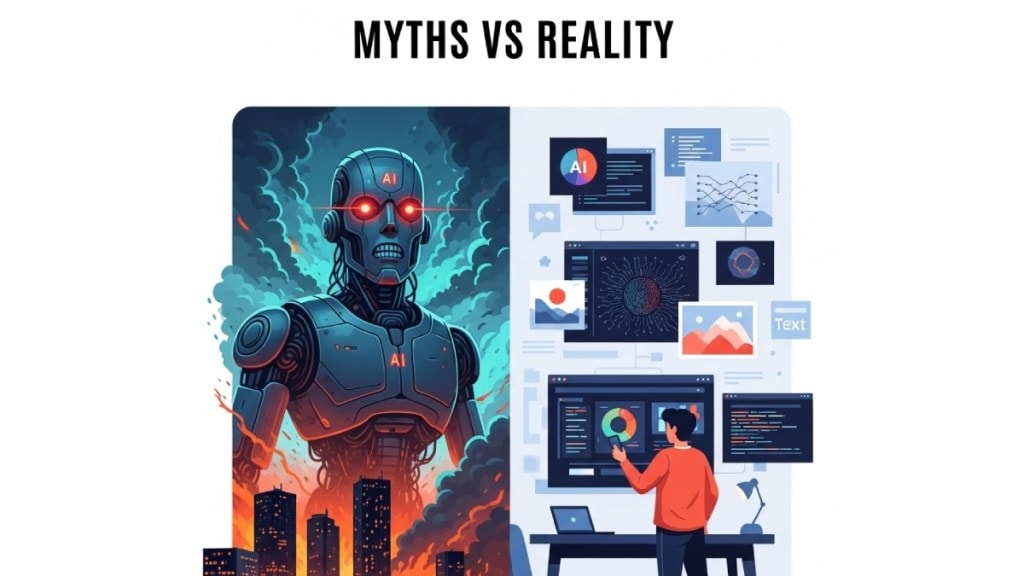
Generative AI has woven itself into our daily lives faster than Sam Altman’s commitment to becoming the next Steve Jobs. In just a matter of three years, generative AI tools have the ability to produce text, images, code and even video clips with bespoke audio, that too with remarkable efficiency. Tools like ChatGPT, MidJourney, Gemini, Veo and DALL·E have sparked excitement and curiosity.
At the same time, they’ve also led to plenty of misconceptions. Some see AI as a near-magical entity capable of independent thought, while others fear it will take over human creativity and critical thinking altogether, threatening jobs and other opportunities in the near future.
But is it so? Is generative AI that much of a detrimental factor to humanity’s prosperity? Or should you absolutely not worry about it forever?
In this article, we’ll tackle some of the most common myths surrounding generative AI, separating fact from fiction so you can better understand its capabilities and limitations.
Myth 1: AI thinks like humans
Reality: AI doesn’t think— It predicts
One of the most widespread misconceptions is that AI possesses independent thought and reasoning, similar to a human brain. This forms the basis of all those imaginations that end up leading to the theories of AI making humans hostage – something similar to the world of Terminator (the movie franchise).
However, AI does not ‘think’ in the way humans do. It doesn’t have emotions, intuition, or self-awareness.
Instead, AI works by analysing vast amounts of data and recognising patterns to predict the next most likely response. Large language models (LLMs), like ChatGPT, process words and phrases based on statistical probability rather than actual comprehension. While this can create responses that seem insightful, AI lacks understanding, consciousness and subjective experience.
For example, if you ask AI for life advice, it may generate a thoughtful-sounding response, but it is not forming opinions or feelings. It’s simply predicting words based on common patterns found in similar queries.
Why this matters
Understanding this distinction is crucial when using AI for tasks requiring judgment, creativity, or ethics. AI can provide suggestions, but human oversight is needed to interpret and apply those suggestions meaningfully.
Myth 2: AI is always accurate
Reality: AI can hallucinate and generate false information
Another misconception is that AI always provides accurate and reliable information. However, AI models can hallucinate, which means they generate misleading or entirely false content.
This happens because AI does not fact-check itself. In fact, it simply generates responses based on its training data. If the training data contained inaccuracies or bias, it might include those errors in its answers. Additionally, if asked for highly specific or niche details, AI may fabricate entirely believable incorrect information.
For instance, if you ask AI for a historical event or scientific fact, it may present an answer convincingly without verifying. This is especially problematic in legal, medical or financial contexts where precision is critical.
Why this matters
Users should always fact-check AI-generated content, especially for important decisions or academic work. AI is an excellent assistant but should never be blindly trusted as an authoritative source.
Myth 3: AI replaces human creativity
Reality: AI assists but doesn’t replace original thought
Many fear that AI is replacing creativity, reducing human artistic expression to simple algorithm-based outputs. While AI can generate compelling artwork, text, and music, it does not replace human creativity.
Creativity involves emotion and abstract thought, things that AI cannot replicate. AI generates content based on existing data, which means it lacks the ability to create truly original ideas the way humans do. AI acts as a tool that can help inspire new ideas and automate repetitive tasks but it can’t bring originality.
For example, AI-generated art can produce stunning visuals, but a human must provide meaningful input and refine the final piece to imbue it with artistic intention.
Why this matters
Rather than fearing AI as a replacement for human creativity, creators can leverage it as an assistant.
Myth 4: AI knows everything
Reality: AI has a knowledge cutoff and can’t always access current information
A common misconception is that AI has access to unlimited knowledge and always provides the most up-to-date information. However, AI models are only as informed as their training data, and many models have knowledge cutoffs, meaning they don’t continuously learn from new developments.
For example, if you ask a general AI model about events that occurred after its last training update, it may not provide accurate responses unless it is connected to external search tools. Even AI models capable of browsing the internet may still struggle with accuracy, as they do not always verify sources correctly.
Additionally, AI lacks real-world understanding. It merely analyses data. Therefore, responses can sometimes miss cultural, emotional, or contextual aspects that a human would immediately grasp.
Why this matters
Users should treat AI as an aid rather than an oracle. When looking for current events or breaking news, verifying sources through human research is essential.
Myth 5: AI is completely autonomous
Reality: AI requires human guidance and control
Some believe AI operates independently, making decisions on its own without human intervention. In reality, AI is highly dependent on human direction. Developers build and fine-tune AI models, providing guardrails for responsible use.
More advanced AI models, such as autonomous agents, function within strict parameters. They may optimise solutions within certain boundaries, but they are far from being truly independent entities.
Why this matters
Human oversight is essential in AI applications, particularly in areas such as law, healthcare, and policymaking. AI cannot replace human decision-making, but it can enhance efficiency when used responsibly.
Conclusion
While AI can assist creativity, automate tasks, and provide helpful insights, it does not replace human intuition, reasoning or originality. It is a powerful tool but requires careful use, critical thinking, and human oversight.