



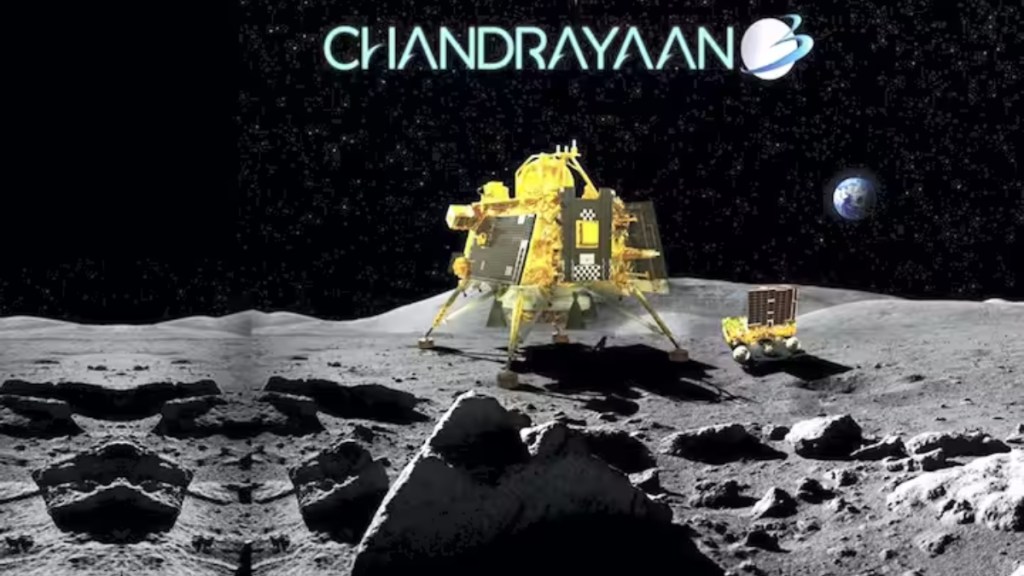
The Indian Space Research Organisation will attempt to wake up the Chandrayaan-3 mission’s Vikram lander and Pragyan Rover today when the Moon will get its first sunrise after weeks of darkness at the south pole. Both lander and rover were put into sleep mode earlier this month.
The agency will try to establish communication with the two after weeks of lunar night.
When did ISRO put the lander and rover in sleep mode?
The Indian space agency on September 4 announced that it had put the Vikram Lander into sleep mode after it conducted in-situ experiments by ChaSTE, RAMBHA-LP and ILSA payloads were performed at the lander’s new location. Prior to this, the lander carried out a hop experiment on the lunar surface. It fired its engines on command and lifted itself off the surface by about 40 centimetres as was expected. It then landed safely at a distance of 30-40 centimetres away.
ISRO had left the lander’s receivers on. Once its solar power got exhausted and its battery was drained, Vikram fell asleep next to Pragyan.
The Pragyan Rover was put into sleep mode on September 2. Its solar panel was oriented to receive the light at the next sunrise on the Moon. Its receiver was left on.
“Hoping for a successful awakening for another set of assignments! Else, it will forever stay there as India’s lunar ambassador,” ISRO had tweeted.
If ISRO is successful in waking up Vikram and Pragyan, they will conduct further experiments on the lunar surface.
Chandrayaan-3 mission
With the Chandrayaan-3 mission, India put itself on the map of major players in the space sector. India’s Chandrayaan-3 mission successfully landed on the Moon on August 23, making India the fourth country to land on the lunar surface and the first to land on the Moon’s south pole.
The successful landing promoted reactions from all around the world. Several nations lauded India for achieving this difficult feat.