



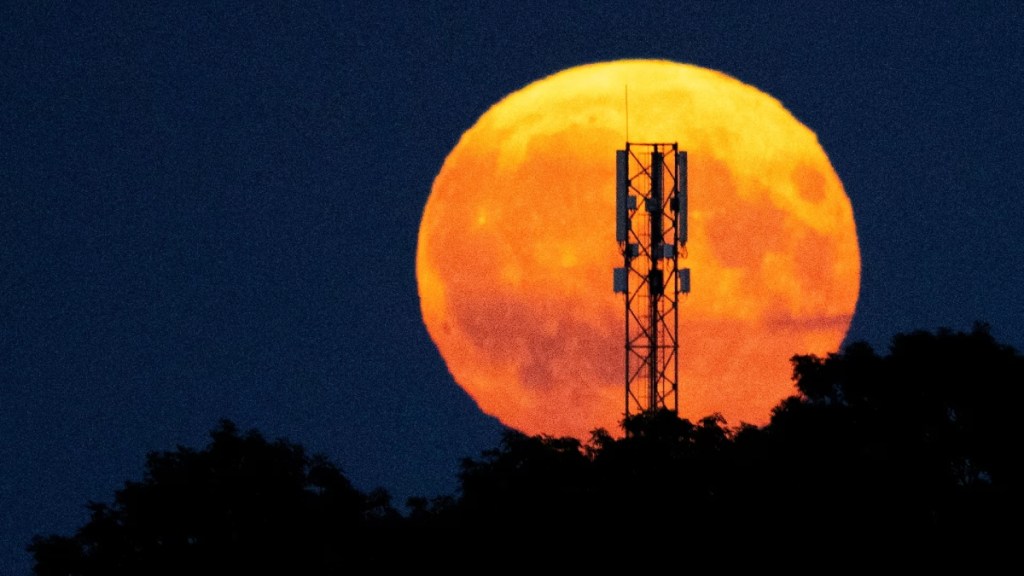
The first supermoon of 2026 is just around the corner and will light up the sky today, January 3. The Moon will look about 30 per cent brighter and nearly 14 per cent larger than the smallest full moon of the year. In India, it will be visible shortly after sunset in the evening.
Along with appearing bigger and brighter, the Moon will also glow in a warm orange-yellow colour. At its closest point, it will be around 362,641 km away from the Earth, making it a striking sight for skywatchers.
What is a supermoon?
A supermoon happens when a full Moon occurs at the same time as the Moon’s closest approach to Earth in its orbit, a point called perigee.
During this phase, the Moon is directly opposite the Sun, and its near side is fully lit. Because it is closer to Earth than usual, it appears larger and brighter in the sky.
When the Moon is closer to the horizon, it often appears orange or yellow. This happens because Earth’s atmosphere scatters shorter wavelengths of light. The Moon may also look unusually large due to the “moon illusion”, a visual effect that makes low-hanging moons seem bigger than they actually are.
Supermoon 2026: When and where it will be visible
The supermoon will reach its peak brightness at 5:30 am EST (4 pm IST) on January 3. In India, the best time to see it will be during moonrise on January 3, shortly after sunset, between around 5:45 pm and 6 pm IST. At this time, the Moon will be in its full phase and at a distance of about 362,641 km from Earth, as per NASA, according to space.com.
The supermoon will be visible at different times across the world. People in New York can see it at 5:30 am EST, in London at 10:03 am GMT, in Tokyo at 7:30 pm and in Sydney at 9:03 pm local time.
The supermoon can be enjoyed with the naked eye and does not need any special equipment. However, using binoculars or a telescope can help spot finer details on the Moon’s surface.
Why it’s called the Wolf Moon
January’s full Moon is traditionally known as the Wolf Moon. The name comes from Northern Hemisphere folklore, where wolves were believed to howl more often during the long, cold winter nights. It is also sometimes called the “Moon after Yule”.