



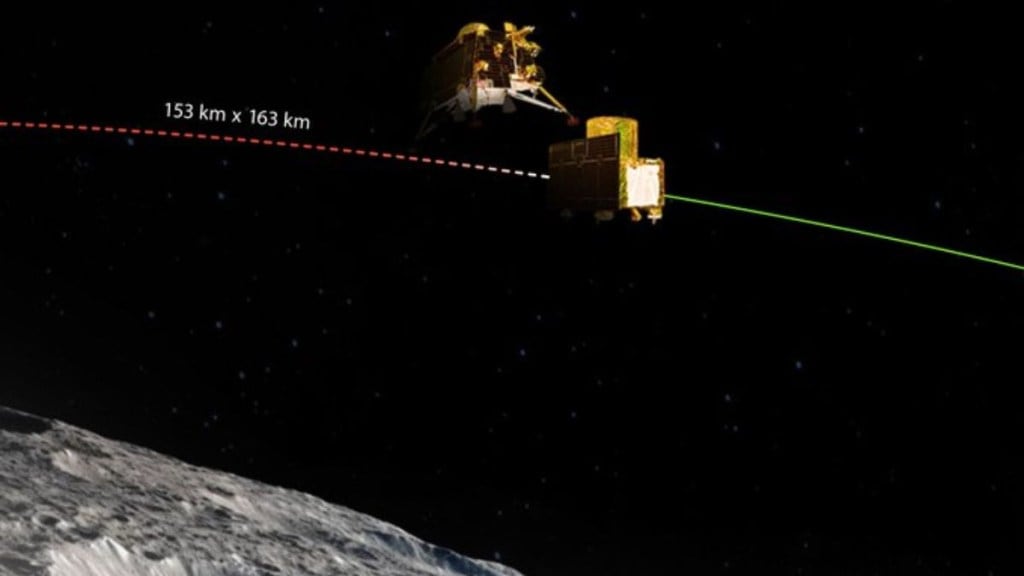
Chandrayaan-3: The Vikram lander module of the Chandrayaan-3 spacecraft successfully detached from the propulsion module today around 1.15 pm. The lander and the rover, Pragyaan, will attempt the landing on the south pole of the Moon on August 23. It may be noted that the lander and the rover are carrying scientific payloads to carry out various experiments on the lunar surface. The mission was launched effectively on July 14 via the GSLV Mark 3 (LVM 3) heavy-lift launch vehicle from the Satish Dhawan Space Centre in Andhra Pradesh’s Sriharikota. Notably, the success of this mission will make India the fourth nation globally to achieve this remarkable milestone, joining the company of the United States, Russia, and China.
Chandrayaan-3: Vikram Lander successfully separated from propulsion module, informed ISRO.
ISRO Chairman S Somanath said that the most critical part of the landing is the process of bringing down the velocity of the lander. This process begins when the lander starts its descent from a height of 30 km to the final landing (position), and that the ability to transfer the spacecraft from horizontal to vertical direction is the "trick we have to play" here. "It is here where we had the problem last time (Chandrayaan-2)," Somanath explained.
The Vikram lander will now commence the final phase of the Moon voyage without the propulsion module. In the next step Lander Module will descend to a slightly lower orbit around the Moon on Friday.
The Chandrayaan-3 mission's lander is named after Vikram Sarabhai (1919-1971), who is widely regarded as the father of the Indian space programme.
Chandrayaan-3 mission entered its last round as Vikram lander was successfully separated from the Propulsion Module today. Now Vikram will reach the lunar orbit with the lander rover.
According to ISRO officials, the velocity of the lander was suppose to slow down from 6000 kmph to 0 kmph in four phases, but the space agency lost contact with it minutes before its touchdown. The ISRO scientists had informed that a software glitch was attributed as the reason behind losing contact with the lander. Read More
The successful landing of Chandrayaan 3 will make India the fourth country in the world to achieve the feat, joining the ranks of the United States, Russia, and China. However, no other country has ever touched down on the lunar South Pole. Read More
Chandrayaan-3 is one of the most cost-effective space missions as compared to its predecessors with an estimated budget of Rs 615 crore.
The reason Moon’s south pole has always caught scientists’ attention is because of the abundance of water and ice. Experts believe that water in this region of the Moon could be used to sustain future manned explorations deeper into space.
The mission objectives of Chandrayaan-3 are to demonstrate safe and soft landing on the lunar surface, to demonstrate the rover operating on the Moon, and to conduct in-situ scientific experiments.
Chandrayaan-3’s soft landing on the south polar region of the Moon will be attempted on August 23. The lander will have the capability to soft land at a specified lunar site and deploy the rover that will carry out in-situ chemical analysis of the Moon's surface during the course of its mobility. The lander and the rover are carrying scientific payloads to carry out experiments on the lunar surface.
Chandrayaan-3 is India’s third lunar mission which was launched on July 14 and entered into lunar orbit on August 5. As the mission progressed, a series of manoeuvres were conducted by the national space agency to gradually reduce Chandrayaan-3's orbit and position it over the lunar poles. The orbit reduction manoeuvres were carried out on August 6, 9 and 14.
After separation, the lander is expected to undergo a deboost, which is the process of slowing down. This step will place it in an orbit where the Perilune, which is the closest point to the Moon, is 30 kilometres and Apolune, the farthest point from the Moon, is 100 km.
Currently, there is a race going on in outer space which has garnered the attention of scientists and space enthusiasts across the globe! After a span of 47 years, Russia inaugurated its latest moon-landing spacecraft on August 11, 2023. It was not supposed to be a planned race but it has turned out to be one, which has got the world wondering – who will reach the Moon’s South Pole first – Chandrayaan-3 or Luna-25? Read more
Chandrayaan-3 lander module's separation has been scheduled on August 17 between 1:00 pm to 1:30 pm.
Chandrayaan-3's Vikram lander is scheduled to separate from the spacecraft's propulsion module today (August 17) between 1 PM to 1.30 PM. The lander and the rover, Pragyaan, will attempt the landing on the south pole of the Moon on August 23.