



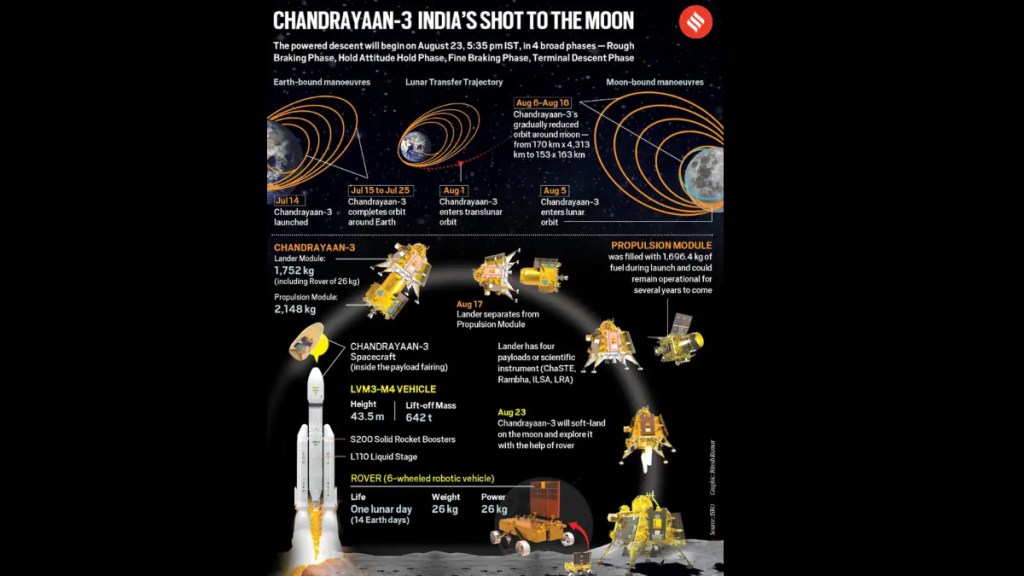
After India’s first attempt to launch Chandrayaan-2 mission was aborted in 2019, ISRO’s then Chairman K Sivan had described the mission’s last 15 minutes before the landing as “15 minutes of terror”. Nearly five years later, the Chandrayaan-3 mission is making its way to its final stages and these last 15 minutes are going to determine the success of the mission, an article published in The Indian Express said.
The Chandrayaan-2 mission met its failure after the Vikram lander crashed onto the lunar surface when it was entering the “fine braking phase” 7.42 kilometres away from the surface.
What will Chandrayaan-3 have to undergo in its final phases?
A critical technical maneuver will be employed when the spacecraft will enter its final 15 minutes to make a soft-landing. The maneuver will see the lander being transferred from its high-speed horizontal position to a vertical one to facilitate a gentle descent.
The final deboosting of the Chandrayaan-3 lander was completed on August 20 which reduced its orbit to 25 km x 134 km around the Moon.
Rough Braking Phase
The landing process includes a very critical part, which will take place simultaneously, under which the lander’s horizontal velocity from over 6,000 kilometres at a height of 30 kilometre from the lunar surface to almost zero for a soft-landing at the designated landing site.
On August 9, the ISRO Chairman S Somanath said the Chandrayaan-3 will be tilted almost 90 degrees at the time when the landing process starts today at 5:47 pm, however, it will be required to come to a vertical position for a landing. The process of turning the lander has seen many simulations this time. This is where we had a problem the last time (which led to the crash of Chandrayaan-2 on September 7, 2019),” he said. He added that the agency needs to ensure that the fuel consumed during the process is less and the calculation of the distance is correct and that all the algorithms work properly.
What happened in 2019 and what are the various stages before landing?
In 2019, three minutes before the final “terminal descent phase”, the lander started spinning over 410 degrees, and ended up being deviated from its measured spin of 55 degrees. There are 12 engines onboard to control the speed and direction of the lander.
– Four engines help reduce the velocity and eight small engines control the direction of the descent. At the beginning of the landing process, when the vertical velocity is zero, the horizontal velocity is 1.68 km/sec.
– This velocity first needs to be to 358 m/sec and a vertical velocity of 61 m/sec is required in the ideal “rough braking phase” of 690 seconds, during which the lander will descend from an altitude of 30 km to 7.42 km.
– During this period, the lander will travel a distance of 713.5 km across the lunar surface towards the landing site.
– At an altitude of 7.42 km from the Moon’s surface, the Vikram lander will go into an “altitude hold phase” lasting around 10 seconds, during which it will tilt from a horizontal to a vertical position while covering 3.48 km.
– The height will be reduced to 6.8 km and the velocity will be reduced to 336 m/sec (horizontal) and 59 m/sec (vertical).
– The landing process’ third stage is the “fine braking phase” which lasts around 175 seconds. During this phase the lander will move into a vertical position entirely. It will cover the final 28.52 km to the landing site and its altitude will come down to 800-1,000 m, and it will finally reach a nominal speed of 0 m/sec.
“From 30 km to 7.42 km (altitude) will be rough braking and at 7.42 km there will be an altitude hold phase where some of the instruments will carry out calculations; at 800 or 1,300 metres (altitude) it will start doing a verification of the sensors, at 150 metres (altitude) it will do a hazard verification and decide whether it should land vertically there itself or move laterally to a maximum extent of 150 metres to avoid any boulders or craters, “ ISRO’s S Somanath had said.
In case of Chandrayaan-2, it was between the “altitude hold phase” and the “fine braking phase” that the lander lost control and crashed.
The Vikram lander can make a touch down at a maximum speed of 3 m/sec without putting the instruments onboard in danger, however, the optimal speed is around 2 m/sec. It can also have a tilt up to 12 degrees and still make a safe landing. Somanath has said that while a 3 m/sec speed sounds low, a human could break all their bones if they were to fall at that speed. “Attempting to land at ultra low speed also requires a lot of fuel, and theoretically, there has to be some velocity to touch down and this has been identified as 1 m/sec. System is however built to handle velocity of up to 3 m/sec,” he added.
Once the lander is on the lunar surface, it will release a rover on board to take pictures and conduct experiments with two onboard instruments.