If playback singer Shaan performed at Serendipity Arts Festival to a full ground, an ensemble of artistes from the Irular tribe of Tamil Nadu led by folk singer S Rani put up a spirited performance at another venue that was no less enjoyable. Singing of love, longing and life, the energetic band dressed in their ethnic selves put up a foot-tapping show that was pure joie de vivre.
Art in Shuttles and Tavernas
Taking the festival shuttle, one finds an unexpected partner to share the ride with—a young poet who has given up Mumbai’s madness to adopt Goan susegad.
Rochelle D Silva reads out a few of her poems during the short trip, but what one leaves with is not just poetic enrichment. It is inspiration for a life that chooses contentment—no big career moves, no huge ambitions, no aggressive strategies, but making peace with yourself. Part of Poems on the Move, curated by artists Thukral and Tagra, the project promotes five such poets.
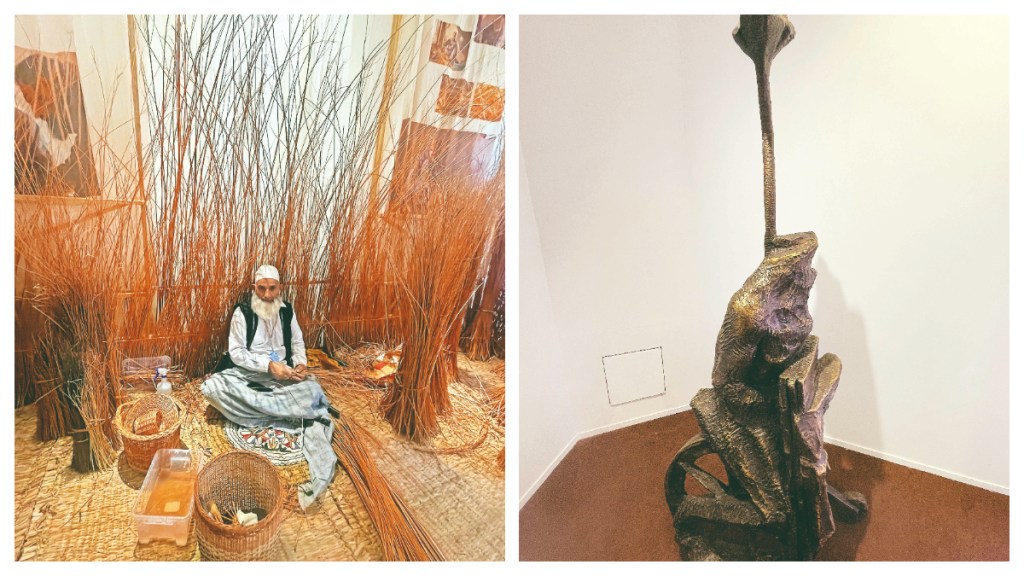
Amid the hectic festival serenely sit artists from Kashmir, working on their crafts. Mehraj Ud Din Pir from Ganderbal is a master artisan in Kani Kaam—willow wicker craft. He patiently moulds the wild willow strips into pliable material that is transformed into beautiful baskets and artefacts in his hands. Across him sits Namda artistan Farooq Ahmed Khan, creating shawls and rugs from sheep wool. He says festivals like Serendipity give people like him exposure and a platform to showcase their crafts. In another corner, an entire cubicle houses works of seven artists with disabilities. They might be dyslexic, audio-visually challenged or unable to perform the simple task of walking straight, but their creative expression is no less powerful.
Curated by Salil Chaturvedi, the project celebrates the ability to create, and is aptly titled Therefore I Am. In a festival that has roped in celebrated culinary names like Thomas Zacharias, Manu Chandra, Rahul Akerkar, Prateek Sadhu, local chefs who proudly display the intricacies of Goan food, enlightening visitors about a cuisine that is much more than xacuti and vindaloo, are equally impressive. They may not be offering noveau cuisine, but as custodians of tradition and forgotten recipes, their role becomes perhaps more important.
A little skit, Goa is a Bebinca, set in Fontainhas, Panjim’s old Latin Quarter, in an old Portuguese-style house, is a huge hit at the festival. Local artistes in a taverna-like ambience introduce the participatory audience to Portuguese and Konkani culture via food, drink, and even societal stereotypes. The audience downs feni after feni even as early as 11 am, tasting little bites of Goan food as the performance progresses, soaking in stories of fading traditions, community and cultural preservation, and leaving with huge smiles all around.
Decade of Inclusion
In its ten years, the festival has encouraged over 10,000 such budding artists through residencies and grants as well. Commenting on the festival’s support to new and lesser known artists, founder-patron Sunil Kant Munjal told FE: “Serendipity Arts Festival is a unique platform that gives the same stage and the same importance to globally recognised and celebrated artists, as it does to the new and emerging artists. From the outset, Serendipity was imagined as an ecosystem rather than a showcase. Many artists doing important work are not always visible within dominant institutional or commercial frameworks, and our role has been to create conditions where such practices can grow with time and care.”
He added: “Through the festival, residencies, grants and year-round initiatives, we try to offer artists space to experiment, to fail, to reflect, and to develop work without pressure of immediate validation. What matters to us is continuity—building relationships, providing mentorship, and enabling artists to engage with peers and audiences over the long term. If new voices are able to find confidence, rigour, and sustainability through this process, then the institution has done its work.”