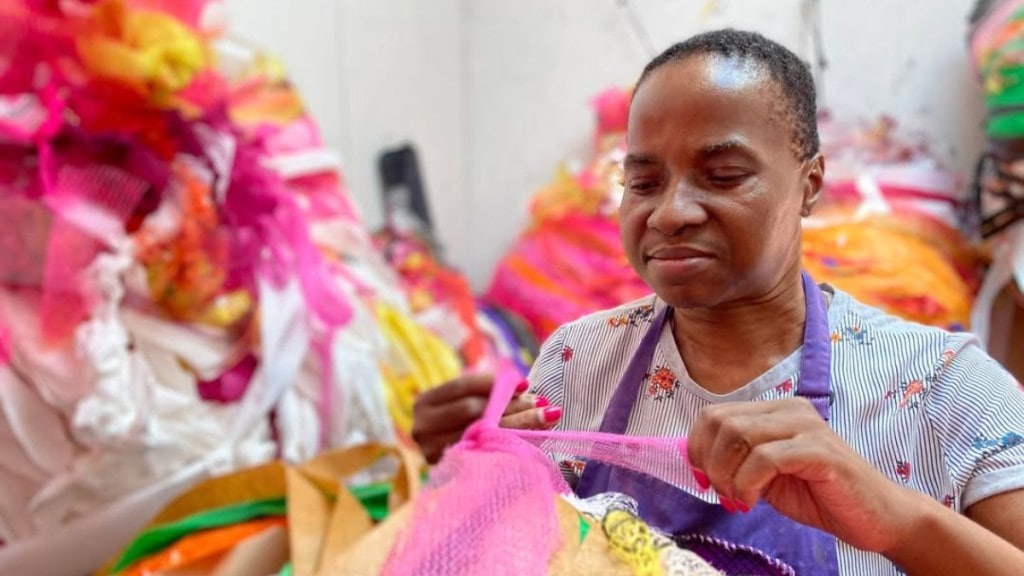
Art transcends language yet unites those without words. One such awardee at the Turner Prize 2025 defied all norms and claimed the UK’s top contemporary art award. Nnena Kalu’s bold, hanging sculpture gained international acclaim overnight. However, the artist behind the art is equally stunning, breaking all norms and conventions.
Nnena Kalu has a learning disability and limited verbal communication. Shooting to fame after the prestigious award, she became the first neurodivergent or learning-disabled artist to win £25,000 (Rs 29 crore) at the ceremony in Bradford on December 9.
Who is Nnena Kalu?
Born in Glasgow in 1966 to Nigerian parents, Nnena Kalu was raised in London under supportive care. In her early years, he began her practice at the Hill HJouse day centre in South London. She then worked with the visual arts organisation ActionSpace since the late 1990s. Artistic facilitator Charlotte Hollinshead supported her and Kalu’s work, driven by rhythmic and repetitive gestures. Standing out for its texture, form, and concept, her sculptures usually feature recycled materials like VHS tape, parcel tape, cling film, fabric, rope, ribbon, string, and cardboard, alongside swirling, vortex-like drawings on paper.
Kalu has been making waves on the international art scene, with her work featured in shows such as Drawing 21 (2021) at Liverpool’s Walker Art Gallery and the 2024 Hanging Sculpture 1 to 10 installation at Manifesta 15 in Barcelona. The jury, led by Tate Britain director Alex Farquharson, praised her “bold and compelling” abstract creations, noting how beautifully she captures gesture in sculptural form, as well as her impressive command of scale, composition and colour. She emerged as the winner over fellow nominees Mohammed Sami, Zadie Xa and Rene Matić. The full shortlist is currently on display at Cartwright Hall Art Gallery in Bradford until February 2026.
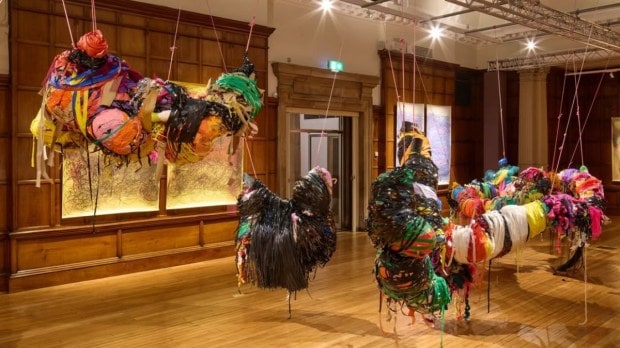
Kalu’s Turner Prize winner
Nnena Kalu featured a boldly coloured, cocoon-like hanging sculpture suspended at eye-level, which was made by winding and knotting recycled material. With spirals and spools, the Nnena Kalu tried to capture a ‘joyous uplift’ in a three-dimensional form with brushstroke-like spatial presence.