By Soma Das
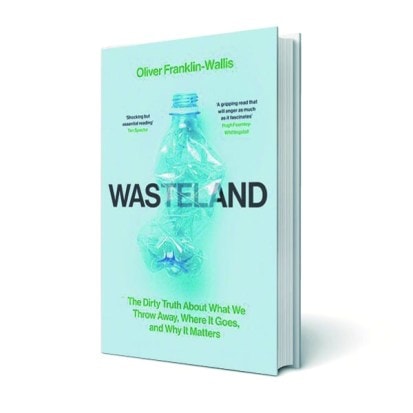
Wasteland: The Dirty Truth About What We Throw Away, Where It Goes, and Why It Matters
Oliver Franklin-Wallis
Simon & Schuster
Pp 400, Rs 799
A chunk of Black Himalaya on the margins of east Delhi, and a choking chemical Ganga flowing through the heart of India figure as disturbing silent protagonists in Wasteland, a non-fiction by Oliver Franklin-Wallis, a British journalist who embarks on a global tour to look at what we throw away, where it goes and why it matters. “We dump our waste on the margins and the marginalised,” declares Franklin-Wallis, probably the first dedicated global waste tourist of our generation.
He dares to attempt a trek-up the Ghazipur land-dump in Delhi with his tourist guides—waste-picker Anwar and waste-trader Akbar—who have secretly sneaked him in. Locals call this waste-hillock ‘Mt Everest’, and the author scans the drink cans, chips packets, ceramic shards, shaving razors among the 87 types of waste, the pickers sort out to dub it a ‘capitalism sundae’. Why is this mound of waste, called Ghazipur landfill and not land-dump, it’s not a hole in the earth that’s being filled, it’s being dumped in open growing upwards and outwards, he begins with the most fundamental question.
Worldwide, a third of our waste is dumped in open sites like in Ghazipur, another 37% is land-filled, the author reckons. That’s because waste management is expensive, while dumping virtually costs nothing. The problem is we are generating waste at a scale and pace unprecedented in history, but globally only a fifth of our waste is recycled, while the rest is either burned, dumped or buried. This narration echoes in speeches of Mr Nitin Gadkari, road and transport minister of India, who says, “This era belongs to entrepreneurs who will turn waste into wealth.” Interestingly, his team in the ministry are now focusing on pilot projects to use waste from Ghazipur and other land dumps to make roads in Delhi, but that will hardly be enough to solve the Everestine problem of open dumps and waste sites.
The chapter is as much about the waste dump as it is about the marginalised who tend to it, who almost revere the dump. Where you see waste, I see livelihood, says Akbar. Over time we learn to read the waste the way sailors can read a river current, philosophies Anwar, one of the 4 million waste workers in India who recycle our waste economy, finding value in what we throw away. Over 70% of waste workers in India earn less than `10,000 monthly with little access to government benefits, found a UNDP 2022 survey. This is when their work is not only poorly paid but dangerous too. At the peak of Delhi summer, the waste mounds could be unbearably hot, forcing workers to work through the nights. Accidents are not uncommon either.
At the bottom of the waste pyramid are mostly women. The author chats with one such woman worker, who offers her daughters to him at the end of their conversation “Take them with you.” At the top of the waste pyramid are very few women. Victoria Pritchard, a feisty woman manager of landfills in England, frets about ill-fitting PPE (personal protective equipment) designed for men. I don’t want a pink one with flowers, just one that fits well, she quips. Giving us a study of contrasts between landfills of poor and rich countries, the author shows how waste is “our secret history, the under history”. From murder victims to antiques, to favourite brands, all end up in these dumps—making them valuable for archaeologists and garbologists. One man’s trash is another’s treasure.
In another chapter, following Ganga from tributary ‘Yamuna’ in Delhi to Kanpur, the author wonders—how did the most sacred river end up among the most polluted? Yamuna, source to 70% of water supply in Delhi, was declared ‘biologically dead’, unfit for aquatic life in 2017.
A personal history of Feroz, who lives by the river and earns his livelihood as a diver supports the claim. He has seen the species of fishes reduce from a thousand to two over the past two decades, when industries started springing up. He dives for immersing ashes, retrieving valuables, and about twice a month to rescue or bring up bodies of people who attempt suicide from road bridges above. During Covid-19, Feroz recalls diving 50 times a day to dump ashes, every time downing a glass of alcohol before he dived to drown his grief. But Feroz believes in the holiness of Ganga and is sure that pollution can’t harm you if you have faith.
The author explores the complex dynamics of tanneries causing pollution in Ganga and meets IIT Kanpur professors who say “there is no record of …how much industrial waste is being dumped, how many carcinogenic elements are being put into water”. At the last count, studies show 350,000 known chemicals registered globally for production. In Ganga and elsewhere we may have crossed the ‘planetary threshold’ for chemical pollutants—a tipping point at which toxic substances threaten the integrity of ecological processes. Returning from Kanpur—he crosses a huge waste dump sized several football fields, carpeted with leather scraps dried out, water pooling and goats and chickens picking through waste for food.
“…how little we truly see of the way things are made”, the author feels sick standing on that ‘monument of slaughter’, remembering a sight out of Cormac McCarthy novel known for his graphic depiction of violence. To a less well-read Indian mind, his chapter on Ganga may remind a legendary song of Bhupen Hazarika: “Oh Ganga, why do you still flow?”
Readers in India concerned about our country must read at least two chapters —‘The Mountain’ and ‘The Unholy Water’. But if you consider yourself a citizen of the world, and care about the planet, you must brave the full book to understand this hidden world of waste, no matter where you live. It’s probable that a section of Indian readers will accuse the narration of ‘a western bias’, of peddling unflattering stereotypes about poor and dirt in India. But they would have missed the point. Sometimes it takes a fresh perspective to notice what we take for granted. Franklin-Wallis spares no one—fast fashion, e-commerce cardboard boxes, smartphones, gadgets. A third of what we throw away today is produced the same year and the waste industry has ‘profited from our disgust’. Some detailing in the book may seem obnoxious, but if you wish to save this planet, don’t scrunch up your nose, and turn your eyes away.
Soma Das is the author of The Reluctant Billionaire and an adviser to agencies in the development space