



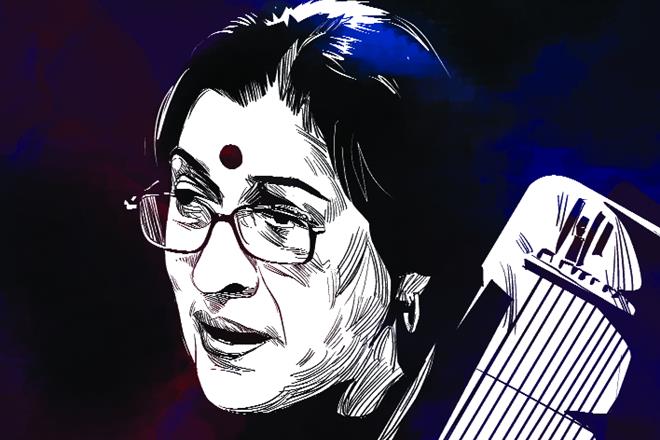
To describe Kishori Amonkar as the doyenne of Hindustani classical music is an understatement. Also, saying that she was one of the most legendary exponents of the Jaipur-Atrauli Gharana won’t do justice to what she was. And mentioning that she was conferred with Padma Vibhushan and Padma Bhushan won’t suffice to describe her stature. Kishori Tai was all what’s said here and much, much more than what mere words can describe. Her music was divine. Although a disciple of Mogubai Kurdikar, her mother and a staunch follower of Gharana rules, Kishori didn’t limit herself to the Jaipur-Atrauli Gharana. Founded by the legendary late Alladiya Khan, the followers of the Jaipur Gharana are known for strict adherence to tradition.
Kishori was no exception. Her greatness, however, was not only in following the Gharana rules and mastering the grammar of music, she was outstanding because of her ability to absorb the best and the beautiful from every other Gharana. In fact, this is what made Kishori Tai a near-complete singer.
Kishori Tai learned music from various gurus, including Anjanibai Malpekar of the Bhendi Bazar Gharana, Anwar Hussain Khan of the Agra Gharana, and Sharadchandra Akolkar of the Gwalior Gharana—all different genres. Although the ragas that all these Gharanas present are the same, their rendition is different due to the unique style that each Gharana possesses. Kishori Tai had an amazing ability to infuse the best of every Gharana and present in her unique, soul-touching style.
Kishori Tai, undoubtedly, was ahead of her times. At a time when Gharanas and their music was considered a moribund structure, young Kishori ventured into unchartered territories by blending different streams to create her own. Needless to say, she was at the receiving end for this musical ‘blasphemy’. However, there were an equal number of music aficionados who were appreciative of her. Before choosing a completely different path of her own, Kishori immersed herself into the history of Hindustani classical music.
She thoroughly studied Bharata Muni’s Natya Shastra as well as Vedic music. That’s why conversing with her was as great as listening to her music. I had the privilege of interviewing her a couple of times. Both occasions were as brilliant as her baithaks. Not many can articulate the way she could. And she could because she had her own independent understanding and conviction about the Hindustani classical music. Her ability to analyse music and its impact made her the most sought-after musician—even for interviews. All this helped her come out with a genre which was unique to her. What was so special in her music?
You might also want to see this:
There are a handful of performers who have the ability to make their music cerebral, inspiring and soul-stirring. Whatever she sang, Kishori Tai left her mark. Be it film music, recitation of Meera’s Bhajans, Thumri, Tappa or Marathi poetry, Kishori Tai could absorb the content and present it in such a way that critics and commoners loved it. It’s very rare. Rare because the Hindustani classical music is bound by certain grammar and rules that can not be bent to suit the performer. If one decides to stick to grammar, it may put off commoners, even though critics may appreciate it. If one plays to the gallery by flouting all the rules, it doesn’t stay in the category of ‘classical’ music. The huge following Kishori Tai has is a tribute to her extraordinary ability to stick to the classical path and still experiment.
Hindustani and Karnatak music are two distinctly different streams. Kishori Tai was one such artist who could bridge the two and perform with another legendary artist of Karnatak music, the late Dr Balamuralikrishna Aiyer. The jugalbandi between these two was a matter of folklore in the world of music for quite some time. With her sudden death, the last of the gold standard of Hindustani classical music has disappeared.