



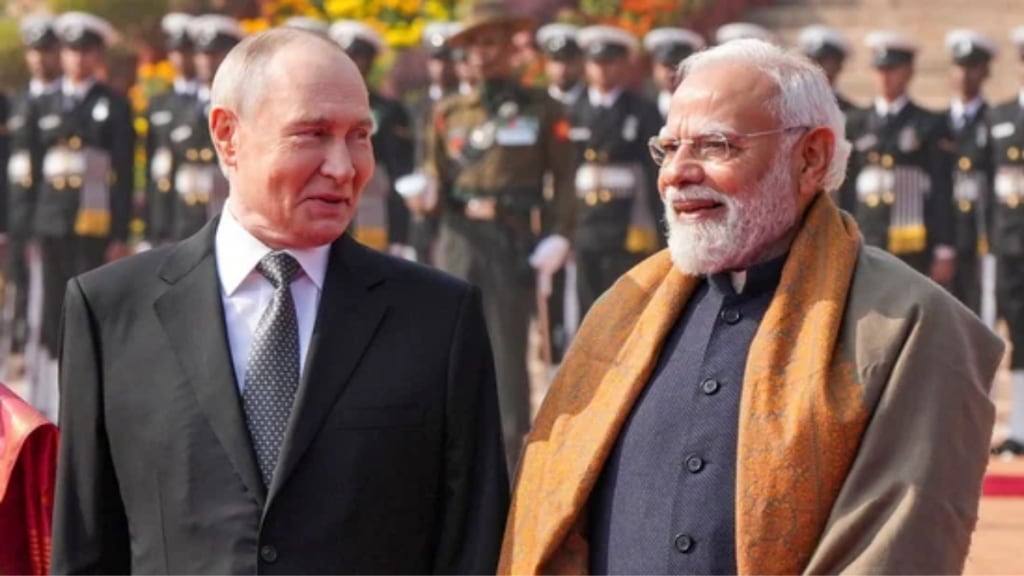
Russian President Vladimir Putin’s ongoing visit to India entered its second day on Friday as the two countries firmed up an ambitious roadmap to improve their long-standing strategic partnership against the backdrop of Western sanctions and a turbulent global order.
Meeting in New Delhi, Prime Minister Narendra Modi and President Putin set the tone for the decade ahead by adopting the Programme for the Development of Strategic Areas of India-Russia Economic Cooperation till 2030, a five-year plan promising wider cooperation in trade, energy, technology and security.
“Over the past eight decades, the world has witnessed numerous ups and downs,” Modi said at the joint presser “And amidst all this, the India-Russia friendship has remained steadfast like a pole star.”
What is India – Russia Economic Cooperation Programme 2030?
The leaders agreed that boosting economic engagement is now the core priority. Taking aim at tariff barriers, logistical bottlenecks and payment disruptions due to sanctions, both sides committed to seamless trade flows and increased use of national currencies for settlements. Putin emphasised that the two nations are looking at “increasing annual bilateral trade volume to $100 billion”. The roadmap also calls for strengthening industrial ties, technology partnerships, and a more balanced trade, with Russia welcoming India’s intent to expand exports.
Linking the oceans and the arctic
Transport corridors emerged as a major focus, from the International North-South Transport Corridor to the Chennai, Vladivostok maritime link and even Arctic shipping lanes. The two sides explained the need for a stable logistics ecosystem to support enhanced connectivity and welcomed fresh cooperation between the railways of both countries. They also added intent to scale investments in Russia’s Far East and the Arctic, seeing opportunities in energy, mining, agriculture and maritime transport.
From oil to nuclear and critical minerals
Energy is the backbone of this partnership, and Moscow promised reliability amid global volatility. Putin said Russia stands ready “for uninterrupted shipments of fuel to India” and also proposed cooperation on small modular nuclear reactors and floating nuclear power plants. Both sides acknowledged productive work in crude oil, refining technologies, LNG infrastructure, underground coal gasification and nuclear energy with timelines reaffirmed for Kudankulam Nuclear Power Plant units.
Russia and India defence partnership
Military and military-technical collaboration, a decades-old pillar is being reshaped with India’s pursuit of self-reliance. The new direction? Joint R&D and manufacturing of advanced defence systems under Make-in-India, including local production of spares for Russian-origin equipment with an eye on exports to friendly nations. Both leaders appreciated the INDRA exercises and committed to more exchanges between defence forces.
Space and high-technology
ISRO and Russia’s Roscosmos are expanding collaboration in areas including human spaceflight, rocket engines and deep-space missions. Beyond space, both sides agreed to stimulate cross-border innovation ecosystems, from academia to start-ups, in critical and emerging technologies, rare earths, digital security and cyber infrastructure.
Culture, workforce and tourism
Visa simplification, skilled labour mobility agreements, student welfare and cultural festivals are being pushed to ensure the partnership is not just strategic, but social. Film cooperation and tourism exchange are expected to rise with 30 days free e-visa access.
Russia reiterated firm support for India’s permanent seat at a reformed UN Security Council. Both leaders committed to strengthening their joint influence through BRICS, SCO and the G20, and advancing the concerns of the Global South.