



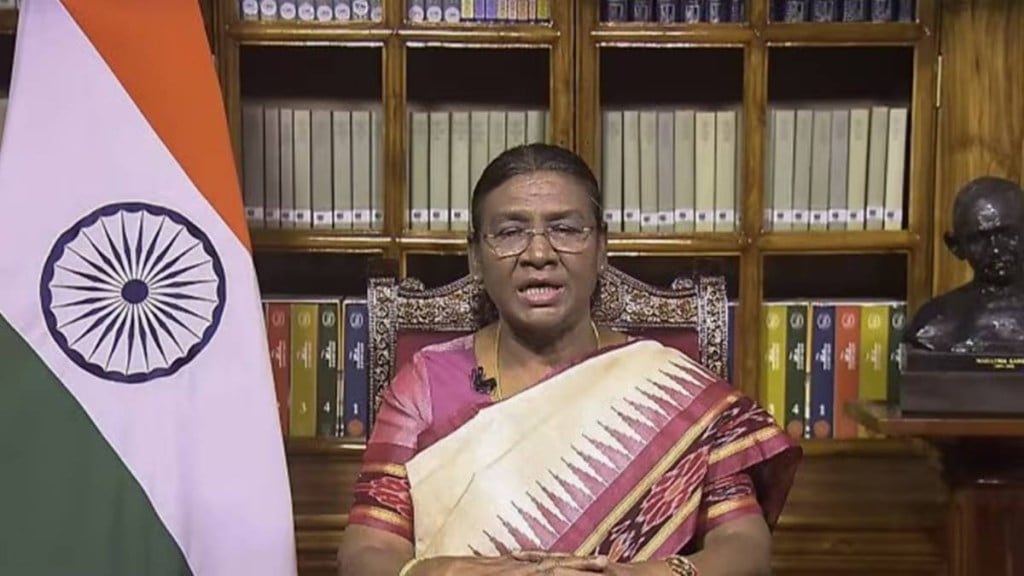
The VB G RAM G bill became an official Act of Parliament on Sunday after receiving assent from President Droupadi Murmu. It is set to replace MNREGA for national rural employment — with states now tasked with preparing and notifying their schemes within six months of enforcement. The Central government will soon notify a date for the newly signed act to come into effect.
Opposition outrage
Opposition parties have been vehement in their criticism of the new Act — protesting the removal of ‘Mahatma Gandhi’ from the name of the policy. They have also flagged the reduction in central funding for the scheme and noted that it could strain state budgets and potentially limit jobs. VB G Ram G Act is supply-driven and contains normative caps — with fewer grassroots powers for gram sabhas, and no penalties for non-provision of work.
The Congress is mulling a nationwide movement across all states against the Viksit Bharat Guarantee for Rozgar and Ajeevika Mission (Gramin) (VB-G-RAM-G) Act. Party leader Jairam Ramesh told ANI that the Congress Working Committee meeting scheduled for December 27 will finalise an action plan.
“The fundamental character of MGNREGA has been changed; the basic structure of the scheme has been altered. The employment that was being provided to rural, deprived, and exploited people has been taken away,” senior Congress leader Jairam Ramesh told ANI.
How does it differ from MGNREGA?
The VB-G RAM G Act repeals the MGNREGA and paves the way for a structural transformation of the government’s role in the rural employment landscape.
| Viksit Bharat Guarantee for Rozgar and Ajeevika Mission (Gramin) Act | Mahatma Gandhi National Rural Employment Guarantee Act |
| 125 days of wage employment | 100 days of wage employment |
| Provides for normative allocation to states. Any expenditure beyond it has to be borne by the state governments. | It is demand-driven. The government has to allocate additional funds if there is demand for work. |
| State governments will take on a larger share of the expenditure than before. Financial liability to be shared 90:10 for the northeastern and Himalayan states, and 60:40 for all other states and UTs with legislature. Whole cost to be borne by Central government for Union Territories without legislature. | 100% of wages to be paid by the Centre. Material cost shared 75:25 between the Centre and the states.the state governments will take on a larger share of the expenditure than before. |
| State will notify a period covering the peak agricultural seasons of sowing and harvesting, during which work can not be sought under this scheme. | Work can be sought throughout the year. |
| Four thematic focus domains: water security through water-related works, core rural infrastructure, livelihood-related infrastructure and works for the mitigation of extreme weather events. | Work is divided into broad categories such as water conservation, drought-proofing, irrigation, renovation of traditional water bodies, land development, and flood control. |
| Programme officer to allot at least 50% of the works in terms of cost under the scheme, to be implemented through the gram panchayats. Work shall originate from the Viksit Gram Panchayat Plans, prepared by the gram panchayats and integrated with the PM Gati Shakti National Master Plan. | Gram panchayat is responsible for identification of projects in its area. Plans and decisions regarding the nature and choice of works to be undertaken, the order of each worksite selection, etc., would be made in open assemblies of the gram sabha or ward sabha and ratified by the panchayat. |
| Every panchayat to prepare saturation-mode plans based on its classification into categories A, B, C — determined based on development parameters. | No categorisation of panchayats. |
| Talks about a comprehensive digital ecosystem, including biometric authentication at various levels, global positioning system or mobile-based worksite monitoring, proactive public disclosures, and artificial intelligence for planning, audits and fraud risk mitigation, which will be used to modernise governance, accountability and citizen engagement. | No such provision. |