



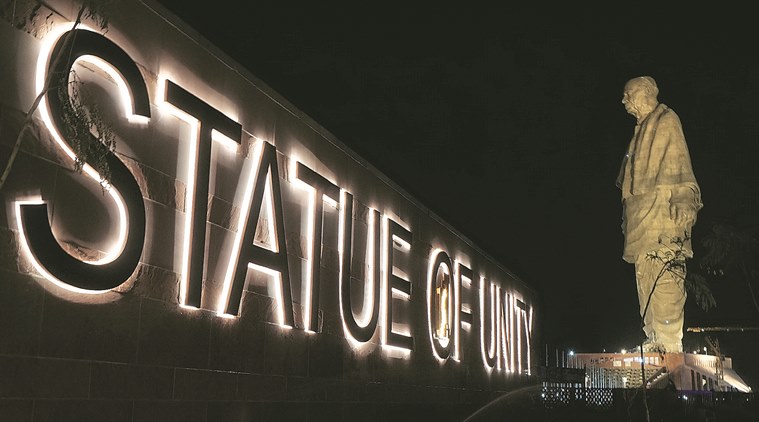
Statue of Unity, India’s ode to Sardar Vallabhbhai Patel and the Indian freedom struggle, will be the world’s tallest statue, twice the size of the Statue of Liberty. The Statue of Unity will be unveiled by Prime Minister Narendra Modi on October 31, which also marks the 143rd birth anniversary of Sardar Patel, the Ironman of India. The world’s “tallest statue” dedicated to independent India’s first Home Minister stands at 182 metre (597 feet) tall.
The monument is touted to become one of the most important tourist places of India. However, the gigantic project required years-long dedication and confronted an array of issues and challenges. Here are some challenges that authorities faced throughout the construction.
Statue of Unity: All you need to know about 182-metre statue of Sardar Vallabhbhai Patel before world witnesses the engineering marvel
Statue of Unity Construction
The cost of the project is worth Rs 2,989 crore and work is going on at five major sites, according to the Indian Express report. The statue, the walkway, the ticket counter, the food court, the four-lane approach highway and the yard where the parts are being assembled, and the Shrestha Bharat Bhavan (a 52-room three-star lodging facility) are being built. A massive 4,076 labourers are tirelessly working day and night. The labourers are divided into two shifts. Around 1000 workers are busy in cladding of the statue alone.
Apart from local workers, a strong contingent of 200 from China have been working in batches for two-three months each since September 2017. L&T, which is the executing firm, says, “The construction has been done in four stages, including a mock-up, 3D scanning technique as well as a computer numerical control production technique for accurate reproduction of minute details.”
Why Chinese involvement
In the last few days, a political slugfest erupted over the Chinese involvement in the making of the ‘Statue of Unity’. Congress President Rahul Gandhi, during a rally in Madhya Pradesh’s Satna, said, “The Prime Minister used to say that we will install the statue of Sardar Patel in Gujarat. It is unfortunate that the iron man’s statue will be inscribed with ‘Made-in-China’ as it is being made by China.” The statement drew sharp criticism from BJP and PM Modi who said, “People see caste, state, election… Stop belittling great personalities. Modi is living, abuse him 24 hours, and if that is not enough, do it for 26 hours.”
However, the IE report says it was L&T which had recommended Chinese foundry Jiangxi Tongqing Metal Handicrafts Co. Ltd (or the TQ Art foundry) for moulding the cladding of the bronze statue. An official said that no foundry in India has the expertise to cast a bronze statue as tall as the Statue of Unity. Also, the aforementioned Chinese foundry is known for its bronze casts and the firm offered to work at a speed which will ensure that project will finish by the October 31 deadline.
Cladding challenges
The cladding of the statue has remained a challenge. An L&T engineer told The Indian Express that the statue will have about 1,850 metric tonnes or 18.5 lakh kilogrammes of bronze cladding in all. The amount of steel and concrete used would amount to several times more. On December 15, 2013, then Gujarat CM Modi had flagged off 1,000 trucks to travel to seven lakh villages, carrying about three lakh empty kit boxes, to collect soil and the scrap-iron farm implements.
Subsequently, by 2016, 135 metric tonnes of iron were collected in various forms. This cladding was done under the close watch of the award-winning designer Ram V Sutar. 5,000-odd bronze panels were transported over the sea and then by road. These were assembled at an off-site workshop in Kevadia Colony.
Another challenge was showing the specifications, including showing Patel’s legs clad in a dhoti and his feet in sandals. These would mean the statue is thinner at the base than the top which goes against the norms of what other tall statues have followed. Officials have kept the slenderness ratio between the top and bottom half of the Patel statue to 16:19 — significantly higher than the 8:14 ratio norm in tall buildings.
Wind, earthquake challenges
Natural factors like wind, earthquake have posed a stiff challenge before engineers. A top Sardar Sarovar Narmada Nigam Ltd (SSNNL) official predicts the statue can sustain wind velocity of 220 km/hour and earthquakes measuring up to 6.5 on the Richter Scale, which are at a depth of 10 km and within a radius of 12 km of the statue. To resist earthquake and wind forces, engineering teams first constructed the core wall, the RCC spine of the statue. Then steel frames were affixed.
Face challenge
Another challenge came in the form of the looks of the statue. Since Patel’s face will be an important aspect, special care has been given on the last few metres, comprising the head and shoulders. “We have set aside two weeks in the beginning of October to complete the face,” an L&T official was quoted as saying by IE.