



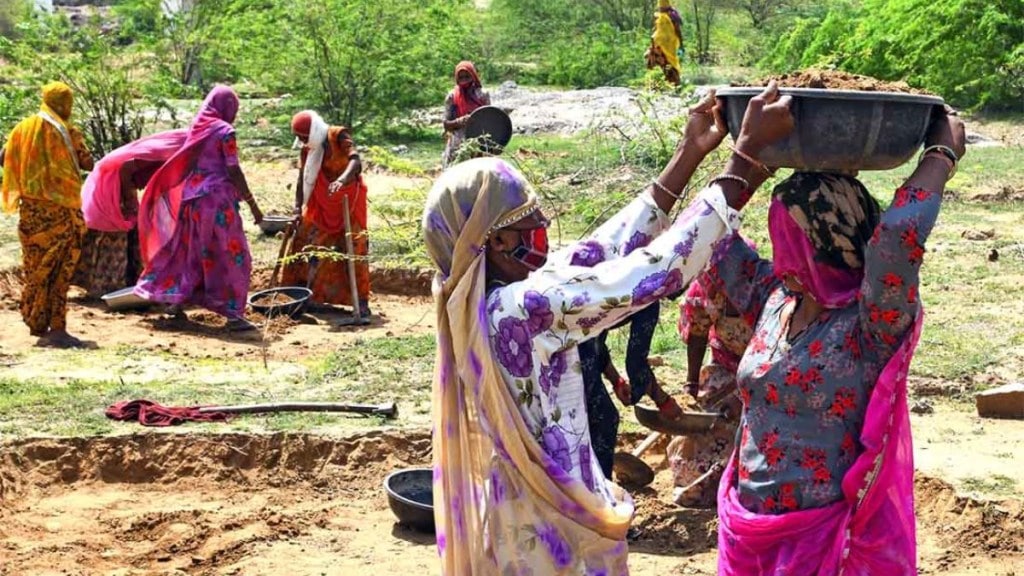
To curb rampant leakages, the proposed law to replace the two-decade-old rural job guarantee programme –MG-NREGA– seeks a complete overhaul of the programme, shifting focus to strategic infrastructure creation and a predetermined funding pattern. The scheme will no longer be demand-driven, and states will share its costs in line with other centrally sponsored schemes in a 6:4 ratio.
Under the current system, MG-NREGA operates as an open-ended, demand-based programme in which the Centre bears the full cost of unskilled wages—typically accounting for nearly 75% of the scheme’s annual outlay of about Rs 85,000–90,000 crore. States contribute only 25% towards material costs and skilled or semi-skilled labour, resulting in limited fiscal responsibility at the state level.
What’s the purpose behind revamping the scheme?
The proposed Viksit Bharat –Guarantee for Rozgar and Ajeevika Mission (Gramin) Act, 2025 (VB–G RAM-G) seeks to correct this imbalance by actually converting the programme into a centrally sponsored scheme (which it already is but never enforced) with a standard 6:4 Centre–State funding ratio for non-hilly states and 9:1 for north-eastern and hilly states, bringing it in line with other major central schemes.
Despite moving away from an open-ended demand model, the Centre has proposed to increase the statutory employment guarantee from 100 to 125 days per rural household. The objective is to ensure income support during agricultural lean seasons while addressing unintended distortions caused by public works during peak farm activity.
Deadline for states
The Bill allows states to notify up to 60 days of no-work periods in aggregate during peak sowing and harvesting seasons, ensuring labour availability for agriculture and preventing artificial wage inflation. At the same time, states will be legally bound to pay unemployment allowance if work is not provided during the eligible periods.
A major shift under the new framework is the reorientation of works away from fragmented, low-impact activities towards strategic rural infrastructure creation. Priority will be given to four categories: water security, core rural connectivity, livelihood-supporting infrastructure, and climate-resilience projects. The aim is to ensure that public expenditure under the scheme results in durable assets that raise agricultural productivity, improve market access and strengthen rural resilience to climate shocks.
The proposed law also mandates Viksit Gram Panchayat Plans, prepared at the local level and integrated with national spatial platforms, to improve planning coherence and asset quality. This will be complemented by a much tighter digital governance framework, including AI-based fraud detection, real-time monitoring systems, GPS-enabled verification and stronger, more frequent social audits.
Explaining the rationale for the overhaul, a government note said MGNREGA was designed for the rural realities of 2005, while rural India has since undergone a structural transformation. Poverty levels fell sharply from 25.7% in 2011–12 to 4.86% in 2023–24, supported by rising incomes, consumption and financial inclusion, as reflected in recent MPCE (Monthly Per Capita Expenditure) and NABARD surveys.
Despite multiple reform attempts, serious systemic failures persisted. Investigations in 19 districts of West Bengal uncovered non-existent works and fund misuse, leading to payment freezes. Monitoring across 23 states in FY26 found works not commensurate with expenditure, machine use in labour-intensive projects and widespread bypassing of digital attendance norms. Post-pandemic data also showed that only 7.61% of households completed 100 days of work.
“These entrenched issues required a new framework, not incremental fixes,” the note said, adding that the new law aims to create a cleaner, more accountable and infrastructure-driven rural employment system aligned with the Viksit Bharat 2047 vision.