



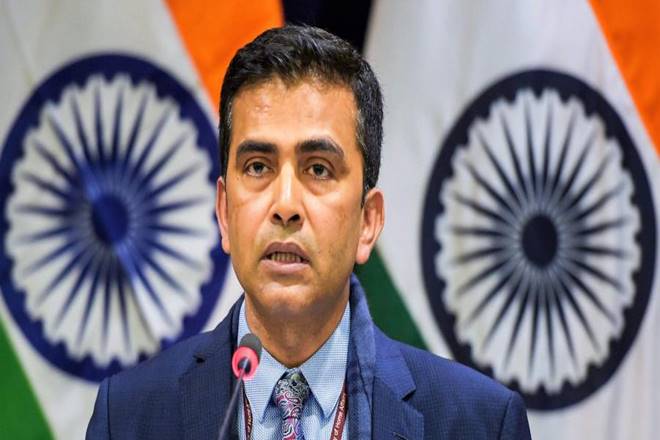
A day after UN High Commissioner for Human Rights moved the Supreme Court over Citizenship Amendment Act, India on Tuesday reacted strongly and told the international body that it had no locus standi on issues pertaining to New Delhi’s sovereignty. New Delhi said that the citizenship law is an internal matter of India and concerns the sovereign right of the Indian Parliament to make laws. “We strongly believe that no foreign party has any locus standi on issues pertaining to India’s sovereignty,” MEA spokesperson Raveesh Kumar said.
The Ministry of External Affairs reacted after UN High Commissioner for Human Rights, Michelle Bachelet, informed India’s Permanent Mission in Geneva that her office had filed an Intervention Application in the Supreme Court with respect to CAA. The petition raises concerns over the CAA with respect to India’s human rights obligations, including the right to equality.
“The examination of the CAA in the present case raises important issues with respect to international human rights law and its application to migrants, including refugees. The examiniation by the Honorable Court of the CAA is of substantial interest to the High Commissioner, considering its potential implications for the application and interpretation of Indian’s international human rights obligations, including the right to equaliy before the law and the prohibition of discriminatiion as well as the CAA’s impact on the protection of humkan rights of migrants, including refugees in India,” it states.
Responding to the petition, New Delhi said that India was clear that CAA is constitutionally valid and complies with all requirements of constitutional values. “It is reflective of our long-standing national commitment in respect of human rights issues arising from the tragedy of the Partition of India,” Kumar said.
Stressing that India is a democratic country governed by the rule of law, Raveesh Kumar said: “We all have the utmost respect for and full trust in our independent judiciary. We are confident that our sound and legally sustainable position would be vindicated by the Hon’ble Supreme Court.” The CAA makes people from six minority communities — Hindus, Buddhists, Jains, Sikhs, Parsis — in our three Islamic neighboring countries Afghanistan, Pakistan and Bangladesh eligible for Indian citizenship.
The law leaves out Muslims on the ground that they are unlikely to face religious persecution in Islamic countries. However, this justification has not gone down well with a section of people here in India and in some other Islamic countries. Some of the opposition parties too have been against the law and have passed resolutions against it.