



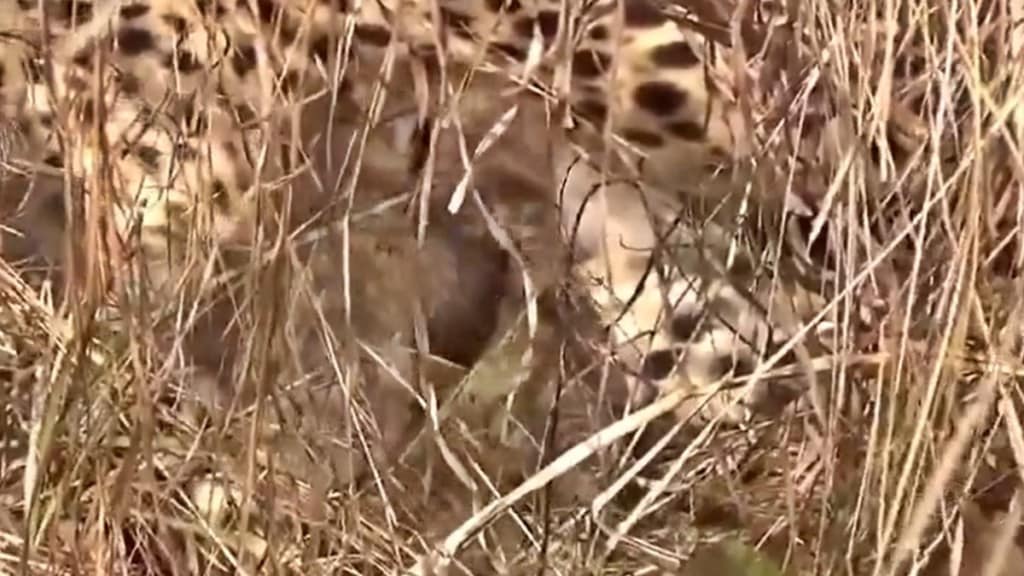
Following the recent birth of cubs by a Namibian cheetah named Aasha, another cheetah Jwala has given birth to three cubs at Kuno National Park in Madhya Pradesh.
Union Minister of Environment Bhupendra Yadav, shared the news on X, stating, “Namibian Cheetah named Jwala has given birth to three cubs. This comes just weeks after Namibian Cheetah Aasha gave birth to her cubs.”
He also extended congratulations to all wildlife frontline warriors and wildlife enthusiasts nationwide and shared a video of the little ones.
Earlier on January 16, Namibian cheetah Shaurya passed away at KNP in Madhya Pradesh, confirmed by State Forest Minister Nagar Singh Chouhan.
Also Read:Good news! Namibian Cheetah Aasha welcomes three cubs at Kuno National Park
As per an official statement from the additional chief conservator of forest and the director of the Lion Project at Kuno, a tracking team observed indications of incoordination and a staggering gait in Shaurya at approximately 11 am on Tuesday, prompting an urgent need for medical intervention.
“After noting these signs, the cheetah was tranquilized, and a medical examination revealed weakness. Despite attempts to revive the cheetah through medical intervention, it developed post-revival complications, ultimately leading to its demise. The animal did not respond to CPR efforts,” stated the APCCF and the Director of the Lion Project in the official statement, as ANI reported.
Also Read:Two more cheetah cubs die at Kuno Park in MP
On September 17, 2022, Prime Minister Narendra Modi released the first batch of eight Namibian cheetahs into Kuno National Park (KNP) on his birth anniversary. The cheetahs were translocated from Namibia and South Africa as part of a project aimed at reintroducing the big cats, which had been extinct in India for several decades.
In the second batch, a total of 12 cheetahs were imported from South Africa. Despite this, out of the 20 cheetahs translocated to India in two phases, 8 did not survive. Following these events, 12 cheetahs from South Africa were introduced into Kuno in the subsequent February.
The translocation process was conducted under the careful oversight of an expert team, consisting of government officials, scientists, wildlife biologists, and veterinarians from Namibia, South Africa, and India, as previously communicated by the Ministry of Environment, Forest, and Climate Change
(With ANI Inputs)