



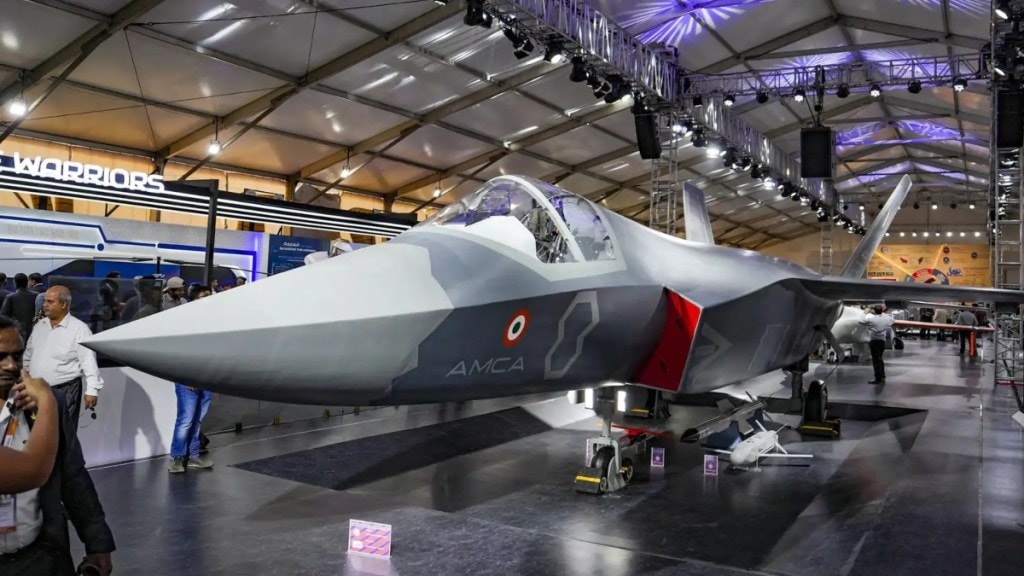
In a landmark move toward developing India’s first fifth-generation stealth fighter, the Defence Ministry has granted formal approval to the execution model for the Advanced Medium Combat Aircraft (AMCA) programme — a pivotal moment in India’s effort to join the exclusive group of nations capable of creating next-generation combat aircraft.
On Tuesday, Defence Minister Rajnath Singh approved the framework under which the Aeronautical Development Agency (ADA) will spearhead the AMCA project, working in partnership with private industry. The green light reflects New Delhi’s intention to fast-track prototype development and expand the nation’s aerospace expertise, aligned with the broader vision of Aatmanirbharta (self-reliance).
Touted as India’s response to fifth-generation air dominance, the AMCA is envisioned as a stealth-intensive, multirole platform, featuring technologies such as sensor fusion, internal weapons carriage, state-of-the-art avionics, and supercruise capability. Once inducted, the aircraft is expected to dramatically bolster India’s aerial combat capabilities, particularly in high-threat environments.
2035: The deadline for India’s most ambitious fighter jet
Though the execution framework is now in place, the challenge ahead is formidable. The AMCA marks the most technologically complex aviation programme India has ever undertaken. The Defence Research and Development Organisation (DRDO) has set a 2035 deadline to deliver the aircraft.
“This journey began only in 2024, when the Cabinet Committee on Security sanctioned the project,” DRDO Chairman Samir V Kamat had previously said. “It will take ten years, and we have committed to delivering the platform by 2035.”
This timeline is in line with global benchmarks. Fifth-generation aircraft such as the U.S. F-35 or China’s J-20 have typically taken over a decade from inception to deployment, often facing major engineering and design obstacles. The AMCA will follow a similar trajectory, requiring breakthroughs not only in stealth architecture but also in propulsion systems, electronic warfare, and integrated combat networks.
One of the most vital components — the engine — is expected to be developed via a joint venture with a foreign original equipment manufacturer (OEM), a strategy that DRDO believes will reduce risk and speed up progress.
“We learnt a lot from the Kaveri engine, but that was fourth-gen. Now we’re aiming for sixth-gen engine tech,” said Kamat. Discussions with international partners are underway.
Directed energy weapons: Leaping into future warfare
In parallel with the AMCA programme, India has achieved another milestone in advanced warfare capabilities — a successful test of a 30-kilowatt directed energy weapon (DEW) designed to disable drones and electronic surveillance equipment.
Developed by the Centre for High Energy Systems and Sciences (CHESS) under DRDO, the Mk-II(A) laser system shot down multiple drones during recent trials at the National Open Air Range in Kurnool.
With this test, India has entered a select group of nations — including the US, Russia, and China — that possess demonstrable high-energy laser weapon technology. DRDO is also progressing on related technologies like electromagnetic pulse and microwave-based systems, aiming to establish a future-ready arsenal inspired by “Star Wars”-style combat.
“The synergy between DRDO labs, industry, and academia in this programme is setting the tone for what the future of warfare will look like,” Kamat said.
A pivotal moment for India’s defence landscape
The twin breakthroughs — the AMCA moving into its execution phase and the laser weapon demonstrating operational success — represent a major strategic inflection point for Indian defence planning.
As other indigenous platforms such as the VSHORAD, MPATGM, and LCA Mk II approach induction, India’s defence production ecosystem is on the verge of significant transformation.
For defence analysts and aerospace observers, the progress of the AMCA will serve as a litmus test for India’s aspirations to achieve true strategic independence in the skies — and whether the 2035 goal is a bold ambition or an attainable target.