



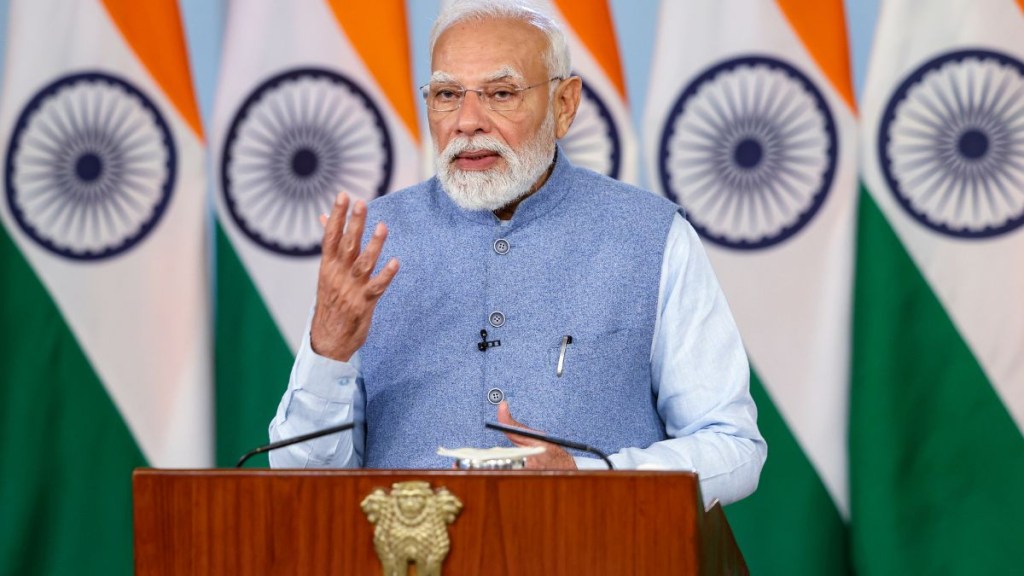
Prime Minister Narendra Modi on Saturday strongly condemned what he called a “colonial narrative” behind the term Hindu rate of growth. He said the phrase unfairly associated India’s slow economic expansion in the decades after Independence with Hindu culture. The PM described it as a derogatory idea rooted in a “slave mentality”.
Speaking at the 23rd Hindustan Times Leadership Summit, the Prime Minister said India must eliminate this colonial-era mindset within the next 10 years. He argued that the sluggish 3-3.5% growth seen during successive Congress governments was not cultural, but policy-driven, with economic expansion barely keeping pace with population growth.
Reframing ‘Hindu Rate’ as policy failure
PM Modi highlighted how past governments’ economic mismanagement led economists like Raj Krishna to coin “Hindu rate of growth” in the 1970s, unfairly blaming an entire society rather than flawed socialist policies.
At HTLS, he declared this an “insult to society,” reflecting a colonial hangover that stifled self-confidence and innovation even 79 years post-independence. Under his leadership, India has shifted to proactive, saturation-driven reform, delivering schemes 100% to all citizens, lifting 25 crore from poverty and fuelling MSME hubs in villages and smaller cities. Women’s global “nari shakti” and farmers’ tech connections exemplify this break from reactionary politics.
‘India is full of self-confidence’
He also emphasised that India stands at a juncture where it is full of self confidence even as the world has seen many ups and downs, be it financial crisis or global pandemic. These situations, in some way or another, challenged the world. Today, the world is full of uncertainties, but amid this, our India is emerging in a different league, he added.
‘World talks about slowdown, India talks about growth’
PM Modi added that while the world’s pace has slowed down, it hasn’t deterred India from narrating tales of growth.
“This represents a shift in resilience, a change in mentality that fosters finding solutions, and a change in aspirations. India is not only transforming today, but is also transforming the tomorrow that is about to come,” he added.