



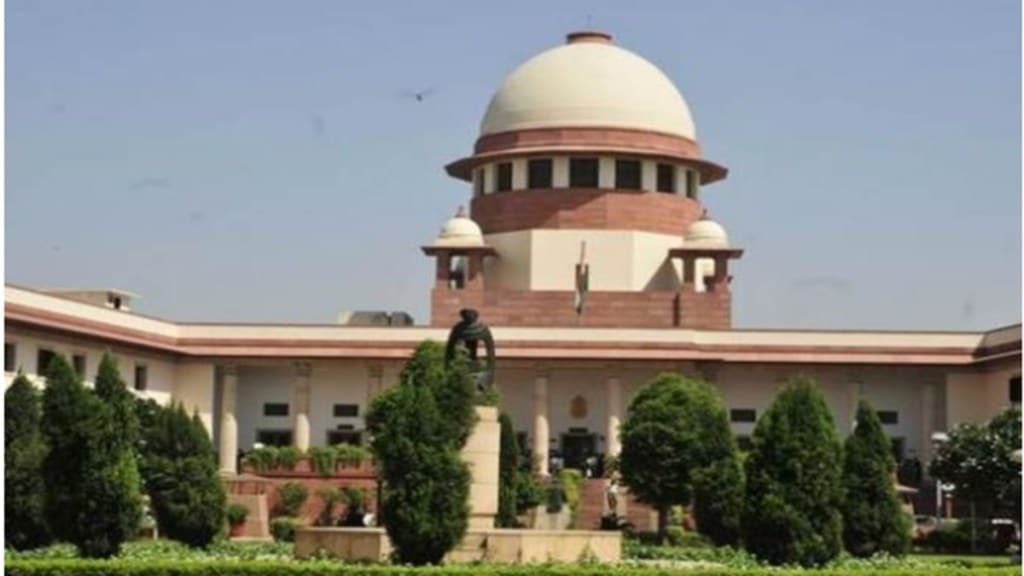
The law that provides the basis for reservation for the Economically Weaker Sections (EWS) is a “fraud on the Constitution and violates the basic structure”, a lawyer on behalf of petitioners opposed to the EWS quota told the Supreme Court on Tuesday, Bar and Bench reported.
The Supreme Court on Tuesday began hearing on the cases challenging the constitutional validity of the 103rd Constitution amendment that provided for the EWS quota. It will resume hearing on Wednesday. Three lawyers appearing for the PIL petitioners opposing EWS quota presented the case.
Also Read: Supreme Court fixes issues for adjudication on pleas challenging Centre’s 10 per cent EWS quota
A five-judge bench, comprising Chief Justice of India UU Lalit, along with Justices Dinesh Dinesh Maheshwari, S Ravindra Bhat, Bela M Trivedi and JB Pardiwala are hearing the matter.
The Union government introduced the EWS quota for those who cannot avail of reservations granted to Scheduled Castes, Scheduled Tribes and Other Backward Classes (OBCs), but have an annual family income of less than Rs 8 lakh. However, the rider is that a family which owns more than five acres of agricultural land or 1,000 sq. ft. of residential land will not be eligible.
“This 103rd amendment is a deceitful and a backdoor attempt to destroy the concept of reservation by granting this to the forward class,” advocate Mohan Gopal told the apex court, as quoted by Bar and Bench.
He said that the constitutional amendment was dividing the country on caste lines and is being “seen as an instrument to protect the privileged rather than safeguarding the marginalised.”
“The citizens who are educationally and socially backward as well as SCs and STs cannot take the benefit of reservation even if they fall within the economically weaker sections. This is wholly impermissible as it shows that special provisions have been made in favour of the economically weaker upper classes only,” Mohan argued in court, reported PTI.
Gopal had submitted that the EWS quota reversed the actual concept of reservation and had converted it into a scheme for financial upliftment.
Also Read: EWS quota: Supreme Court admits plea challenging Rs 8 lakh annual income criteria, hearing on August 2
“We must see 103rd amendment as an assault on the Constitution. It seeks to nullify, and neutralise the Constitution’s idea of treating unequals unequally. It stabs the Constitution in the heart,” the advocate, who is also a professor, said.
Meanwhile, senior advocate Meenakshi Arora argued that the EWS is caste-based.
“Reservation is class-based but the EWS is caste-based. Representation is a guard rail which has been built in and it cannot exceed 50 per cent. Reservations are not a poverty alleviation program and it was held in Indira Sawhney,” she said, as quoted by Bar and Bench.
Senior advocate Sanjay Parikh said the exclusion of poor belonging to Scheduled Castes(SCs), Scheduled Tribes(STs) and Other Backward Classes(OBC) made this provision for forward classes only and hence it was violative of the principle of equality and other fundamental rights as envisioned by the framers of the Constitution.