



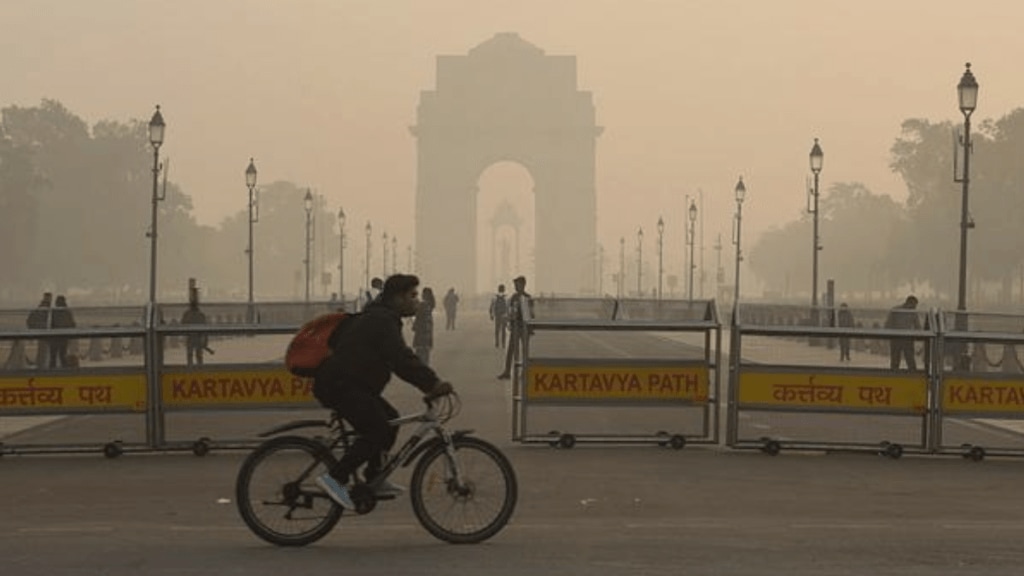
Amid the “very poor” Air Quality Index (AQI) in the national capital, the Commission for Air Quality Management (CAQM) has rejigged the Graded Response Action Plan (GRAP) measures. CAQM, in its release, has said that some GRAP 4 measures will be taken under GRAP 3; GRAP 3 measures under GRAP 2 and GRAP 2 measures under GRAP 1.
The revisions to GRAP measures were made after the Supreme Court observed that CAQM should take “proactive actions” to prevent further deterioration of air quality in Delhi-NCR.
GRAP: What changes have been introduced?
The Commission has reviewed and revised GRAP measures to tackle the “hazardous” AQI in Delhi. GRAP 4 measures, which have been moved to GRAP 3, include the work-from-home policy.
- NCR State Governments/GNCTD to decide on allowing public, municipal and private offices to work at 50 per cent strength and the rest to work from home.
- Centre may decide to permit work from home for employees in central government offices.
At the moment, GRAP Stage 3 is in force in Delhi, which bans non-essential construction and demolition work and restricts certain categories of vehicles, including those below the Bharat Stage (BS)-IV emission norms. Residents have also been advised to limit outdoor activities, particularly during the early morning and late evening hours. In addition to this, schools and other institutions have also been advised against sports or other outdoor physical activities by the Delhi government.
GRAP 3 measures moved under GRAP 2 include staggering timings for public and municipal offices in Delhi-NCR.
- (i) GNCTD and NCR governments to collectively decide to stagger timings for public offices and municipal bodies in Delhi and the adjoining areas – Gurugram, Faridabad, Ghaziabad and Gautam Budh Nagar.
(ii) State governments to decide to stagger timings for public offices and municipal bodies in other areas of NCR.
- Centre to stagger timings of Central Government offices in Delhi-NCR.
With the new rejig, the GRAP 2 measures, such as uninterrupted power supply, Do’s and Don’ts to minimise pollution, synchronisation of traffic movement, would be moved under GRAP 1.
Here’s what the order said:
- Ensure uninterrupted power supply to discourage use of alternate power-generating sets/ equipment (DG sets etc.)
- Synchronise traffic movements and deploy adequate personnel at intersections/traffic congestion points for smooth flow of traffic.
- Alert in newspapers/TV/radio to advise people about air pollution levels and Do’s and Don’ts for minimising polluting activities
- Augment public transport services through CNG/ electric buses and metro services by inducting additional fleet and increasing the frequency of service. Introduce differential rates to encourage off-peak travel.
The Commission also directed the immediate incorporation of the changes by the relevant authorities.
Delhi AQI today
The AQI in Delhi as of 1 pm is 364, which falls in the “very poor” category, as per the Central Pollution Control Board (CPCB). As per CPCB classification, an AQI between 0-50 is considered “good”, 51-100 is “satisfactory”, 101-200 is “moderate”, 201-300 is “poor”, 301-400 is “very poor”, and 401-500 falls under the “severe” category.