



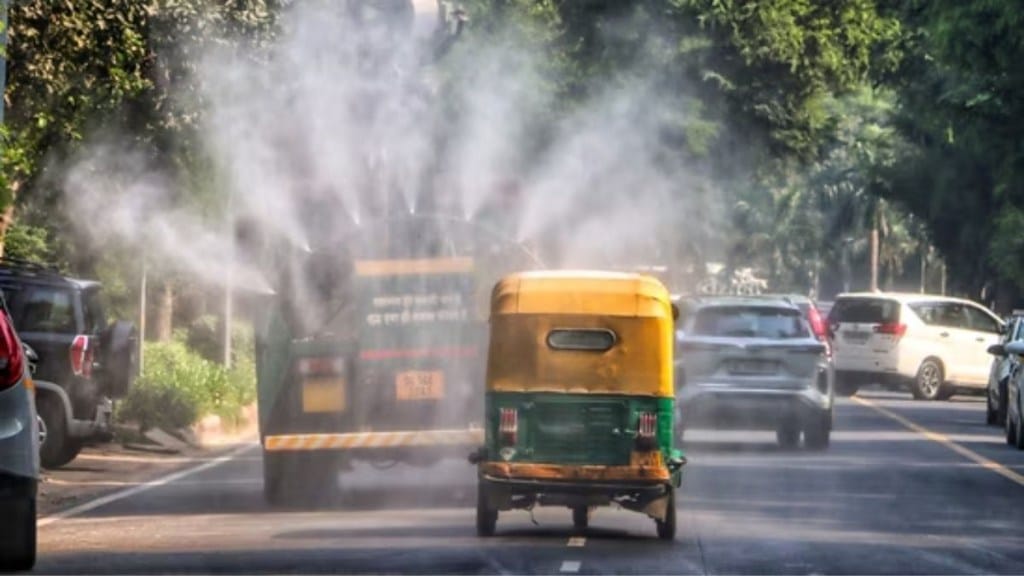
Hazardous air quality has emerged as a critical issue across South Asia. In India, Delhi, the capital, remains engulfed in severe pollution, with the city enduring dangerously high levels of air quality for the tenth consecutive day. In Pakistan, particularly in Punjab, smog levels have reached alarming levels, prompting the provincial government to take drastic action, including shutting down schools, amusement parks, and museums.
Delhi continued to struggle with severe air pollution on Sunday, marking the 10th consecutive day since Diwali, as a thick layer of smog enveloped parts of the city. According to the Central Pollution Control Board (CPCB), the Air Quality Index (AQI) in Delhi was recorded at 335 as of 8 am, falling under the ‘very poor’ category. Several areas in the national capital also showed alarming AQI levels, as per data from the System of Air Quality and Weather Forecasting and Research (SAFAR-India).
Key locations across the city reported hazardous air quality, with Anand Vihar recording an AQI of 351, Bawana at 383, CRRI Mathura Road at 323, Dwarka Sector 8 at 341, IGI Airport at 326, ITO at 328, Lodhi Road at 319, Mundka at 358, Najafgarh at 341, New Moti Bagh at 394, Okhla Phase-2 at 339, RK Puram at 368, and Wazirpur at 366. These readings reflect the continued health risks posed by the ongoing pollution crisis in the capital.
Meanwhile, several parts of Mumbai also witnessed smog blankets. However, according to the data, the air quality in Mumbai and its surrounding areas remained at a “moderate” level.
The iconic Taj Mahal in Agra, Uttar Pradesh, was shrouded in a thin layer of haze on Sunday morning, although the city’s air quality was recorded as ‘satisfactory.’ According to CPCB, the air quality in Agra was categorised as ‘satisfactory’ on Sunday, a slight improvement from the ‘moderate’ levels recorded on Saturday. CPCB data showed that the Manoharpur area of Agra had an Air Quality Index (AQI) of 93, classified as ‘satisfactory,’ while the Shahjahan Garden area recorded a lower AQI of 73 as of 8 am.
Pakistan blinded by smog, Multan grapples with AQI 1,914
Lahore and Multan in Pakistan are facing severe smog, with Air Quality Index (AQI) levels reaching hazardous levels, according to the Swiss live air quality monitor. In Multan, the AQI peaked at an alarming 1,914, making it the world’s most polluted city at the time, while Lahore’s AQI hit 760, according to a report in news agency ANI.
The smog situation continues to deteriorate in Punjab province, with Multan seeing an apocalyptic rise in air pollution. On Friday morning, the city’s AQI exceeded 2,000, a level deemed catastrophic, according to Dawn news.
The smog crisis in Pakistan, particularly in Multan and Lahore, has overwhelmed authorities, with pollution levels reaching hazardous levels. In Multan, the AQI hit a record 2,135, and PM2.5 levels soared to 947 micrograms per cubic meter, far exceeding the WHO’s safe limit. Lahore has faced widespread disruptions, including road closures and accidents due to poor visibility. In response, the Lahore High Court has imposed early market closures, and the Punjab government has declared a high-alert status, closing parks and museums until November 17. However, despite these measures, the pollution continues to pose severe health risks.