



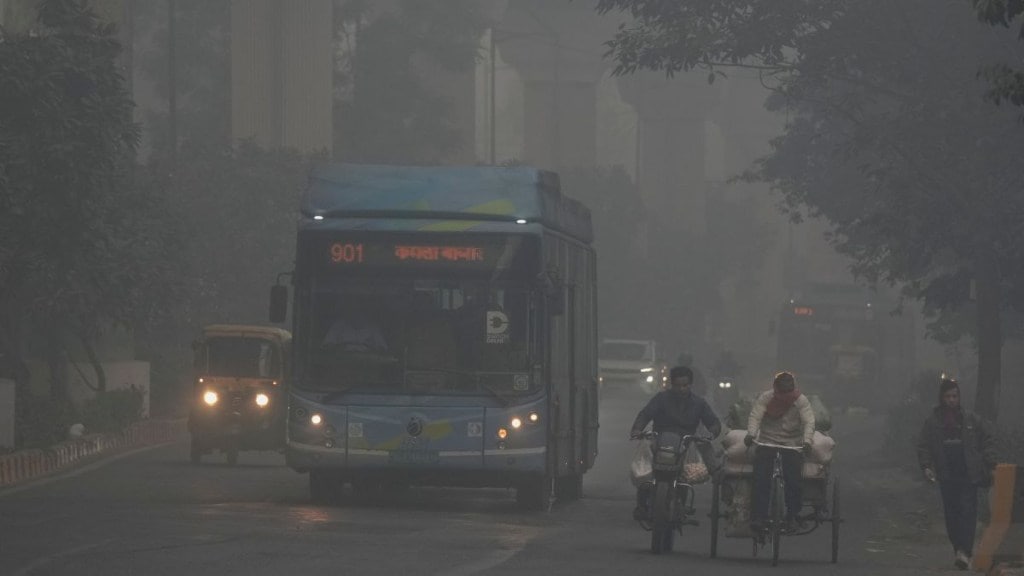
It was a usual morning for people of Delhi on Sunday (Dec 14), a morning dominated by severe air quality index (AQI) and thick smog shrouding the skies in every corner of the national capital and adjoining region. The scenes have been the same for years now, making it perhaps, normal for the citizens who have accustomed themselves with depleting AQI, simultaneous measures of Grade Response Action Plan (GRAP) and others.
Social media is flooded with visuals from places including, Akashardham, DDA park at MB Road, ITO, AIIMS, and Yamuna Bazar, among other areas. In all the videos, one thing is common – thick, polluted haze.
Delhi: Visuals from the Akshardham area with an AQI of around 400 pic.twitter.com/ERH9l6Ffhp
— IANS (@ians_india) December 14, 2025
It is not winter fog the national capital could enjoy, it is a dangerous layer of poison that is severely affecting the health of all – especially those suffering from some illness already.
As of 11 am on Sunday, the average AQI of Delhi was 458. The Government of India recently said it prioritises its own scale for AQI measurement, not the one that the World Health Organization (WHO) has in place.
Air quality panel acts, would it be enough?
Time and again, the Commission for Air Quality Management (CAQM), Delhi government and Centre have imposed restrictions to mitigate the pollution levels which increase exponentially during winters. The AQI in Delhi was 441 at 6 pm on Saturday.
Amid the deteriorating air quality, the capital again juggled between different stages of GRAP measures. The Ministry of Environment, Forest and Climate Change on Saturday said the worsening air quality is due to feeble Western Disturbance approaching north-west India.
Delhi: Visuals from ITO area show very poor air quality, with AQI around 450 pic.twitter.com/nkJUNgQcz6
— IANS (@ians_india) December 14, 2025
Hence, it implemented Stage-IV of extant GRAP – ‘Severe+’ Air Quality (Delhi’s AQI > 450), with immediate effect in the entire NCR. And a 5-point action plan was thus laid as mentioned below:
- Stop entry of BS-IV truck traffic into Delhi (except for trucks carrying essential commodities/ providing essential services.) All LNG/ CNG / Electric/ BS-VI Diesel trucks shall however be permitted to enter Delhi.
2. Enforce strict ban on plying of Delhi – registered diesel operated BS-IV and below Heavy Goods Vehicles (HGVs) in Delhi, except those carrying essential commodities / providing essential services.
3. Ban C&D activities, as in the GRAP Stage-III, also for linear public projects such as highways, roads, flyovers, overbridges, power transmission, pipelines, tele-communication etc.
4.i State Govts. in the NCR and the GNCTD to mandatorily conduct classes in schools for children even for higher classes i.e. from class VI to IX and XI in a “Hybrid” mode i.e., both in physical and online mode (wherever online mode is feasible) in the territorial jurisdiction of the NCT of Delhi and in the districts of Gurugram, Faridabad, Ghaziabad and Gautam Buddha Nagar.
4.ii The NCR State Governments may also consider conducting classes for students as above in a “Hybrid” mode in other areas in NCR.
5. State Governments may consider additional emergency measures like closure of colleges/ educational institutions and closure of non-emergency commercial activities, permitting running of vehicles on odd-even basis of registration numbers etc.
But the measures are lifted as soon as the AQI improves, which is, AQI below 400.
People troubled as AQI only worsens
The situation is not new for Delhiites, but the talks and opinions are. A user claimed that he visited the NCR regions (Delhi, Noida and Gurgaon), and the AQI seems “above 800”.
“I have been to Noida, Delhi, and Gurgaon in last few days.The AQI is definitely not 488,it is at least above 800,” he said.
Another said that “400 paar was promised in politics” – a reference to PM Narendra Modi-led NDA’s campaign during Lok Sabha elections 2024.
VIDEO | Delhi: Dense smog engulfs the national capital, with visuals from the Yamuna Bazar area showing visibility dropping sharply as thick haze lingers in the air. Air quality remains a concern as winter intensifies and AQI further deteriorates across the Delhi-NCR region.… pic.twitter.com/g69EZA5V00
— Press Trust of India (@PTI_News) December 14, 2025
“Delhi already has it. Not in votes. In AQI. Look at the data from 2020–2025 and a pattern screams back:
Every single year, October–November–December explodes into hazardous air. No surprises. No learning curve. Just ritual pollution. Five years. Same band. Same “unhealthy” baseline,” she said.
“Delhi hasn’t failed to diagnose the problem. It has failed to act early. The only thing that consistently goes 400+ in this city is the air we breathe. And somehow, that’s become acceptable,” she added.
A citizen, meanwhile, said odd-even should be brought back. “Pollution has only increased. I am having difficulty breathing. The government should take stronger measures. It is good that GRAP 4 has been invoked in the national capital. I suggest the ‘odd-even’ scheme should also be implemented,” he told ANI.
The AQI level in many areas in the capital has breached the average: Bawana (497), Narela (492), Okhla Phase 2 (474), Ashok Vihar (493), ITO (483), DTU (495), and Nehru Nagar (479).
AQI in other cities across the country like Mumbai, Varanasi, and Bengaluru among others are also becoming a topic of debate. However, the prolonged situation in Delhi continues to lead the concerns among all.